Montenegro clears EU benchmarks, Croatia holds firm
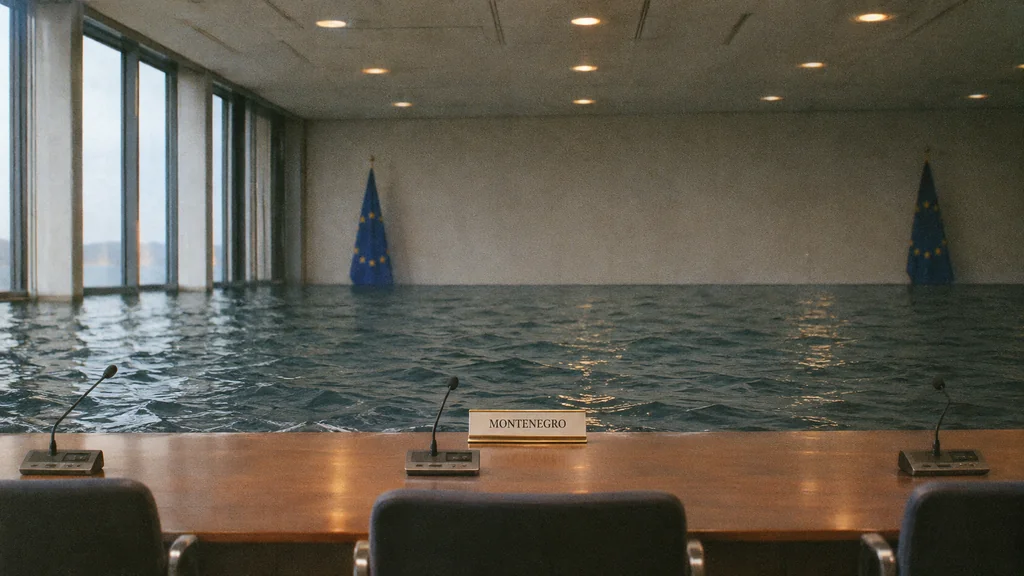
Montenegro nears the end of talks, but agreement remains across the water.
Image composition · tobriefOn 4 November the European Commission found that Montenegro has met every benchmark it set for finishing its membership talks (European Commission). That brings the Adriatic country close to the end of negotiations. The Commission only grades candidates, though. EU governments decide, and any one of them can hold things up. Croatia is doing so, and Prime Minister Andrej Plenković says six of Zagreb's demands remain unmet (Croatian government).
The talks are divided into 33 chapters, policy areas where a candidate proves it can apply EU law, and Montenegro has opened all of them and provisionally closed 21 (Montenegro report). "Provisionally" means governments can reopen any chapter until the final deal.
The Commission's roadmap aims to end the talks in December 2026 at a final intergovernmental conference, the formal meeting where governments and the candidate seal the deal (Commission roadmap). That date depends on decisions the Commission does not take. Enlargement Commissioner Marta Kos says Montenegro is "on track" to become the EU's 28th member in 2028, and she calls the December goal "realistic", which is a hope rather than a guarantee (European Commission).
Why one government can stop the clock
A chapter closes only when every member state agrees, so a single capital can keep any of them open. Croatia's objection has kept the foreign-policy chapter, the part of the talks covering a candidate's alignment with EU diplomacy and sanctions, from closing since 2024 (Radio Free Europe). That documented hold is narrower than our report last month that Croatia was blocking four chapters (To Brief), and it is what the record supports.
Plenković said on 3 November that two of Zagreb's eight conditions had been met. Both were symbolic: a renamed swimming pool and an approved memorial plaque (Croatian government). The rest are harder. They include compensation for former detainees of the Morinj camp, the fate of 14 missing Croatians, property claims, the land and sea border, and the return of the training ship Jadran (Radio Free Europe).
Zagreb's strongest case rests on the missing, the detainees and the property claims. These are questions of war-crimes accountability and property rights, and they overlap with the rule-of-law standards the EU demands of every candidate. Croatia's foreign ministry argues that settling them is needed to win its parliament's backing for Montenegro's entry. It also concedes that the EU dislikes importing bilateral disputes into enlargement (Croatian foreign ministry). The border and the ship fit that description far better than the missing people do.
Montenegro refuses to bargain under pressure. Foreign Minister Ervin Ibrahimović said on 2 November that his government would accept no ultimatums on Jadran, the Prevlaka border area or compensation (Vijesti). Compensation appears on both governments' lists. Any deal will have to be found there, and so will any deadlock.
Two more vetoes after the talks end
Closing the talks would not make Montenegro a member. The European Parliament must then consent by a majority of all its members, governments must approve admission unanimously, and every member state and Montenegro must ratify the treaty (EUR-Lex, Article 49). Each of those steps gives every capital another chance to say no. Kos put the treaty signature in June 2027 "at the earliest" (European Commission).
The terms of that treaty are also unsettled. Governments have begun arguing over a proposed 15-year period after entry in which serious breaches of EU values could trigger stronger penalties, with Montenegro first in line (Euronews).
The Commission cannot close the foreign-policy chapter over Croatia's objection, which makes Zagreb a concrete obstacle to the December target. Montenegro still has work of its own to finish. Brussels wants more final verdicts in high-level corruption cases and two pending constitutional changes, one of them on ministerial immunity (Montenegro report). Those reforms are in Podgorica's hands. The six demands are not. Plenković's and Ibrahimović's governments now have to find a settlement both can defend at home, starting with compensation. If they cannot, December slips, whatever the Commission's scorecard says.
Details about this article
- Model:
- claude-opus-5-5
- Generated:
- 11/5/2026, 2:04:05 AM
- Pipeline run:
- eu_pipeline_20261105_005007
- Watermark:
- SynthID (Google's invisible watermark)
- Human review:
- None before publication