Must Meta hunt Künast’s fake quote?
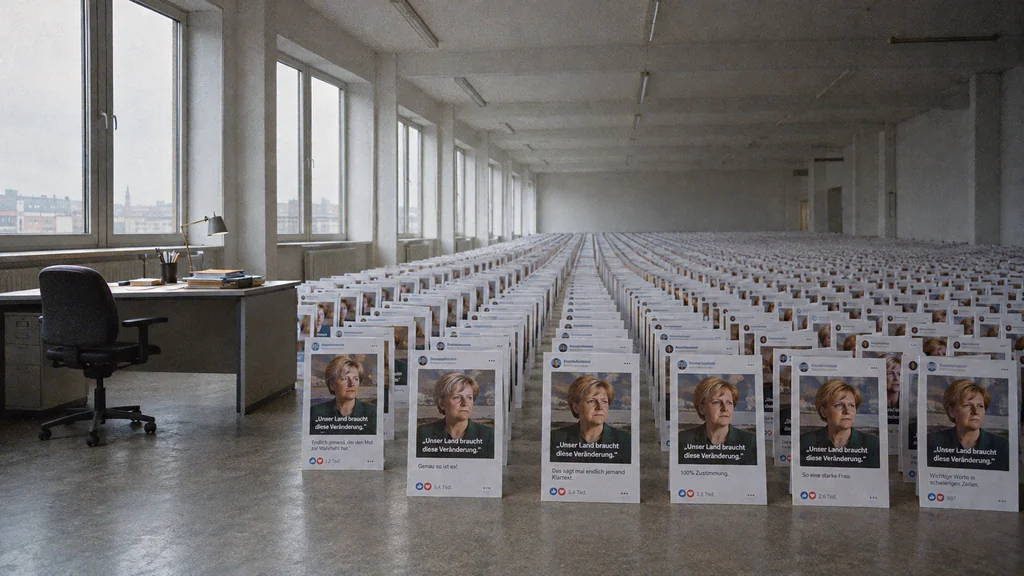
Each altered repost asks who must find it and read it.
Image composition · tobriefRenate Künast, a German politician, proved that a Facebook meme put invented words in her mouth. On 27 October 2026, Germany's Federal Court of Justice asked EU judges whether Meta must find and assess the remaining copies itself, or only delete the ones she reports (BGH). Courts across the EU will work from their answer.
The meme pairs her photo, name and party with a sentence she never said: "Integration begins with you Germans learning some Turkish" (Stern). Künast did the detective work herself. She reported the original and eight look-alikes to Meta, supplied their web addresses and documented that the quote was invented, and Meta removed them over time (BGH). The court gave no count of how many copies remain.
So the searching still falls to her. Her lawsuit tries to end that by asking for a court order that makes Meta remove identical or "substantially equivalent" memes still on Facebook (Tagesschau). German courts have backed her on removal so far, with Frankfurt's Higher Regional Court upholding the order in substance on 25 January 2024 (Frankfurt judgment).
When a copy stops being a copy
"Substantially equivalent" sounds simple until you picture two uploads. One shows the invented sentence beneath Künast's face with an insult in the caption. The other shows the identical image captioned "this quote is fake."
Software can flag both as near-matches. Only reading the caption reveals that the first repeats the defamation and the second corrects it. The German court itself notes that similar memes can be found technically, while their meaning cannot be judged purely automatically (BGH).
Meta builds its defence on that gap. The company argues that a neutral host must remove unlawful posts once they are properly identified, but need not search for others. Interpreting altered memes, it adds, would require manual review (LTO).
HateAid, the advocacy group backing Künast, counters that once a platform knows a claim is unlawful, it should find, check and remove equivalent versions (HateAid). Otherwise the person targeted carries the search indefinitely, while the company holding the content waits to be told.
The line EU judges left open
In a 2019 case brought by Austrian politician Eva Glawischnig-Piesczek, EU judges allowed courts to order Facebook to remove close copies of an unlawful post, provided the platform need not make its own legal assessment of them (EU court, C-18/18). A repost under an insult fits that rule easily. A repost under a correction needs someone to judge its meaning, and Künast's case sits exactly on the line that ruling left open.
The German court's six questions press on that line (BGH). The central one concerns the Digital Services Act, the EU's rulebook for online platforms. That law bans "general monitoring," meaning any requirement that platforms search users' posts indiscriminately. The judges want to know whether ordering Meta to check look-alikes of one proven falsehood by hand crosses into that ban.
The division of labour is fixed. EU judges interpret the rule, and Germany's court then applies it to Künast's case (EUR-Lex). Courts in every member state facing the same kind of claim will read EU law the same way. No date for a ruling has been set.
The EU already accepts that a platform can be ordered to remove near-identical copies of a proven lie. The open point is whether Meta can also be made to read the ones that differ. If the answer is yes, the job of finding existing unlawful copies shifts from the person they name to the company that hosts them. If it is no, Künast and anyone targeted the same way keeps reporting them one web address at a time. Either way, Germany's judges will still decide what the reading means for her.
Details about this article
- Model:
- claude-opus-5-5
- Generated:
- 10/28/2026, 1:27:22 AM
- Pipeline run:
- eu_pipeline_20261028_005008
- Watermark:
- SynthID (Google's invisible watermark)
- Human review:
- None before publication