Narva supplies EV magnets; metal origins unknown
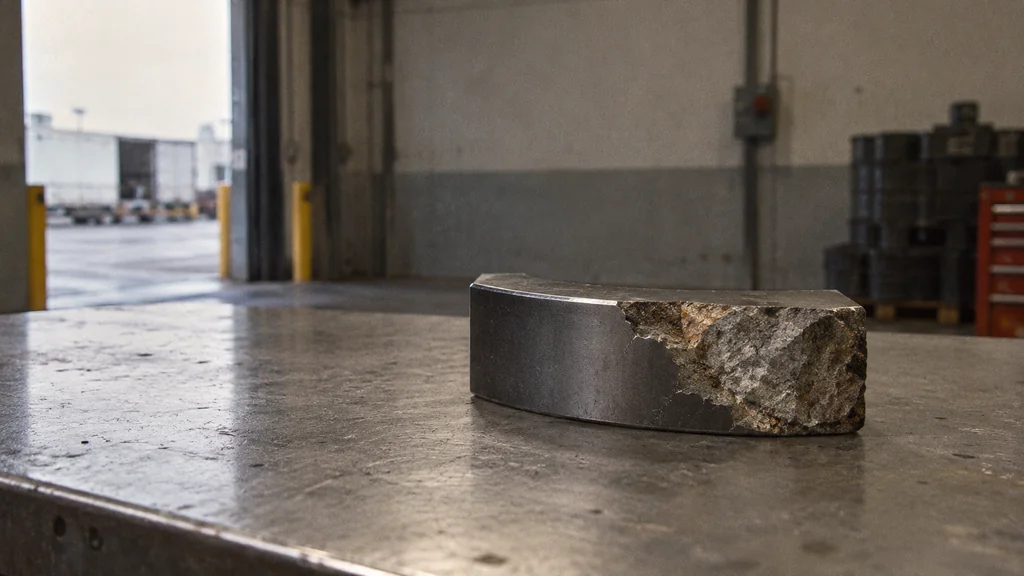
Narva delivers approved magnets; the origin of their metal remains undisclosed.
Image composition · tobriefA factory in Narva, Estonia, has begun commercial deliveries of rare-earth magnets to a maker of electric-vehicle motors. Neo Performance Materials, which owns the plant, said on 14 September that the customer had approved the product first (Neo, 14 September 2026). Narva is now a working supplier rather than a test site. Nobody outside Neo can yet measure how much supply it adds, or where the metal inside its magnets comes from.
Rare-earth magnets pack strong magnetism into a small space, so engineers can build compact, powerful motors. A large share goes into traction motors, the motors that turn an electric car's wheels. Europe has bought most of these magnets from China. In the first half of 2024, China supplied 92% of Germany's imported permanent magnets (Beschaffung aktuell). That figure is a German snapshot from two years ago, not a measure of Europe's position after this shipment.
A customer said yes
The change is the customer's verdict. In August, Neo's quarterly results still described Narva as producing samples for customers to test (Neo Q2 2026 results). A sample lets a buyer check one design. Approval, which the industry calls qualification, means the buyer has certified that the factory can supply its motor programme reliably, batch after batch.
By Neo's account, one buyer gave that approval in September and deliveries followed. Neo has not named the buyer. It describes the firm only as a supplier that sells components directly to carmakers, so its country and the price it pays are unknown.
The missing number
The announcement gives no volume. Rohstoff.net, a German trade outlet, noted that Neo has published no current production figure (Rohstoff.net). The plant has a design capacity, but that rates what the equipment could make, not what it ships. Fastmarkets reported the first commercial shipments as Neo announced them, without independently confirming the amount or the customer (Fastmarkets).
What can be stated is narrower. Neo now has a commercial customer for its European plant. That customer now has another approved magnet supplier. Nothing published shows a price saving, or a measurable fall in Chinese imports.
An approved second source can still matter a great deal to the firm that holds one. In October 2025, Rotek, a motor maker in Bremerhaven, told NDR that one Chinese supplier had temporarily stopped delivering rare-earth components, and that its backup supplier was also Chinese (NDR). A backup in the same country gives little protection when the trouble starts in that country. Rotek is not known to buy from Narva, and the September deliveries help only the one buyer Neo says it has approved.
Where the metal comes from
A magnet sits at the end of a long chain. First, ore is mined. Then individual rare earths are separated out as oxides, and those oxides are turned into metal and alloy. Only after that is the magnet pressed. Narva performs that last step.
No published record shows which oxides or metals went into the September magnets, or where their ore was mined (Rare Earth Exchanges). That gap decides what the shipment means. If the inputs still come from China, Europe has gained the final step of the chain while the earlier dependence stays where it was. If they come from elsewhere, the gain reaches further back. The available evidence cannot tell the two cases apart.
The milestone itself is measured. Europe has a factory delivering customer-approved magnets for electric-car motors, which it did not have in August. The gain in supply is not measured. Only Neo can measure it, by publishing how many tonnes Narva ships each month and where the metal in those magnets was mined and refined.
Details about this article
- Model:
- claude-opus-5-5
- Generated:
- 10/4/2026, 2:01:04 AM
- Pipeline run:
- eu_pipeline_20261004_005006
- Watermark:
- SynthID (Google's invisible watermark)
- Human review:
- None before publication