Neptun Deep narrows its gas deadline
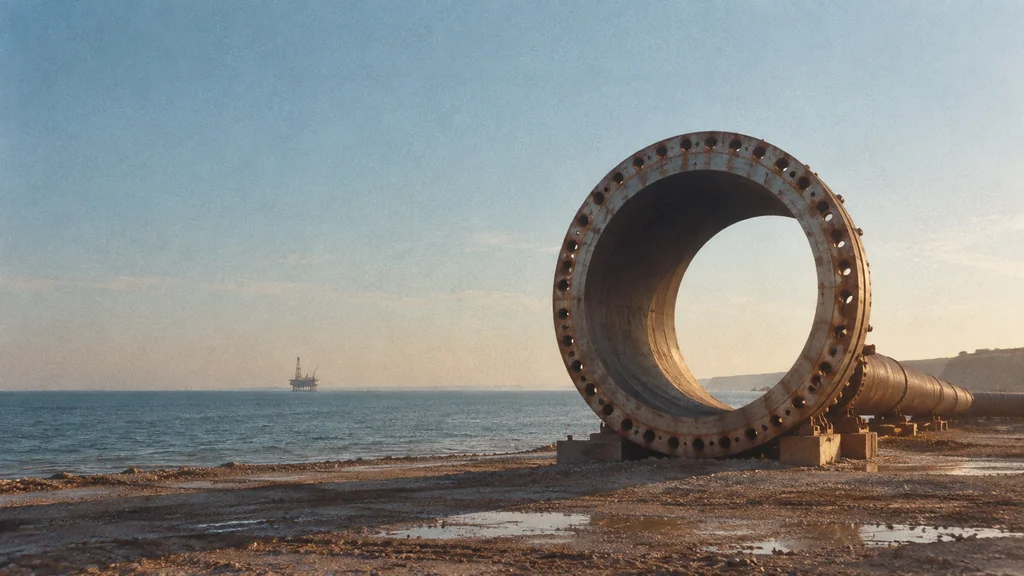
Seven wells are finished; the path to first gas still needs connecting.
Image composition · tobriefSeven of the ten development wells at Neptun Deep, Romania's deep-water gas field in the Black Sea, are now finished, its operators reported on 28 September. They expect first gas to enter the national pipeline network in the first half of 2027 (OMV, Digi24). The startup window is narrower than before, but the companies have not said how much gas the field will deliver next year, or who will buy it.
The field belongs in equal shares to OMV Petrom, the Romanian arm of Austria's OMV, and Romgaz, a company partly owned by the Romanian state. Each partner sells its own share of the gas, so every supply deal will be signed by one of them.
Seven wells done, and the connections still to make
In July, the partners reported six finished wells, the Neptun Alpha production platform installed at sea and a pipeline of roughly 160 kilometres to carry gas ashore (OMV). We covered that milestone at the time (To Brief). Since then the project has added one well and a tighter forecast.
The work left is mostly about connecting and testing. Ziarul Financiar, a Romanian business daily, went through the companies' stock-exchange filing: the last three wells still have to be completed, and the equipment on the seabed has to be hooked up to the platform and the line ashore (ZF). After that comes commissioning, a set of tests proving the connected system runs safely before normal production begins. Until both steps are done, the well count overstates how close the field is to producing.
The land side has been ready for a while. Ion Sterian, head of grid operator Transgaz, said in September that the Tuzla–Podișor pipeline, roughly 308 kilometres long, was completed in June 2025, commissioned that October, and is waiting for Black Sea gas (Mediafax).
A full-speed rate is not a 2027 total
Once gas starts flowing, output will rise in steps while the operators test the system. It keeps rising until it reaches a plateau, the steady rate a field can hold once it runs at full speed.
According to the filing as reported by ZF, that plateau is about 8 billion cubic metres a year (ZF). The operators aim to reach it by the end of the third quarter of 2027 (Digi24).
That figure is a speed, not a volume. A field that hits full pace in the autumn spends the earlier months starting up and ramping, so it produces well below its annual rate in that calendar year. The companies have given no total for 2027.
The rate still tells you the field's eventual size. Germany's trade agency GTAI put Romania's existing production at around 9-10 billion cubic metres a year, so at full speed Neptun Deep would add supply on a similar scale (GTAI). That is a statement about capacity from late 2027 onwards, not about next winter.
A reserved route is not a sale
Traders have already reserved room to move gas out of Romania. Citing pipeline operator FGSZ, the Hungarian business site Portfolio reported that a 6 July auction allocated all the capacity still on offer in the Romania-to-Hungary direction through 2032 (Portfolio). That shows demand for the route, but not how much gas will actually move along it.
A booking gives a trader the right to push gas through a pipe. It is not a purchase, and it does not say whose gas will fill the slot. Nothing in the auction result ties those reservations to Neptun Deep, or to a contract with OMV Petrom or Romgaz.
The operators have supplied two things: a startup window in the first half of next year, and a full production rate they expect to reach months later. They have supplied no figure for how much gas the field will deliver during 2027, and no firm volumes, prices or delivery points for any buyer. The one caveat is that even the startup window is their own forecast, and it holds only if connecting and testing the field goes to plan. Until the partners publish those terms, nobody can say how much Neptun Deep gas will reach Romanian consumers or neighbouring markets in 2027, or at what price.
Details about this article
- Model:
- claude-opus-5-5
- Generated:
- 9/29/2026, 2:26:49 AM
- Pipeline run:
- eu_pipeline_20260929_005007
- Watermark:
- SynthID (Google's invisible watermark)
- Human review:
- None before publication