Niculescu’s 280 votes buy no budget majority
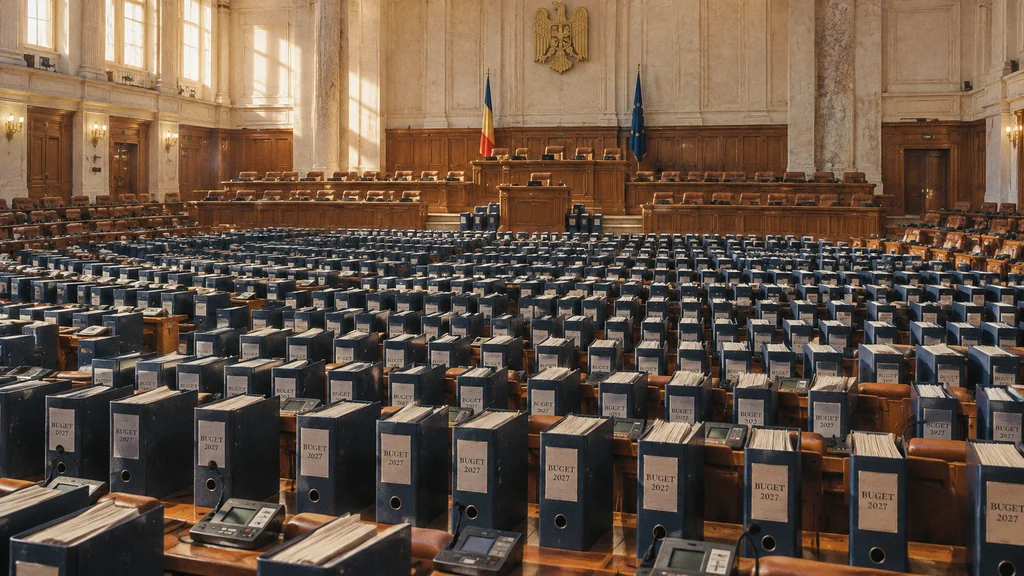
Romania’s new government has its mandate; the budget still needs votes.
Image composition · tobriefRomania's Parliament approved Luca Niculescu's government on 20 October by 280 votes to 58, well above the 233 required (AGERPRES). The vote ends the caretaker period that followed the fall of Ilie Bolojan's cabinet, and ministers have their full powers back. Their first job is a budget that Brussels and the parties outside the cabinet can both accept, and no one has promised them the votes to pass it.
What the oath changed, and who sits at the table
Niculescu is an independent diplomat. President Nicușor Dan nominated him after three failed attempts to form a government (To Brief). Under Romania's constitution, a dismissed cabinet may only keep the administration running. A sworn-in cabinet can draft budgets, propose laws and issue emergency ordinances, which are decrees that take effect before Parliament votes on them (Romanian Constitution).
Inside the cabinet, one party dominates. Figures linked to PSD hold 12 of the 18 ministerial posts (Euronews România). PSD is the Social Democratic party whose break with Bolojan started the crisis. It now shapes the government from within, but it cannot pass laws alone.
Two shields, neither of them a majority
Niculescu leads a minority cabinet. To pass bills he needs two parties outside it: Bolojan's liberals, PNL, and UDMR, the party of Romania's ethnic Hungarians. Each has promised not to bring him down for now. Neither has promised to vote for his laws.
PNL signed a written pledge not to start or back a no-confidence motion before 1 March 2027. The text explicitly rules out a coalition and does not commit PNL to support government bills (Cotidianul). The party has also named its price for backing next year's budget: a deficit no higher than 5.3% of GDP (Radio România).
UDMR's deal gives Niculescu six months without a censure motion and puts money for local governments at its centre. Its leader, Kelemen Hunor, says the party will judge each later proposal on its merits (Libertatea). Both protections expire long before the government's programme ends in 2028 (official programme).
Three demands, one budget
The first test is a revision of this year's budget. Finance Minister Alexandru Nazare plans to do it in two stages, starting before the end of October with urgent spending on hospitals, emergency services and ambulances (AGERPRES). PSD, the cabinet's own backbone, wants something else first. It is demanding a full audit of public finances presented to Parliament and a pact against new taxes in 2027 (PSD priorities).
The 2027 budget is the larger fight, and three actors judge it. Parliament must pass it. PNL has made its votes conditional. The Commission will check whether Romania stays on the spending path that EU governments set under the excessive deficit procedure, the EU process for countries whose deficits break its limits. That path caps how fast state spending may grow (Council recommendation).
The gap shows up in the forecasts. The government's programme aims for a deficit of 5.2% of GDP (official programme). The Commission expects 5.8% (European Commission). If the Commission is closer to the mark, the budget breaks PNL's condition before talks even begin. Closing that gap means spending cuts or tax rises, and PSD opposes the tax rises.
The budget may also have to absorb a bill the new cabinet arrived too late to prevent. Commission rules set 31 August 2026 as the deadline for the last reforms Romania promised in return for EU recovery grants, including a unified public-sector pay law (Commission guidance). Where those reforms were missed, the projects tied to them lose EU money. They will then need national funding or will have to be dropped.
A deadlock would not shut the state down. If no budget passes by year end, the old one rolls over under monthly spending limits (Public Finances Law). That safety net lowers the cost of stalling, both for the government and for the parties that withhold their votes.
Niculescu is protected against an immediate no-confidence challenge, but he has no agreement that guarantees him a budget majority. The 280 votes cannot settle that. Investiture is a secret ballot, so the tally does not show how each party voted. The budget will be the first vote that does.
Details about this article
- Model:
- claude-opus-5-5
- Generated:
- 10/21/2026, 8:15:51 AM
- Pipeline run:
- eu_pipeline_20261021_072148
- Watermark:
- SynthID (Google's invisible watermark)
- Human review:
- None before publication