Nord Stream’s first trial leaves orders open
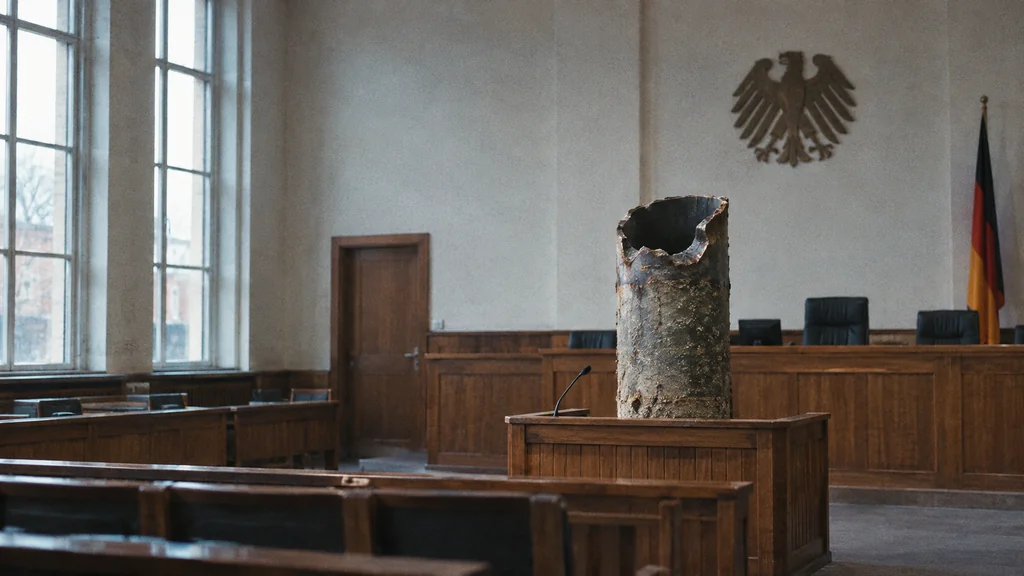
Hamburg’s judges can decide guilt without naming who ordered the blast.
Image composition · tobriefOn Wednesday, 14 October, a court in Hamburg opens the first trial of anyone accused of taking part in the 2022 Nord Stream pipeline sabotage (Hamburg court, dpa via Die Zeit). The defendant, a Ukrainian army officer identified as Serhii K., is charged with a war crime. The judges can decide his guilt without establishing who, if anyone, gave the order.
What prosecutors say happened
Germany's federal prosecutors allege that K. helped lead a crew that sailed a chartered yacht from the German island of Rügen. In their account, the crew fixed timed charges to the pipelines near Bornholm before the blasts of 26 September 2022 (Federal Court of Justice).
The prosecutors also claim he acted on behalf of state bodies in Ukraine. Their public notice names no ministry and no official (federal prosecutors).
No confession has been made public. The case rests mainly on travel records. When Germany's highest criminal court kept K. in detention in December 2025, it pointed to Polish border data, a passport in a false name carrying his photograph, and expert comparison of images (ruling).
His lawyers dispute that this places him at sea. ZDF reports that no fingerprint or DNA match puts him aboard, and one lawyer relays K.'s account that he was in Ukraine at the time (ZDF).
Whether the pipes were a fair target
The defence has a fallback that goes to the core of the charge. Under the laws of war, attacking a civilian object (property with no military role) can be a war crime, while striking a military target may not be. The charge against K. stands only if Nord Stream counts as civilian.
His lawyers therefore ask whether pipelines earning Russia money during its invasion could have been a lawful target. The Federal Court of Justice rejected that argument at the detention stage. It held that indirect gas revenue did not turn the pipes into military targets (Federal Court of Justice).
What the verdict does not have to answer
Hamburg is trying K., not Ukraine. On 30 September the judges refused the pipeline operators' request to join the case as co-plaintiffs (private parties who sit alongside prosecutors with their own procedural rights). They said the trial concerns the defendant's own conduct and guilt, and is not a place to prepare possible Russian compensation claims against Ukraine (Hamburg court).
Clues about orders may still surface in evidence. Reporters who examined the indictment describe intercepted calls from K.'s detention in Italy, in which he reportedly suggested he had not acted alone and felt abandoned by Kyiv (ARD-led investigation).
Kyiv's public position is narrower than a flat denial. On 9 July, Ukraine's prosecutor general said its own investigation had found no facts showing state participation, and proposed a joint investigation with Germany (Reuters).
The blasts did not cut Europe's gas supply, because Nord Stream 1 deliveries had already stopped in early September 2022 (Federal Network Agency). The European stakes are legal, and they show up in how two other EU countries handled a second suspect.
Germany wants an alleged diver, Volodymyr Zhuravlov, under a European arrest warrant (the EU tool meant to make handing suspects between member states close to routine). In October 2025 a Warsaw judge refused to surrender him. The judge reasoned that a presumed Ukrainian strike on an aggressor's infrastructure could be a legitimate act of state rather than a crime to prosecute; Prime Minister Donald Tusk had already said a handover was not in Poland's interest (PAP).
Croatia went the other way. A three-judge panel approved Zhuravlov's surrender on 18 September, and an appeal is pending (HRT, tportal).
Neither court judged whether the sabotage was a crime. Each decided only whether to hand a suspect over, and the Croatian ruling may still fall. Still, a Polish judge treated as possibly legitimate what German prosecutors charge as a war crime. Every government with undersea cables and pipelines has reason to watch which view Hamburg's judges adopt.
If they convict K. on the war-crime count, they will have found that a Ukrainian officer attacked civilian infrastructure in breach of the laws of war. They can reach that verdict while the alleged state direction stays unattributed. Naming a sponsor falls to Germany's federal prosecutors, who alleged one without saying who, and to Ukraine's prosecutor general, whose office says it has found none.
Details about this article
- Model:
- claude-opus-5-5
- Generated:
- 10/12/2026, 1:40:06 AM
- Pipeline run:
- eu_pipeline_20261012_005007
- Watermark:
- SynthID (Google's invisible watermark)
- Human review:
- None before publication