Nordic Putin call leaves Europe sidelined
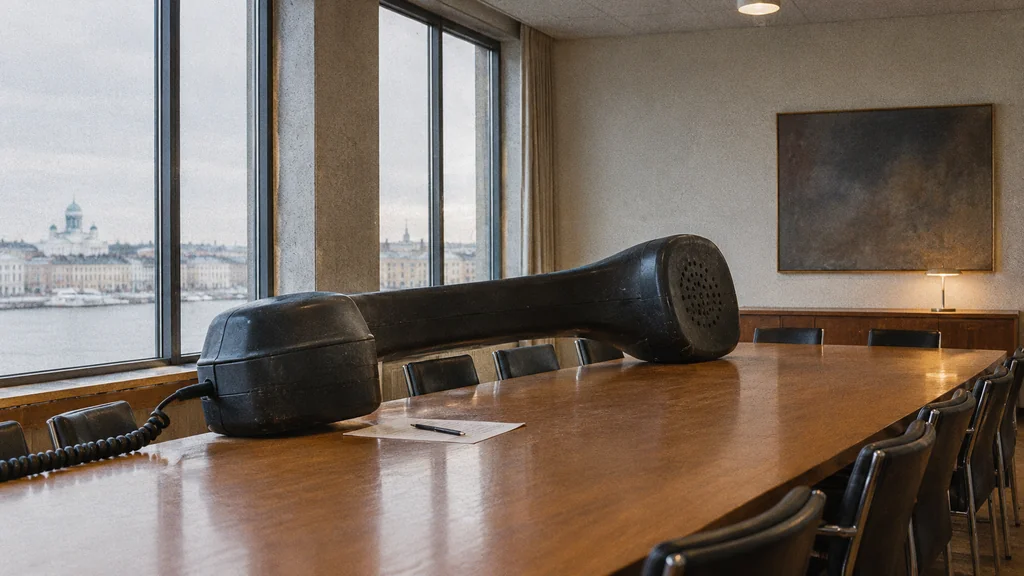
A call reaches Moscow before Europe chooses who speaks for it.
Image composition · tobriefFinland's President Alexander Stubb and Norway's Prime Minister Jonas Gahr Støre spent 90 minutes on the phone with Vladimir Putin on 27 October (Anadolu Agency). Neither side announced an agreed agenda or a concession (Finnish presidency). Helsinki and Oslo spoke to Putin after consulting Kyiv. Europe, however, has not agreed who can speak for it, and Moscow has offered it no place at the talks.
What the call carried, and what came back
Kyiv was involved before the call was made. The two leaders prepared it with Ukraine as a follow-up to talks with Volodymyr Zelenskyy and US envoys (Finnish presidency). Stubb relayed Ukrainian proposals on issues such as energy infrastructure and prisoner exchanges. He also passed on Zelenskyy's position that territory should be settled only in a meeting between the two presidents (Yle).
Both men said they spoke for Finland and Norway, not for Europe (Norwegian government). That disclaimer frames everything that followed.
Moscow gave little ground. The Kremlin's readout said peace requires Russia's interests to be taken into account "fully and unconditionally" (Anadolu Agency). Reuters, citing one unnamed source close to the Kremlin, reported that Putin refused any compromise on controlling all of Donbas (Reuters).
Zelenskyy was briefed afterwards. He repeated that Russia must take real steps to de-escalate attacks on Ukraine's energy system (Ukrainian presidency). Poland's Donald Tusk, who also heard from Stubb, said both sides had kept their positions (Polish prime minister's office).
Who got a say
The sharpest criticism came from the Nordic neighbours. Denmark's Mette Frederiksen called the call Finland and Norway's "own initiative" and said it had not been coordinated with the rest of Europe. She also said she saw no sign that Russia wanted peace (TV 2 Denmark).
Sweden's Ulf Kristersson was more careful. He said he got about an hour's notice. He warned that contacts of this kind risk splitting Europe's voice, but he did not say this call had caused a split (Expressen).
Støre replied that every ally was informed beforehand and briefed thoroughly afterwards (TV 2 Norway). Both accounts can be true at once. A heads-up tells partners about a decision already taken. Consultation lets them shape it. Kyiv was consulted. Copenhagen and Stockholm, by their own account, were informed.
A channel without a mandate
Germany and Poland responded by proposing their own route to Moscow. Friedrich Merz said Russia and the United States cannot settle the war over the heads of Kyiv and Europe. He called the Nordic role constructive and said Germany and other Europeans were working on a format for contact with Moscow (Reuters). Tusk argued that Europeans should set up working contact before any ceasefire talks begin (Polish prime minister's office).
Neither leader has said who would sit in that channel. They have not said who would choose that person or whom they would represent: the EU, a group of willing countries, or only their own governments. Moscow has already answered the question that matters most. It said a European representative was not under consideration for now (Vedomosti).
Europe does hold leverage that no phone call can spend. The EU Treaty makes unanimity, meaning any member government can block, the general rule for decisions under the bloc's common foreign policy (EUR-Lex). That gives member governments their own say over the foreign-policy decisions behind Russia sanctions. Washington cannot simply trade that say away in a deal with Moscow.
The call opened a channel to the Kremlin and gave Kyiv and its partners a fresh reading of Moscow's terms. It produced no announced concession, and it settled nothing about who may speak for Europe. Merz and Tusk now owe their allies the membership and mandate of the contact they propose. Even with that answer, Moscow still controls whether a European voice enters the talks at all.
Details about this article
- Model:
- claude-opus-5-5
- Generated:
- 10/28/2026, 1:26:59 AM
- Pipeline run:
- eu_pipeline_20261028_005008
- Watermark:
- SynthID (Google's invisible watermark)
- Human review:
- None before publication