One seat divides Sweden’s rival blocs
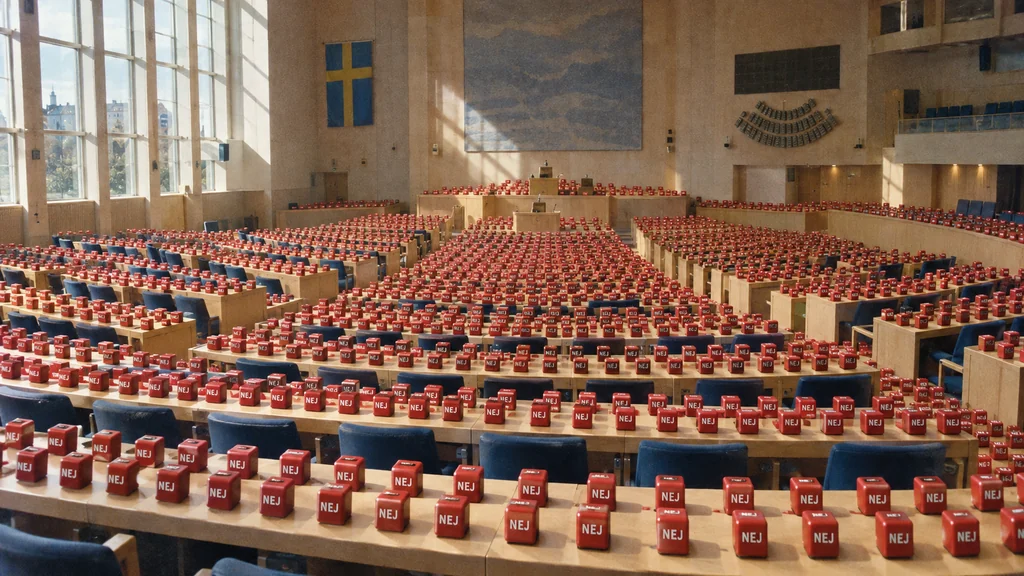
Sweden counts its seats, but every coalition still confronts refusal.
Image composition · tobriefWith roughly 80% of districts counted on election night, Sweden's opposition held 175 seats to the governing side's 174 in the 349-seat Riksdag (parliament). SVT reported those preliminary numbers, but the split is provisional. A single seat separates the two coalitions, and the parties still disagree over who may enter government. The final seat may determine who can block a prime minister. Neither bloc has an internal agreement capable of producing one.
The count that decides
Sweden's Election Authority will count remaining advance votes and late overseas ballots starting Wednesday 16 September, possibly extending into Thursday (Election Authority). County electoral boards then conduct a separate recount and inspection. The result becomes authoritative only when the Election Authority formally certifies it, expected around the weekend of 19–20 September (Election Authority).
That number matters because Sweden governs through negative parliamentarism: a prime minister survives unless 175 MPs actively vote against them. The Riksdag speaker (talman) nominates a candidate for a parliamentary vote. The bloc with 175 seats can block any rival, but only if every one of its MPs votes no. The draft's central tension is exactly this: neither side can assume that discipline from its own partners.
Andersson's problem, Kristersson's problem
On the left, Social Democrat leader Magdalena Andersson said she was open to cooperation with every party except the Sweden Democrats (TT/Hallands Nyheter). But she told the Left Party it had "a long way to go" before entering government. Andersson succeeds if fewer than 175 MPs oppose her. That requires two concessions from unwilling partners: the Left must accept exclusion from cabinet, and the Centre Party must tolerate Left influence from outside it. On election night, neither party had publicly agreed.
On the right, Prime Minister Ulf Kristersson promised the Sweden Democrats cabinet seats for the first time (AP, BBC). During 2022–26, SD shaped government policy without holding ministries. Kristersson wants to change that, but cannot bind his coalition partners. The Liberals, who served in his cabinet during the same period, never publicly accepted sitting alongside SD ministers (SVT). Even if late ballots gave the right 175 seats, Liberal resistance to SD in cabinet could prevent those seats from producing a government.
The EU budget veto
Swedish coalition arithmetic rarely makes European headlines. The strongest reason it should now is money. Sweden joined Germany, Austria, Denmark, Finland and the Netherlands in August demanding cuts of several hundred billion euros from the Commission's nearly €2 trillion proposal for the EU's seven-year budget (German Chancellery). That budget requires unanimity among all member states (Article 312 TFEU), giving Sweden an individual veto (Article 312). Most Swedish parties oppose a larger EU budget (University of Gothenburg), so opposition to higher spending will likely survive a change of government. What could shift is which programmes Stockholm protects inside a smaller total. A left-led government reliant on the Centre and Greens would face pressure to shield climate spending. A right-led government with SD influence would face pressure to cut it.
On defence, seven of eight Riksdag parties support higher spending, and parliament unanimously approved a SEK 12.9 billion Ukraine aid package in March (Riksdag). Sweden's commitment to NATO and Ukraine aid enjoys broad consensus that neither coalition outcome would reverse.
The Wednesday count will identify the larger bloc. Governing will still require either the Left, the Centre, the Sweden Democrats or the Liberals to retreat from an election-night position. Until one of them does, Sweden has a parliament but no path to a cabinet.
Details about this article
- Model:
- claude-opus-4-6
- Generated:
- 9/14/2026, 1:37:49 AM
- Pipeline run:
- eu_pipeline_20260914_005006
- Watermark:
- SynthID (Google's invisible watermark)
- Human review:
- None before publication