OpenAI’s 7/8 proof faces human review
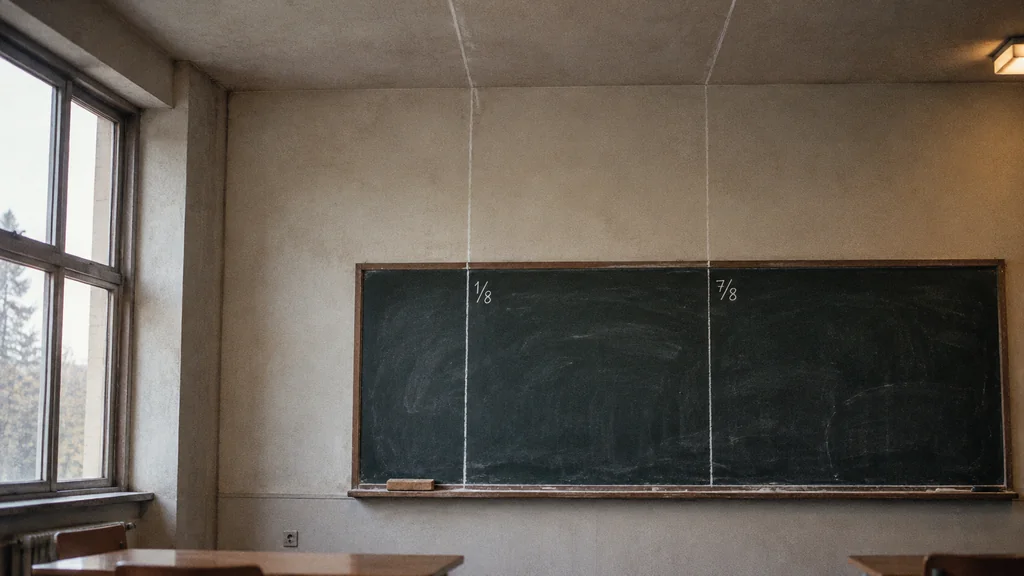
A fixed boundary holds, while the question at the centre remains.
Image composition · tobriefOpenAI says a 199-page manuscript, attributed to one of its internal AI models, proves that the Riemann zeta function has no zeros anywhere the input's real part exceeds 7/8 (September manuscript). This "quasi-Riemann hypothesis" stops short of the famous Riemann hypothesis. It replaces older boundaries that kept shrinking with one that stays put, and software has already checked a formal version of it.
A map with forbidden zones
The zeta function is the mathematical object most closely tied to how prime numbers are spread out. Picture it as a machine that takes a point on a flat map and returns a value. Each point has a left-right position, which mathematicians call its "real part," and a height. Zeros are the spots where the machine returns exactly nothing.
The important zeros were already known to sit inside a vertical strip between real parts 0 and 1. The Riemann hypothesis says every one of them lies on the strip's centre line, at 1/2 (Quanta). Proving that has defeated mathematicians for generations, so they have tried a smaller task: fencing off regions where zeros cannot be.
Earlier fences ran along the strip's right edge, and they were awkward. The higher you climbed, the further right the fence slid toward real part 1, so the guaranteed zero-free zone grew thinner with height. Quasi-Riemann asks for a straight fence that never moves. The September 30 manuscript placed it at 7/8, and because the important zeros mirror each other around the centre line, a matching fence follows at 1/8 (September manuscript).
These fences are outer limits. A zero sitting exactly on one is not ruled out, and the wide band between them stays open, which leaves the Riemann hypothesis itself unresolved. Still, no computer could have reached this result by searching, because it makes a promise about infinitely many zeros.
Proving that something isn't there
How do you show a zero cannot exist anywhere in an endless region? The proof doesn't hunt for zeros. It places zeta inside a carefully chosen family of related functions, then shows that a zero beyond the fence would force the whole family to break a rule it must obey.
Think of an auditor who never examines a suspicious entry directly. Instead, she proves the entry cannot exist, because the books would stop balancing if it did. The mathematician Alexander Dunn called the result "a surprising synthesis of well-known ideas" (Quanta).
Others are already reworking the method. Baiying Liu adjusted it to nudge the 7/8 fence to about 0.874957 (Liu).
A checker's yes and a mathematician's yes
For the 7/8 theorem, OpenAI also supplied a proof written in Lean, a proof assistant (September manuscript). Lean is software that accepts an argument only when every logical step follows mechanically from its rules, like a referee who won't let a single unjustified move stand. Its approval certifies the theorem as it was typed in. That differs from mathematicians understanding why the argument works.
That human understanding is still being built. Readers have focused on a shorter, 49-page manuscript dated October 5, which proves a weaker fence at 11/12 and is easier to follow (October manuscript). Terence Tao, one of the field's most respected voices, wrote on October 19 that quasi-Riemann is established, while noting that both arguments are still being digested (Tao).
OpenAI released the preprints on October 6 and lists itself as their author (OpenAI). The split of work between model and people rests on the company's own account, a question that also surrounded DeepMind's peer-reviewed proofs (To Brief).
Today there is a machine-checked theorem that keeps every important zeta zero behind a fixed boundary at every height, while the centre-line hypothesis stays unresolved. Software has accepted the encoded proof. Mathematicians are still reading the arguments themselves, and their review will decide whether the field adopts the result as settled.
Details about this article
- Model:
- claude-opus-5-5
- Generated:
- 10/20/2026, 7:05:34 PM
- Pipeline run:
- eu_pipeline_20261020_180759
- Watermark:
- SynthID (Google's invisible watermark)
- Human review:
- None before publication