Our closest microbial cousins grow arms
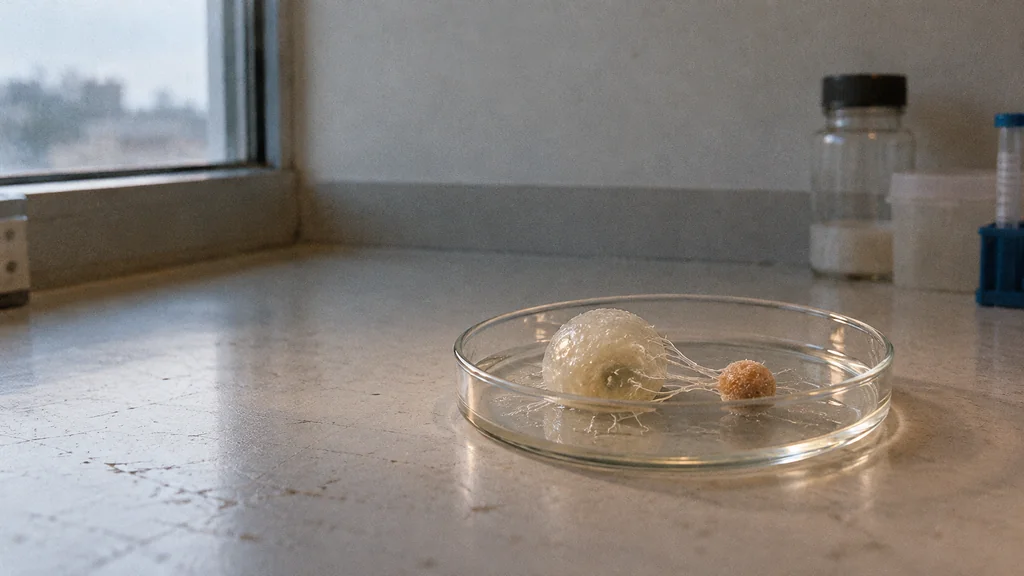
A living archaeal cousin offers a closer look at an ancient partnership.
Image composition · tobriefEvery animal, plant and fungus is built from complex cells thought to have begun when a simple microbe called an archaeon took in a bacterium for good, but how that partnership started is still argued over. A Japanese team has now grown two strains of Heimdallarchaeia, the archaea that genetic studies place closest to our own cells, after about three years of adjusting nutrients and conditions (JAMSTEC). The cells, described in Nature on 28 October 2026, have a plain interior and long, branching arms that touch the microbes around them (Nature).
Our cells keep their DNA in a nucleus and get energy from mitochondria, tiny power units descended from that captured bacterium. Archaea have neither. Which came first, the nucleus or the lodger, and what the host looked like at the time, remain open questions.
Genome surveys pointed to a group called the Asgard archaea, whose DNA carries genes resembling those our cells use to build their internal scaffolding, with Heimdallarchaeia sitting nearest to us (JAMSTEC). Until now, scientists knew the group mainly from DNA fragments sifted out of mud and water. A genome works like a parts list. It can't show you the shape of the machine, what it runs on or who it works alongside.
Arms that reach next door
Hiroyuki Imachi and Masaru K. Nobu led the work at JAMSTEC, Japan's marine research agency, with collaborators including Kyoto and Nagoya universities (Kyoto University). Their samples came from a methane-producing well in Chiba, in groundwater linked to ancient seawater (Jiji).
Both strains were cultured together with methanogens, microbes that make methane for a living. One strain, HC1, grew in a defined pair with a single methanogen partner. That gives researchers a clean two-member relationship to study, without a crowd of other microbes muddying the picture.
Under the microscope, both are small, roughly round cells that sprout long, branching membrane extensions, and those extensions touch their partners. For HC1, the arms add up to about 1.4 times the volume of the cell body (JAMSTEC). Picture a pea that has grown more vine than pea. The inside is far plainer, with fibrous material and granules but no nucleus or other lasting walled-off compartments like ours (Jiji).
The shape is familiar. In 2020 the same group grew the first Asgard archaeon, from a more distant branch, and it too lived with partners and sprouted extensions (JAMSTEC). The new cultures carry that pattern to the lineage nearer to us.
Living on a neighbour's leftovers
Biologists call this kind of arrangement syntrophy. One organism's waste becomes another's dinner, much as a brewery's spent grain feeds the cattle on the farm next door.
According to the paper, the archaea break down protein-derived food. The authors propose, partly from the genes the microbes carry, that this digestion releases hydrogen or formate (a simple carbon compound) for the methanogens to consume (Nature). The arms touch the partners, but nobody has yet shown that food travels through them.
Both strains live without oxygen. Yet HC1 kept growing when a little oxygen was present at the start, provided oxygen-consuming bacteria shared the culture (Nature). The researchers' explanation is that those bacteria mop up a gas that harms the archaeon, and nothing shows HC1 itself uses oxygen (JAMSTEC).
A living cousin, not an ancestor
These are cells alive today, so reading ancient history into them takes care. The team sees a hint that an archaeal host could form close outside partnerships while its interior stayed simple, and that oxygen-eating neighbours might have sheltered an oxygen-shy ancestor (JAMSTEC).
Heimdallarchaeia kept evolving long after their lineage split from ours, and their partners here are archaea, while the mitochondrion's ancestor was a bacterium. Studying them is like learning about your great-great-grandparents by visiting a distant cousin. Recent commentary treats such cultures as one line of evidence alongside genetic family trees, not as a recovered ancestor (PNAS).
What the cultures offer is access to a living cell that DNA alone could only sketch. Labs can now watch how these cells build their arms, what happens where the arms meet a partner, how food moves between the two and whether the oxygen effect holds under other conditions. None of that replays the ancient merger, but each answer narrows which versions of the story still fit the evidence.
Details about this article
- Model:
- claude-opus-5-5
- Generated:
- 10/29/2026, 7:26:29 AM
- Pipeline run:
- eu_pipeline_20261029_005007
- Watermark:
- SynthID (Google's invisible watermark)
- Human review:
- None before publication