Paris and Berlin weigh a 90% car target
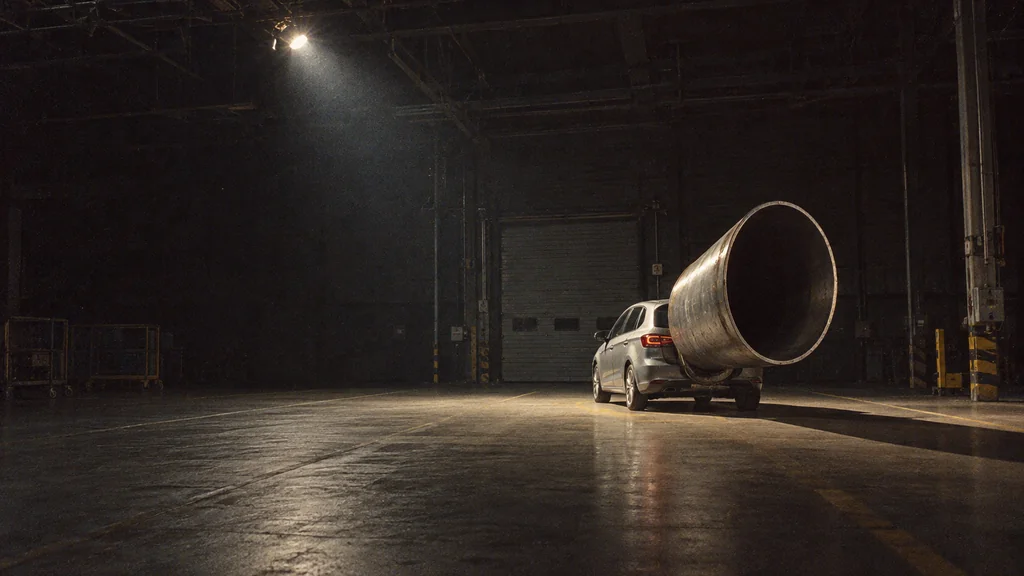
The reported deal would let new cars retain emissions without compensation.
Image composition · tobriefParis and Berlin want to ease the EU's 2035 car-emissions rule while reserving public car money for vehicles built in Europe. According to Reuters and AFP, the provisional text would set the target at a 90% cut with no duty to offset the rest (Reuters, AFP via France 24). Berlin has not agreed, the reported drafts differ on how much relief carmakers would get, and none of it is law.
Three versions of one rule
Start with the law in force. From 2035, each carmaker must cut the average tailpipe CO₂ of all the new cars it sells by 100% against 2021 levels (Regulation (EU) 2023/851). That is why people call it a combustion-engine ban, although it leaves cars already on the road and the used market alone.
The Commission, the EU's executive, proposed a softer version in December 2025. It set a 90% cut, with carmakers covering the last ten points through credits for renewable fuels and EU-made low-carbon steel (COM(2025)995).
As Reuters and AFP describe it, the Franco-German draft keeps the Commission's target and drops the compensation. Carmakers would simply be allowed to emit the remainder.
POLITICO, which says it has seen draft language, describes something looser. Its version adds extra leeway linked to alternative-fuel investment, which could bring the effective cut closer to 80%, plus "supercredits" that count each electric car more than once in a maker's average (POLITICO). No draft has been published, so nobody outside the talks can settle the arithmetic.
The factory half of the bargain
What carmakers give back sits in a separate bill, the Commission's proposed Industrial Accelerator Act. It would tie subsidies and public contracts to European production. A covered car would need EU assembly and, generally, at least 70% of the value of its non-battery parts from sources the act accepts (IAA proposal).
The test would decide who earns a purchase voucher or a public fleet contract. People could still buy cars built elsewhere with their own money. Because the emissions rule and the subsidy test travel through separate bills, Paris and Berlin cannot write the trade into law themselves. They can only push it as a joint position.
Britain could qualify. Reuters reported that the draft counts production in the EU plus European partners that belonged to the single market on 1 January 2020, provided they offer full reciprocity and keep pace with EU rules (Reuters). France had dropped its objection to including the UK (Guardian).
Who can still stop it
The first hurdle is in Berlin. POLITICO reported objections from the Social Democrats, Chancellor Friedrich Merz's coalition partner, and quoted a government spokesperson saying no final agreement existed (POLITICO).
Even a signed text would only open negotiations. France and Germany would need allies in the Council, where national ministers vote: at least 15 of 27 governments, together representing 65% of the EU population (Council). The European Parliament must also approve the same text, and its plenary dates of 23 November and 14 December are forecasts, not deadlines (Parliament procedure file).
Governments disagree. Czechia's position, approved on 16 March, asks for softer targets and more flexibility, and concedes that voting reform down could leave the stricter rule standing (Czech industry ministry). Those stated priorities make even an imperfect relaxation attractive to Prague.
Sweden leans the other way. On 27 July, climate minister Romina Pourmokhtari told parliament that the 2035 requirements were well balanced and rewarded Swedish carmakers that had electrified early (Riksdag). Stegra, a Swedish green-steel maker, had asked the government to keep the steel credit that the Franco-German draft would remove (Stegra submission).
If Reuters and AFP describe the unpublished draft accurately, carmakers would no longer have to compensate for the emissions left over under the Commission's proposed target. In return, public car money would flow to factories in Europe. That outcome still depends on Merz's coalition signing, a Council majority assembled across governments as far apart as Prague and Stockholm, and a vote in Parliament. Berlin owes the first answer: whether it signs, and at which number.
Details about this article
- Model:
- claude-opus-5-5
- Generated:
- 10/16/2026, 1:34:11 AM
- Pipeline run:
- eu_pipeline_20261016_005006
- Watermark:
- SynthID (Google's invisible watermark)
- Human review:
- None before publication