Perovskite panels reach full size
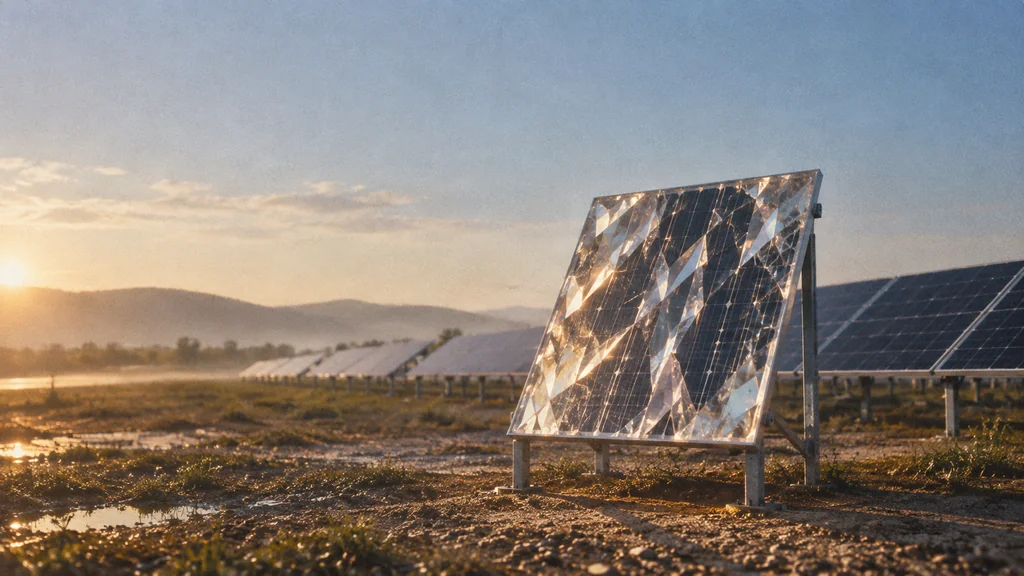
A laboratory material reaches the field; its years outdoors remain unproven.
Image composition · tobriefFor years, perovskite solar cells have set efficiency records on small laboratory samples, while the panels on real roofs stayed silicon. A team led by Nanjing University has now built perovskite modules the size of an ordinary panel, 1.2 by 0.6 metres, and the best one held a steady output of 158.4 watts in testing (Nanjing University). The work, published in Nature on 12 August, shows the material can stay efficient at a size a solar farm could use (Paper).
Size is the problem because of how these cells are made. A perovskite cell turns light into electricity through a very thin crystal layer. Coating a tiny test cell is like painting a postage stamp, where near-perfection is achievable. A panel means coating a much larger sheet evenly and wiring many cell stripes together, and the more area you cover, the more small flaws appear.
Those flaws matter because they waste energy. At a defect in the crystal, some of the electrical charge freed by sunlight is lost before it can reach the wires as useful current. A big panel with many such spots loses a noticeable share of its output.
A better finish for the surface
Chemists fight these losses with passivation, a chemical treatment of the layer's surface that makes defects less harmful. The researchers argue that the standard treatments, based on ammonium-halide compounds, spread unevenly over large areas and break down when heated. They replaced them with lead dioleate, a lead-containing compound that, according to their paper, forms a more stable surface layer and reduces charge loss (Paper). The team, which included manufacturer Renshine Solar, Beijing Institute of Technology and Canada's University of Victoria, then put the idea to work on real modules.
What a full-size panel delivers
Start with the strictest number. Efficiency is the share of incoming light energy a panel turns into electricity. The 0.72 m² module reached 22.0% measured across its entire footprint, including borders and wiring strips that generate nothing (Paper).
This was more than a single lucky panel. The team built 150 of the large modules, which averaged 144 W, so the 158-watt champion is the best of the batch rather than a typical unit (Nanjing University).
A smaller module produced the headline record. It reached 24.0% over an 810 cm² aperture, the active area left once inactive borders are excluded, a result certified by the testing firm TÜV SÜD China (pv magazine). Because the module size and the measuring rule both differ, the 24.0% and 22.0% figures can't be compared directly.
Durability has long been the weak spot of perovskites, which degrade in heat and moisture. In a standard "damp heat" test, which speeds up ageing by holding panels at 85°C and 85% humidity, the university reports that treated modules lost about 2% of their efficiency after 1,300 hours (Nanjing University). Modules with the older ammonium treatment lost about 39% under the same conditions, by the university's account. Tests like this expose weaknesses quickly, though they cannot show how a panel ages outdoors over decades.
A spring beside silicon
The team also took the panels outside. The university reports that a 1 MW perovskite system ran at the same ground-mounted plant as a 3.5 MW commercial silicon system (Nanjing University). Since the arrays differ in size, the comparison used daily electricity generated per unit of installed capacity.
By that measure, the university says, the perovskite system came out ahead by 3.42% in March, 3.79% in April and 5.81% in May 2026. These figures come from the university's own account of one site over one spring. Outlets including the South China Morning Post repeated them without checking them independently.
What the Nanjing team has shown is concrete. It made a batch of metre-scale perovskite modules, obtained a certified record efficiency, and used a surface treatment that sharply slowed damp-heat damage in its tests. Showing that these panels earn more than silicon over their lifetime will take years of outdoor yield data from several climates, plus factory cost figures, and Renshine and its partners are the ones positioned to publish them.
Details about this article
- Model:
- claude-opus-5-5
- Generated:
- 9/24/2026, 1:46:53 AM
- Pipeline run:
- eu_pipeline_20260924_005006
- Watermark:
- SynthID (Google's invisible watermark)
- Human review:
- None before publication