Poland’s court chief suspended, authority disputed
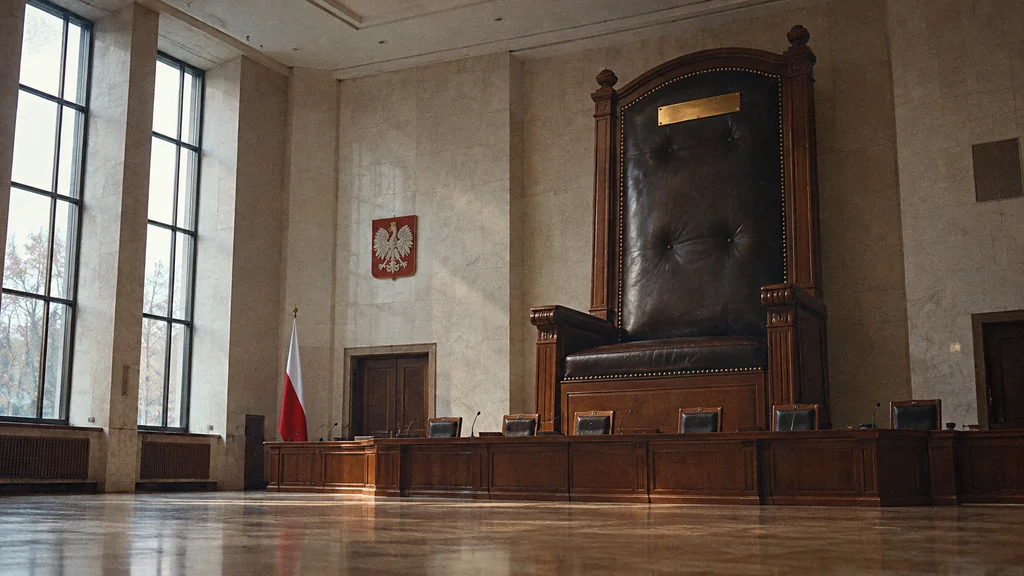
Poland’s constitutional judges disagree over who belongs on the bench.
Image composition · tobriefOn Friday 30 October, judge Anna Korwin-Piotrowska signed orders suspending the president and vice-president of Poland's Constitutional Tribunal for one month (WP, PAP). Within hours, the court's official account replied on X that she was not a judge at all (Tribunal X statement). Poland's constitutional court, which decides whether laws respect the constitution, now has two claims to its leadership. Both rest on one unanswered question: who counts as a member.
The orders target Bogdan Święczkowski, whom then-President Andrzej Duda appointed to lead the tribunal on 9 December 2024 (Presidential record). His deputy, Bartłomiej Sochański, was suspended alongside him.
Elected by parliament, blocked by the president
The Sejm (parliament's lower house) elects the tribunal's judges. But the tribunal's own statute counts as members only judges who have sworn their oath before the president of the republic (Tribunal organization law). President Karol Nawrocki has refused to receive the oaths of judges the current Sejm elected (Reuters).
Korwin-Piotrowska, elected this year, took her oath in the Sejm instead (Rzeczpospolita). For Święczkowski's leadership, that leaves her outside the court.
Two bodies of the Council of Europe, the Strasbourg-based human-rights organisation separate from the EU, have backed the elected judges. On 5 May, the European Court of Human Rights issued an interim measure, an urgent order short of a final ruling. It asked Poland not to obstruct four elected judges, including her, from working (ECtHR interim measure). On 13 October, the Venice Commission, the Council of Europe's constitutional advisers, said the president could not use the oath to veto parliament's choice (Venice Commission).
Borrowing powers she may not hold
A valid seat would still not give her power to suspend anyone. Explaining her orders, she presented herself as the longest-serving relevant judge. She accused Święczkowski of keeping elected judges off the bench, assigning case panels improperly and endangering the court's 2027 budget plan (WP).
Her tool is Article 130 of the law on ordinary courts. It lets a court president or the justice minister suspend a judge for up to one month in urgent cases (Common Courts Act). Lawyers including Marcin Matczak, himself a critic of the judicial overhaul by PiS (Law and Justice, the former ruling party), disputed the legal basis (Rzeczpospolita). The tribunal is no ordinary court, and she holds neither office the article names.
To act as court president, she leans on the tribunal's succession rule. That rule hands the president's duties to the longest-serving judge only when the presidency is vacant (Tribunal organization law). The post was not vacant until she suspended its holder. Critics say she used powers that exist only after the president is gone in order to remove him.
Physical control stayed contested. Warsaw police secured the grounds, citing the safety of judges and staff (Warsaw police). Waldemar Żurek, the justice minister and prosecutor general, asked to lift both men's immunity from prosecution. He insisted the government had not directed her move (POLITICO).
What Europe can and cannot settle
The EU works through a different channel. In December 2025, the EU Court of Justice found Poland in breach of EU law. It cited defects in the tribunal's composition and the tribunal's 2021 rulings rejecting the primacy of EU law (CJEU). The Commission can seek fines through infringement proceedings, its tool for forcing countries to follow EU law (European Commission). Nothing so far shows Friday's orders have triggered that step. Brussels cannot appoint a tribunal president either.
The next test comes on 3 November. Korwin-Piotrowska has called the judges' General Assembly that day to approve the 2027 budget plan (PAP). The statute requires two-thirds of members present for a valid vote (Tribunal organization law). Passing the budget would show who can actually run the court. Each camp counts different judges as members, so a vote one side calls valid, the other will call void.
The record supports a narrow verdict. Nawrocki's refusal to take the oaths keeps Korwin-Piotrowska's membership in dispute, and European bodies have said that refusal should not keep elected judges out. None of those findings says a judge in her position can suspend the court's leadership. Swearing in the elected judges would settle who sits on the tribunal, but the fight over who runs it would remain.
Details about this article
- Model:
- claude-opus-5-5
- Generated:
- 10/31/2026, 1:35:32 AM
- Pipeline run:
- eu_pipeline_20261031_005007
- Watermark:
- SynthID (Google's invisible watermark)
- Human review:
- None before publication