Poland’s eight judges claim a quorum
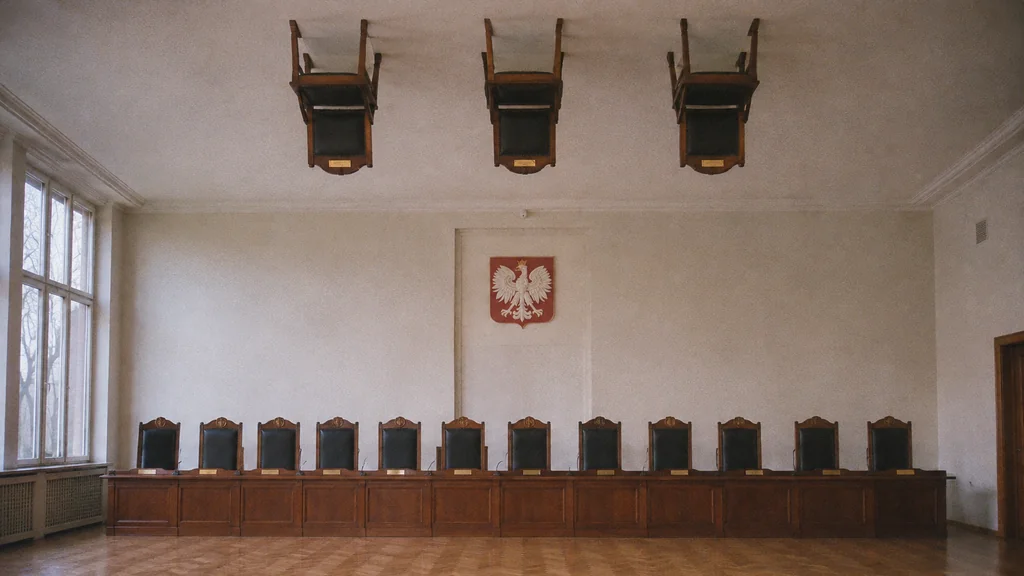
Eight judges count a quorum while three colleagues remain outside it.
Image composition · tobriefEight judges of Poland's Constitutional Tribunal met on 3 November and voted that they had a quorum, measuring themselves against 12 eligible colleagues instead of the court's 15 seats (Business Insider Polska). The judge who called the meeting had suspended two of the three excluded colleagues days earlier (Gazeta.pl). With that count, the eight approved the Tribunal's 2027 budget proposal and opened disciplinary review of its sidelined leaders (Business Insider Polska).
The count matters because of what the Tribunal does. It rules on whether Polish laws respect the Constitution, and its judgments are final and binding on everyone (Polish Constitution). If its quorum depends on whom you choose to count, the other side can call anything it decides void.
How eight became two-thirds
The judges' General Assembly runs the court's internal affairs. To act, at least two-thirds of the "overall number" of judges must attend, and ordinary resolutions also require the president's presence (Tribunal organisation statute).
Critics read "overall number" as the full bench the Constitution creates. Taken together, the two-thirds rule and the 15 constitutional seats put the bar at ten judges (Tribunal organisation statute, Polish Constitution).
Anna Korwin-Piotrowska, who convened the meeting, proposed a smaller base. She removed president Bogdan Święczkowski and vice-president Bartłomiej Sochański, whose duties she had ordered interrupted on 30 October. She also removed Jarosław Wyrembak, whose election she considers defective. Against a base of 12, eight was enough (Gazeta.pl).
The same move covered the second condition. Korwin-Piotrowska presents herself as Święczkowski's stand-in, so her presence substitutes for his only if his suspension is already in force. Both conditions rest on one contested step.
Her approach has serious backers. Former Tribunal president Marek Safjan and lawyer Michał Romanowski were reported to argue that an assembly must be able to act when judges on the roster cannot (Rzeczpospolita). Opponents point to the text. The law counts judges, not active judges, and a temporary interruption does not appear among the grounds that end a mandate (Judges' status statute). On that reading, Święczkowski and Sochański remain judges and stay in the base.
The reasoning also loops back on itself. The same eight drew three-judge panels to decide whether the suspension orders should stand (Onet). Those panels have not ruled. Święczkowski and the judges who stayed away deny that the meeting had any legal effect.
A fight over who counts as a judge
Beneath the arithmetic sits an older quarrel about membership. The Sejm, Poland's lower house, elected eight Tribunal judges in 2026, and President Karol Nawrocki swore in three while refusing the other five (Brussels Signal). Nawrocki and Święczkowski treat the oath the statute requires as a precondition: without it, the five are not yet judges.
The government argues that a president cannot turn a ceremony into a veto over parliament's choice. The Venice Commission, the Council of Europe's panel of constitutional lawyers, endorsed that view in October (Venice Commission). Under that reading, the unsworn judges are full members with every right to sit in the assembly. Everyone at Tuesday's meeting was elected by the current Sejm.
The Commission has taken one side of that question and not the other. A spokesperson said on 31 October that electing the new judges falls within the Sejm's power (Euronews). Justice Commissioner Michael McGrath stopped short of endorsing the suspensions (POLITICO). Brussels backs parliament's appointments, not the method used to sideline the court's leadership.
Judges in neighbouring countries worry about the method. The Czech Judges' Union warned that a constitutional court must not become an instrument of either government or opposition (Česká justice). Ivo Pilving, a senior Estonian judge speaking personally, said force risks producing two rival benches that refuse to recognise each other's decisions (ERR).
That is the risk Tuesday's vote brought closer. When the assembly counted its quorum, it treated Korwin-Piotrowska's suspension orders as effective, before the panels reviewing those orders had decided anything. Every resolution it passed inherits that assumption. Only Nawrocki and the Sejm, by agreeing on who sits on the court, can give its decisions an authority both camps will accept.
Details about this article
- Model:
- claude-opus-5-5
- Generated:
- 11/4/2026, 2:12:22 AM
- Pipeline run:
- eu_pipeline_20261104_005008
- Watermark:
- SynthID (Google's invisible watermark)
- Human review:
- None before publication