Poland’s top judges face a Tribunal standoff
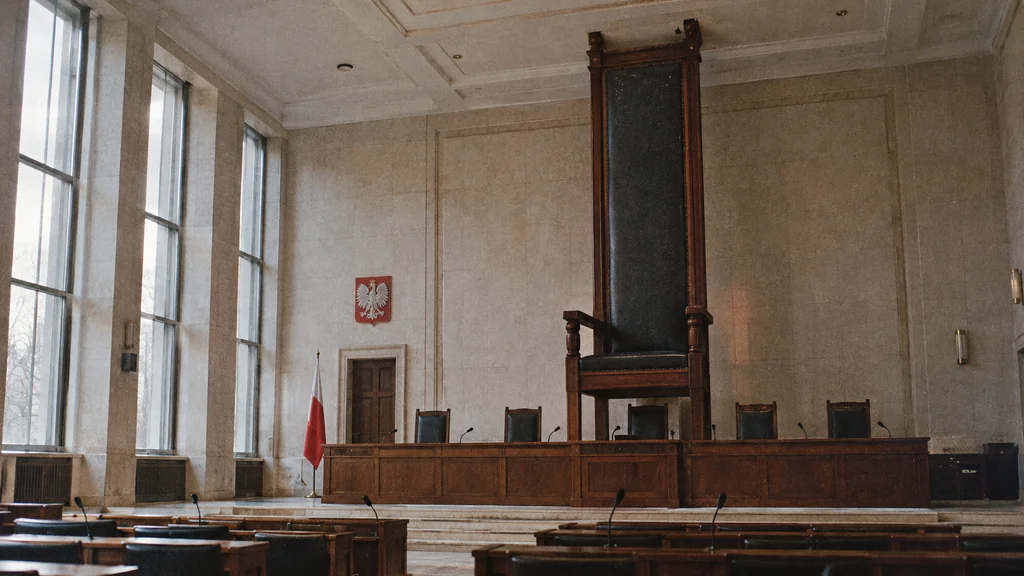
Poland’s judges can weigh in, but the Tribunal’s leadership remains disputed.
Image composition · tobriefPoland's Supreme Court has called all its judges to an emergency meeting on 3 November at 14:00 to discuss threats to the constitutional order and vote on a resolution (PAP). The judges can say where they stand in the fight over the Constitutional Tribunal, the court that decides whether laws comply with the Constitution, but they cannot decide who runs it. The judge now claiming control of the Tribunal also has a much stronger case for her own seat than for suspending its leaders.
Zbigniew Kapiński, the Supreme Court's First President, dated his notice 31 October and argued that extraordinary circumstances required immediate action (WP). The Supreme Court Act sets a minimum of seven days' notice, and its only stated exception covers choosing a new First President (Supreme Court Act). That gives anyone unhappy with Tuesday's outcome a possible procedural objection, although no court has ruled on the point.
An oath the President would not take
Poland's Constitution lets the Sejm, the lower house of parliament, elect the Tribunal's judges (Constitution). The President of the Republic then chooses the Tribunal's president from candidates the judges propose. Bogdan Święczkowski holds that post today.
Anna Korwin-Piotrowska was elected to the Tribunal by the current Sejm. President Karol Nawrocki then refused to receive her oath of office. She swore it in parliament instead (Rzeczpospolita).
Święczkowski's camp argues that without the presidential oath she is not a judge at all. Brussels sees it differently. On 31 October a European Commission spokesperson said that appointing new Tribunal members is the Sejm's power under the Constitution (La Libre/AFP). The Commission has a direct stake, because the EU Court of Justice ruled against Poland in December 2025 over specific Tribunal appointments and rulings (CJEU).
The confrontation inside the building
On 30 October Korwin-Piotrowska ordered Święczkowski and his deputy, Bartłomiej Sochański, to stop working for up to a month (Prawo.pl). She also restricted their access to the building and declared that she would lead the court herself.
Święczkowski refused to comply. He told staff to ignore what he called unlawful summonses (TVN24).
Nawrocki went to the building overnight. Police deployed there cited public order and left the question of who is in charge untouched, a standoff we covered as it began (To Brief).
A strong claim and a weak one
Korwin-Piotrowska's claim to her seat has support from two Council of Europe bodies, and they carry different weight. In May the European Court of Human Rights issued an interim measure, an urgent request made while a case is pending, asking Poland not to obstruct four elected judges, including her (ECHR). That was a holding instruction, not a final judgment.
The Venice Commission, the Council of Europe's advisory panel on constitutional law, went to the core of the dispute. In October it said a president cannot turn the oath into a veto over the Sejm's choice (Venice Commission). Its opinions bind no one, but this one addresses Nawrocki's refusal directly. Taken together, the record shows that the refusal faces serious legal challenge.
Her suspension of the Tribunal's leaders rests on far thinner ground. The Helsinki Foundation for Human Rights supports the elected judges, yet it finds no clear legal basis for the suspensions (Rzeczpospolita). She relies on a seniority rule. The foundation says that rule applies once the presidency is already empty and gives no power to empty it.
When an ally of the elected judges says this, the objection cannot be waved away as partisan.
What Tuesday's vote can do
Even if it passes, a Supreme Court resolution cannot install a Tribunal president, revoke Święczkowski's appointment or cancel a Tribunal judgment. The Constitution gives those powers to other bodies (Constitution).
The seat question has clearer exits. Nawrocki could receive the oaths, or the Sejm could legislate the alternative oath procedure the Venice Commission proposed (Venice Commission). Either step would strengthen the elected judges' status. Neither would decide whether Korwin-Piotrowska's suspension orders stand.
Tuesday's resolution can put the weight of Poland's top judges behind one side of that argument. It leaves Tribunal staff where they were before the meeting was called, with two judges each claiming to be in charge.
Details about this article
- Model:
- claude-opus-5-5
- Generated:
- 11/1/2026, 1:27:02 AM
- Pipeline run:
- eu_pipeline_20261101_005008
- Watermark:
- SynthID (Google's invisible watermark)
- Human review:
- None before publication