Poland wins Europe’s Patriot repair centre
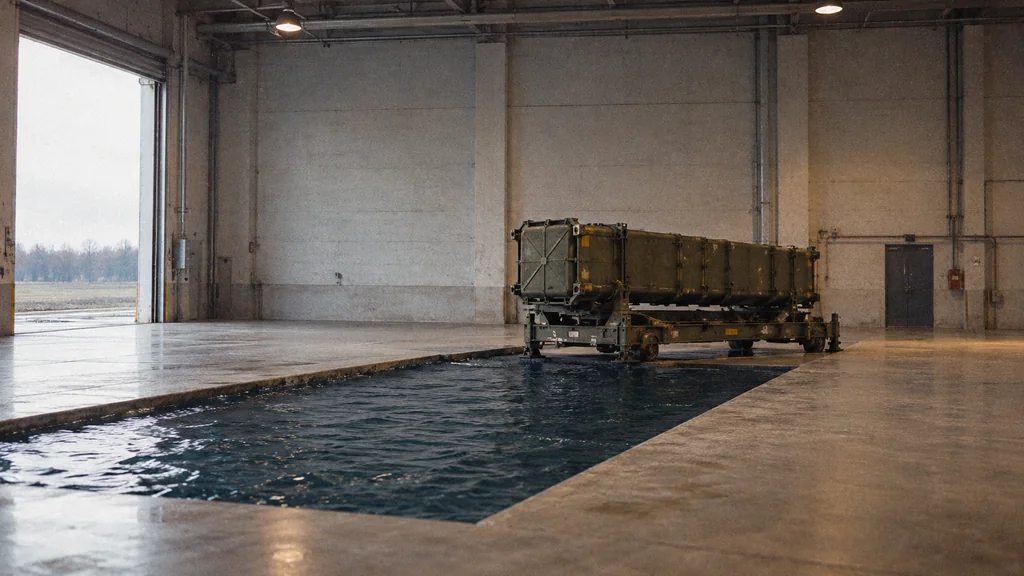
Poland has a host country; Europe still awaits a working repair centre.
Image composition · tobriefThe US Department of War announced on 27 October that Poland will host Europe's dedicated maintenance centre for PAC-3 interceptors, the missiles fired by the US-built Patriot air-defence system (US Department of War). Today, repairs that crews cannot do in the field are carried out at a US Army depot in America, so European missiles must cross the Atlantic and back (US Department of Defense acquisition report). The decision settles where that work will move. Contracts, US permissions and rules on who may use the centre still stand between the announcement and a faster service for allies.
An ocean between the missile and the workshop
A PAC-3 stays sealed in a canister until it is fired. Crews can test it where it stands. Anything deeper goes back to Letterkenny Army Depot in the United States, which a 2018 Pentagon acquisition report names as the site where missiles are repaired and recertified (US Department of Defense acquisition report).
A faulty interceptor in Europe therefore leaves its battery, crosses the ocean, gets opened and fixed, is certified again and makes the return trip. In July, Poland's defence minister said that cycle could sometimes take up to two years (Polish Ministry of National Defence). Presenting the October decision in Brussels, Deputy Defence Minister Magdalena Sobkowiak-Czarnecka spoke of a dozen-plus months (Reuters). These are officials' descriptions rather than measured averages, and they may refer to different cases.
Lockheed Martin, which makes the missile, says the Polish site is planned to handle repair, refurbishment and recertification (Lockheed Martin). If it does, the Atlantic leg drops out of the route and armies get their interceptors back sooner.
That benefit applies only to missiles Europe already owns. Fixing an interceptor does nothing to replace one that has been fired, and Breaking Defense treats this site as separate from new production (Breaking Defense).
Who decides, and who can book it
The project started at a NATO defence-industry forum in Ankara. On 7 July, a Dutch-led group of governments that included Germany, Poland and Sweden signed a statement of intent there to explore the facility (Dutch Ministry of Defence, Polish Ministry of National Defence).
Delivery now depends on fewer hands. The Pentagon has made its choice, and Poland's defence ministry must negotiate the details with Lockheed. The permissions that would allow a Polish site to handle the missile's technical data and certify repairs have not been published.
Poland gains the site and the investment that comes with it. Its neighbours have less certainty. Other European Patriot users would be natural customers. Sweden is one example: its procurement agency confirms its batteries fire the PAC-3 MSE (FMV). Yet no published document gives any ally the right to book the centre, and no published plan says who goes first in a crisis.
What still has to happen
Sobkowiak-Czarnecka put the investment at about 1 billion złoty, roughly $250 million. She said the centre could be running in a year or somewhat longer, after intensive talks with Lockheed (Reuters). Her colleague Paweł Zalewski was more cautious and forecast the turn of 2027–2028 (Portal Samorządowy).
Neither the Pentagon nor Lockheed has named a city or an operator contract. Neither has said how many missiles the centre could handle each year, what the work would cost, or how the bill would be split between governments and industry.
Poland has secured the location and the political credit. The faster turnaround that justified the project remains a promise from officials. The first step toward making it real is a deal between Warsaw and Lockheed that names the site, the work it may perform and the allies allowed to use it. Construction, US approvals and working capacity must follow that deal. Until they do, Europe has a host country, not a repair capability.
Details about this article
- Model:
- claude-opus-5-5
- Generated:
- 10/28/2026, 1:27:23 AM
- Pipeline run:
- eu_pipeline_20261028_005008
- Watermark:
- SynthID (Google's invisible watermark)
- Human review:
- None before publication