Portugal closes plan with €4.6bn unpaid
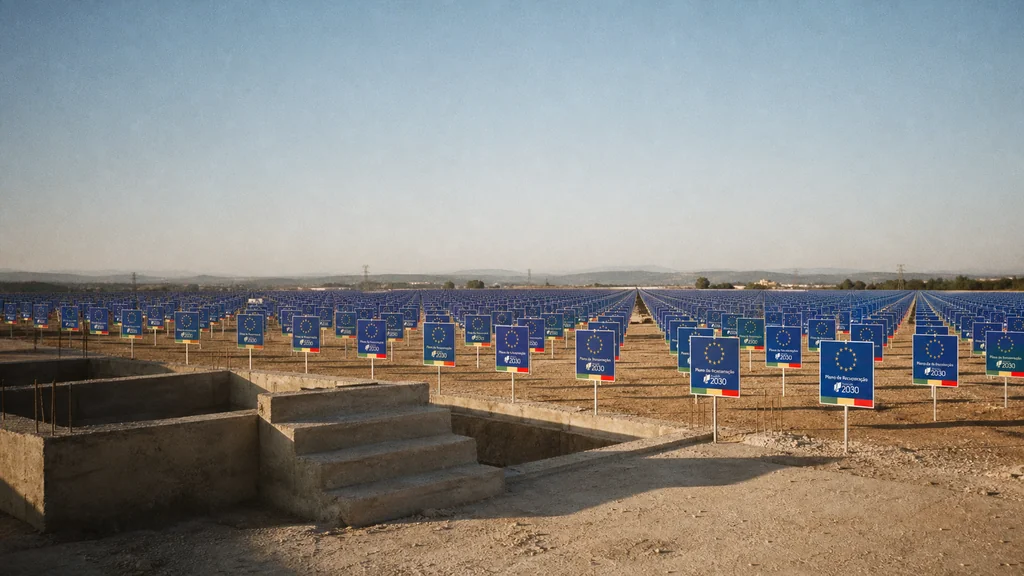
Brussels closes the ledger while Portugal’s unfinished projects remain open.
Image composition · tobriefPortugal's economy minister, Manuel Castro Almeida, declared on 28 August that the country had met every milestone and target in its post-pandemic recovery plan before the EU's 31 August deadline (ECO, Observador). The claim will probably survive Brussels's final check. But "completed" is doing three different jobs, and only one of them is settled.
Brussels Got Its Paperwork. Beneficiaries Are Still Waiting.
The Recovery and Resilience Facility (RRF), the EU's €800 billion joint-borrowing programme launched after Covid, doesn't reimburse invoices the way a normal spending fund does. It pays governments after they prove they've hit agreed reform steps and measurable outputs: a law passed, a school built, a digital system running. Portugal has received about €17.2 billion of its €21.9 billion allocation (Commission Representation in Portugal, IEU Monitoring). One final tranche, roughly €4.7 billion, still depends on the Commission verifying the last batch of targets.
That's the EU compliance ledger, and Portugal is ahead of Spain and Italy on it. The domestic payment ledger tells a different story. As of mid-August, Portugal had paid about €14.3 billion to the companies, municipalities, schools and hospitals actually doing the work (Jornal Económico). That's roughly €3 billion less than what Lisbon has already received from Brussels. For the firms and local governments waiting for reimbursement, the difference between "the money is coming" and "the money is here" is a working-capital problem: they've spent cash they don't yet have back.
Fernando Alfaiate, who runs Portugal's recovery-plan mission structure, told parliament in February that €4.6 billion would still need to be validated and paid to beneficiaries in 2027, well after the plan's official closure (RTP). Companies are the largest group waiting: they've received €5.1 billion so far, while municipalities got €2.3 billion (Jornal Económico).
The Projects That Didn't Fit
Then there's physical delivery. Castro Almeida himself acknowledged that some works remain in progress and may need financing outside the recovery plan (RTP). The government over-contracted by about €220 million so it could swap in completed projects when others slipped (Renascença). That buffer worked for the Brussels scoreboard. It doesn't make the unfinished clinic appear any faster.
Portugal's National Monitoring Commission had flagged 37 investments in worrying or critical condition, warning that 30 to 40 schools risked missing the August deadline (Observador). Several high-profile projects migrated off the plan entirely: Hospital de Todos os Santos, the Lisbon Metro red line expansion and the Algarve desalination plant were removed or resized in successive rounds of reshuffling (ECO).
Housing shows where the bill lands. The government's 1.º Direito programme started with €1.4 billion from the recovery plan. That proved insufficient, so Lisbon topped it up with €2.8 billion from the state budget (Portugal.gov). Taxpayers, through the ordinary budget, are covering what the EU fund could not. Portugal's parliamentary budget office (UTAO) has calculated that reshuffling recovery-plan projects already cost the budget €456 million between 2023 and 2025 (Jornal Económico).
A European Pattern
The gap between what Brussels certifies and what citizens experience is not unique to Portugal. Italy, the RRF's largest recipient, reported only 12.4% of public-works value physically completed by March 2026, despite having received about 85% of its allocation (UPB). The European Court of Auditors has warned that the RRF's payment model verifies whether governments met process targets, not whether those targets produced final results (European Court of Auditors).
The plan that Brussels signed off on is not the same plan originally promised to Portuguese citizens. Projects were removed, resized and swapped to meet the deadline. The ones that didn't fit, the hospitals, metro lines and desalination plants, still need building, and the money must now come from Portugal's own budget or future EU funds. How large that bill grows won't be clear until after September accounting. The Commission can certify Portugal's compliance. Lisbon still has to show citizens that reshuffled projects become delivered services.
Details about this article
- Model:
- claude-opus-4-6
- Generated:
- 8/29/2026, 1:43:12 AM
- Pipeline run:
- eu_pipeline_20260829_005007
- Watermark:
- SynthID (Google's invisible watermark)
- Human review:
- None before publication