Prime editing targets Wilson disease in the liver
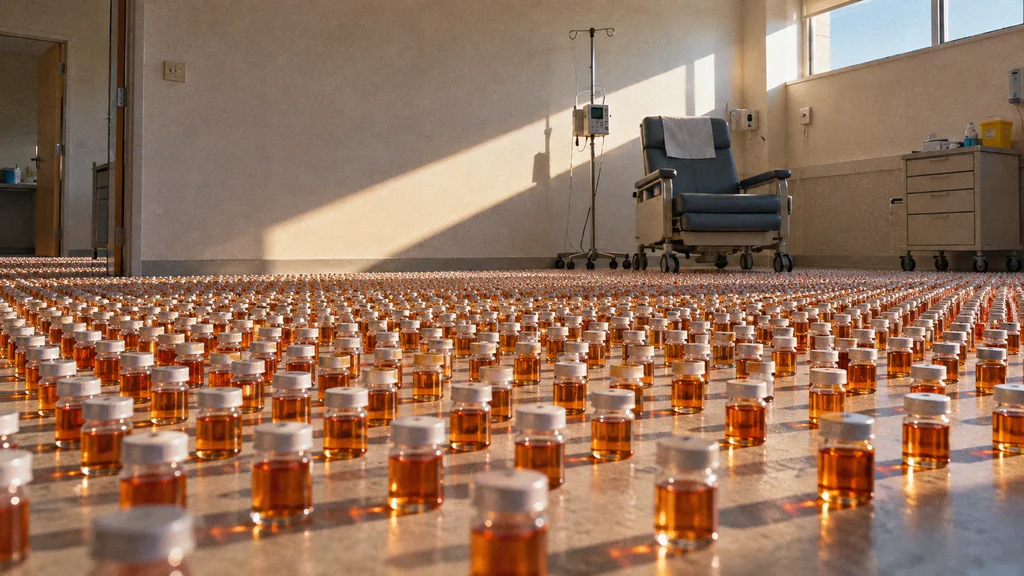
A first infusion begins the long test of copper control.
Image composition · tobriefA person with Wilson disease, an inherited disorder that lets copper poison the liver, has received an infusion designed to correct a single misspelled letter in the DNA of their liver cells. Prime Medicine announced on 5 October 2026 that the first patient had been dosed with the treatment, PM577a. This is the first time a prime editor has been given to work inside the body rather than on cells in a lab (Prime Medicine, Nature). No human editing or health benefit has been reported yet.
A healthy liver uses a protein called ATP7B as a pump. It pushes excess copper into bile so the body can flush it out. When the protein is faulty, copper accumulates and damages the liver and, later, the nervous system (AASLD guidance).
Today's drugs either pull copper out of the body or stop the gut from absorbing it. They manage the disease well, but patients generally keep taking them, because the inherited error behind it stays in place. A lasting repair would go after the cause itself.
Fixing a typo instead of retyping the page
PM577a targets one misspelling in the ATP7B gene called H1069Q, which the company describes as the most common disease-causing variant in North America and Europe (SEC filing). Only people carrying at least one copy can enrol (trial record).
The treatment is infused into a vein inside lipid nanoparticles. These are microscopic particles made of fatty molecules that wrap around their cargo and carry it to the liver (SEC filing). The cargo is two sets of instructions.
The first instruction tells liver cells to build the editing machinery. The second, called a guide, works like a search term with a correction note attached. It leads the editor to the faulty spot and spells out the right letter.
Many earlier CRISPR approaches make a cut through both strands of the DNA double helix. A prime editor nicks just one strand and writes the correction in from its template (original prime-editing paper). It resembles fixing a typo in place with a pen. The design aims to avoid the unwanted damage a full cut can cause, though gentler mechanics alone do not make a treatment safe.
Why working inside the body is the hard part
Prime editing has reached patients before. In 2025, doctors used it to edit blood stem cells taken out of two people with an immune disorder (NEJM). Cells in a dish can be checked before they go back into the patient.
An infusion offers no such checkpoint. Once it enters the bloodstream, the machinery has to find and fix liver cells that no one can inspect beforehand. Other editing tools have already been delivered straight into people, so the new step here is doing it with a prime editor.
The case for trying this in humans rests on animal work that Prime Medicine presented. In mice engineered to carry H1069Q, the company reported high levels of correction in the liver, with liver copper comparable to that of normal mice by eight weeks (company presentation). Copper is what harms patients, so that result means more than an edit count alone. The public summaries omit group sizes and variability, however, and mice cannot tell researchers what dose a person needs.
The trial starts with adults whose copper is already controlled by standard drugs. It is open-label, meaning everyone knows what they receive, and successive groups get higher doses (trial record). Investigators will track safety, image how copper moves through the body, and measure copper in blood and urine.
Because the usual drugs already keep copper in check, early copper readings will need to be read alongside that treatment. The trial will eventually ask whether participants can stop their usual medication. People keeping copper under control after reducing or stopping those drugs would be the clearest sign of real benefit.
Prime Medicine expects initial clinical data in 2027 (Prime Medicine). The facts remain what they were when we first reported the dosing (To Brief). A patient has received PM577a in an attempt to edit liver DNA. Whether it changed the gene or improved copper control remains unknown.
Details about this article
- Model:
- claude-opus-5-5
- Generated:
- 10/26/2026, 1:36:27 AM
- Pipeline run:
- eu_pipeline_20261026_005007
- Watermark:
- SynthID (Google's invisible watermark)
- Human review:
- None before publication