Remote fridge resets spoil food across Europe
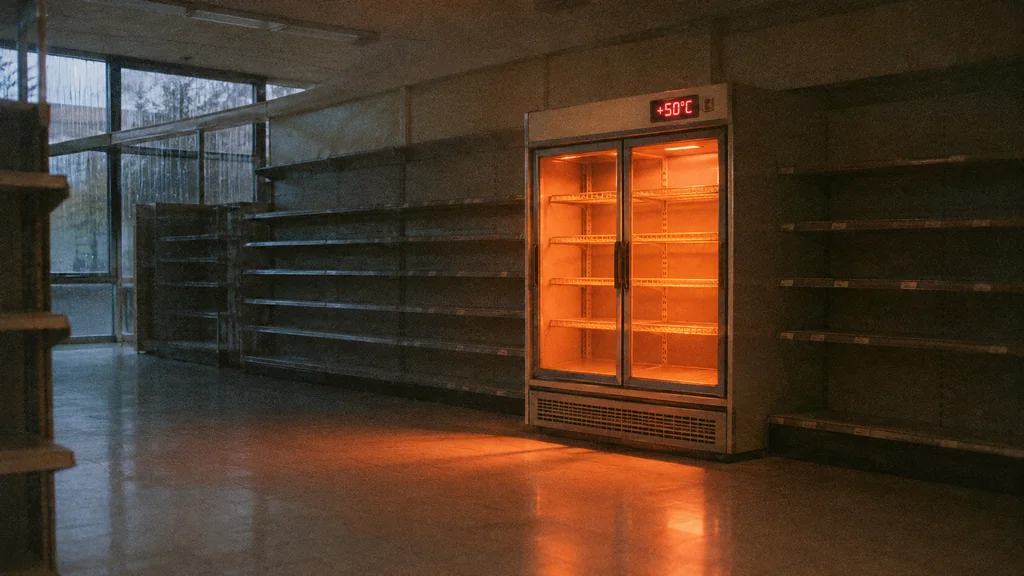
A remote setting leaves a Belgian shop counting the cost of lost food.
Image composition · tobriefConnected refrigeration in shops and a warehouse across Europe has been remotely reset this week, and several businesses have had to throw away food. The manager of the Proxy Delhaize in Tenneville, in Belgium's Ardennes, puts his loss at €20,000 to €25,000 (TV Lux). The equipment was easy to reach from outside. Who reached it, and how, is still unknown.
He saved only a little stock and is consulting insurers, with no payment confirmed. A nearby food business fared differently: its staff stepped in manually and saved all of their stock.
A 50°C setting is not a 50°C freezer
Every chilled cabinet in a modern supermarket answers to a refrigeration controller. This is a small computer that watches temperatures and follows instructions, such as which temperature to aim for and when to defrost. Many controllers can be reached remotely, so a technician can fix a fault without driving out.
The number on that controller is an instruction, a target. Changing it does not change the food's temperature at that moment. Think of a freezer during a power cut: the frozen goods and the insulation hold the cold, so the contents warm gradually rather than all at once.
Estonia's Selver chain shows that gap clearly. A freezer there was told to aim for +50°C, and the chain's contractor reversed the setting within about 10 to 15 minutes (ERR). The cabinet itself barely changed. It had warmed by only about 2 to 3°C, and no food was damaged (ERR).
Other shops lost much more. At Edeka Ernst in Reisbach, Bavaria, the cooling was reportedly switched toward heating with a 50°C setting (BR). Foodsharing volunteers collected what they could, but most of the affected goods were thrown away.
Thrown away, withdrawn or saved
"Affected" covers very different outcomes. Sweden's Axfood said its shops were unaffected. One of its delivery warehouses, however, threw out about SEK 3 million in chilled and frozen goods after someone got in through an external system (BleepingComputer). Ireland's Musgrave withdrew chilled and frozen products from 13 SuperValu shops as a precaution (RTÉ). A withdrawal is a safety call made when nobody can vouch for the food's temperature history, and on its own it does not mean the food spoiled.
Germany's Rewe also discarded refrigerated food at its Raesfeld shop as a precaution and named Danfoss as the system's maker (ZEIT). Italy's Conad confirmed five affected shops out of 3,300 and said quick intervention avoided major losses (ANSA). No country has published a total, and adding these cases together would mix spoilage with caution. Our previous report traced how the incidents spread beyond France's October wave (To Brief).
Exposed equipment, no shared culprit
The common thread so far is the equipment. After the French attacks in October, France's cybersecurity agency CERT-FR named Danfoss and Copeland/Dixell controllers. It warned against leaving their management pages, the web screens technicians use to change settings, reachable directly from the public internet (CERT-FR). On 14 October, Greece's cybersecurity authority counted more than 300 commercial refrigeration controllers in the country that anyone online could reach (Greek cybersecurity authority).
Those findings show that exposed controllers exist, not that every affected shop was entered through one. According to Silicon.fr, Danfoss said the controllers compromised in the latest incidents had internet-facing management pages and still used factory-default passwords, the ones a device ships with. That is the supplier's account, relayed by the publication. Reuters could not establish who carried out the attacks or whether the waves were connected (Reuters).
The protective steps were public before this week. CERT-FR told operators to take controllers off the open internet, replace default passwords and use protected remote access (CERT-FR). Belgium's federal prosecutor has opened an investigation without naming anyone.
Remote changes to cooling settings have forced businesses across Europe to throw away food, and investigators have not established a shared entry route. In Tenneville, a manager is already settling his loss with insurers before anyone can tell him how the intruder got in.
Details about this article
- Model:
- claude-opus-5-5
- Generated:
- 11/4/2026, 2:12:31 AM
- Pipeline run:
- eu_pipeline_20261104_005008
- Watermark:
- SynthID (Google's invisible watermark)
- Human review:
- None before publication