Rhine and Danube freight costs surge
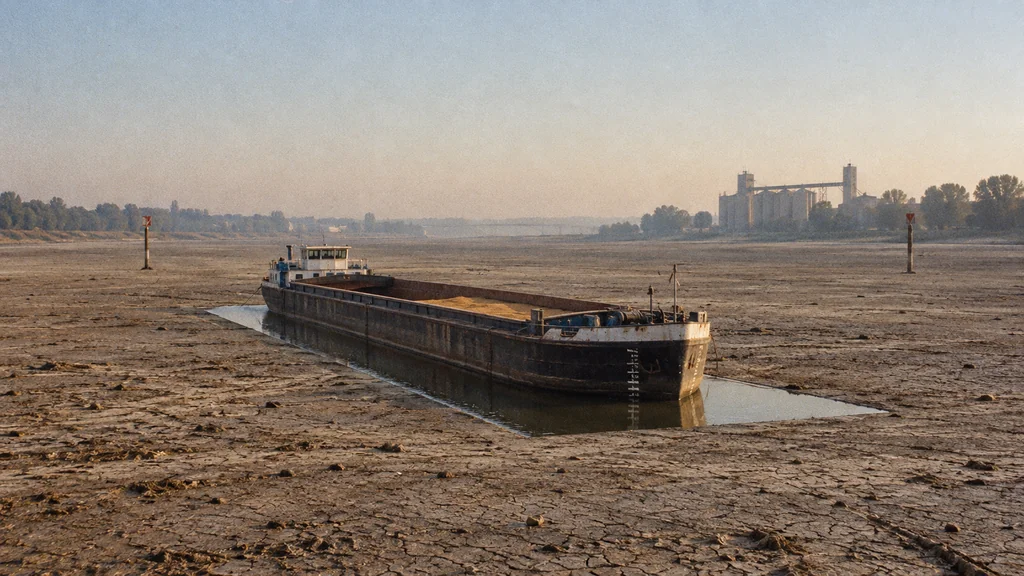
Europe’s shrinking rivers leave every remaining tonne carrying a heavier bill.
Image composition · tobriefRomanian local reports say grain vessels at Calafat, on the Danube's northern bank, cannot load safely because the river is too shallow. Across the continent, barges on Germany's Rhine are sailing at a fraction of their capacity, and BASF has curtailed chemical production at Ludwigshafen (Reuters via MarketScreener). The same cost problem is squeezing both of Europe's major inland freight corridors at once: less water means less cargo per voyage, while the bills for crew, fuel and port fees stay the same.
Shallower water makes every tonne cost more
Shipping can become uneconomic before authorities close a river. When the water beneath a vessel shrinks, the captain must strip out cargo until the hull sits high enough to clear the riverbed. At Austria's Krems Danube port, an operator told local media that with roughly 1.5 metres of depth in the navigable channel, large vessels could load only 200–300 tonnes instead of up to 2,000 (Bezirksjournal). The fixed voyage costs don't change. Spread across a sliver of the normal cargo, the price per tonne multiplies.
The same cost problem appeared on the Rhine. At Kaub, the gauge that governs Middle Rhine traffic read 21–26 cm on 12 September, against a reference low-water mark of 77 cm (ELWIS). Germany's Federal Institute of Hydrology confirmed that sections had reached or passed previous lows during August (BfG). Freight rates on the Rotterdam–Karlsruhe route roughly tripled between late June and late July, from about €45 to €150–155 per tonne (Industrieanzeiger).
On the Danube, Romanian hydrologists forecast September inflow at Baziaș (where the river enters Romania) at roughly 1,400 cubic metres per second, which they called a new September minimum (Observator News, EVZ). Bulgarian gauges on 12 September showed readings well below each station's reference zero (the baseline from which that gauge measures; readings below it signal abnormally low water) across the entire national reach (Utro Ruse, BTA). Serbia's commodity exchange described the Danube route toward Romania's Black Sea port of Constanța as "practically interrupted," though that is a market description rather than an official closure finding (RTS).
Rhine factories, Danube farmers
Rhine barges feed chemical plants. Lower Danube barges carry harvested grain. The drought hits each economy differently.
BASF's Ludwigshafen complex receives around 40% of its raw materials by water; the company warned customers of restricted availability, according to Reuters (Reuters via MarketScreener). When a specific chemical input fails to arrive, an integrated production chain can stall. Road and rail cover urgent shipments at the margins, but emergency Sunday truck exemptions cannot replace a barge fleet (Ingenieur.de).
On the lower Danube, the pain falls on farmers with harvested grain, limited storage and little cash to cover costs while payment is delayed. Every day of delay postpones revenue and risks grain quality. No official cargo ledger documents the tonnage stranded at Calafat, and no full accounting shows where the Rhine's missing barge freight went.
Who pays, who charges more
The bill splits unevenly. Taxpayers in Hungary and Romania are already funding emergency river dredging (Hungarian government, HotNews). Farmers along the Danube absorb storage costs and delayed revenue. Industrial buyers on the Rhine pay surcharges or accept delayed deliveries. Owners of scarce shallow-draft vessels, available silos and rail slots earn higher prices created by the shortage.
Low water made each tonne more expensive on both rivers at once, hitting cash-strapped farmers and water-dependent factories. The total cargo loss remains unmeasured. That gap matters, because it is the difference between a serious disruption and claims of a network-wide breakdown.
How was this article?
Help us get better
Help us get better
Details about this article
- Model:
- claude-opus-4-6
- Generated:
- 9/13/2026, 1:44:59 AM
- Pipeline run:
- eu_pipeline_20260913_005005
- Watermark:
- SynthID (Google's invisible watermark)
- Human review:
- None before publication