Rhine freight costs nearly quadruple
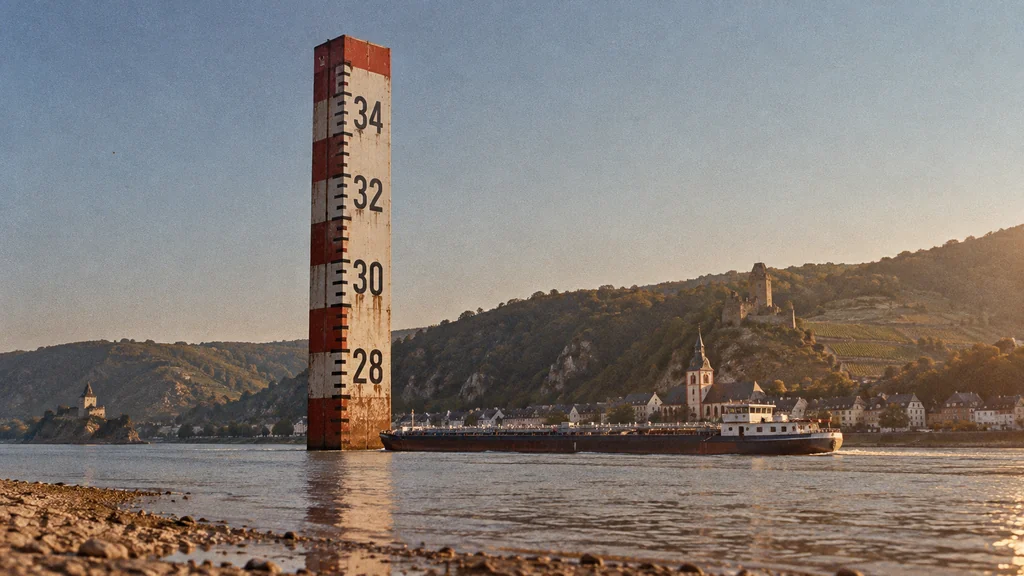
One shallow reading tightens Europe’s busiest industrial waterway.
Image composition · tobriefThe gauge at Kaub read roughly 28 cm on the evening of 13 September (WSV/Pegelonline). Kaub is the narrow Middle Rhine chokepoint where officials measure Europe's busiest inland waterway. That reading is not the river's actual depth: after adding the maintained channel below the reference mark, the navigable fairway came to about 138–141 cm (ELWIS). At that depth, barges cannot load anywhere near capacity. To deliver the same cargo, they run the same route again and again, and each tonne gets more expensive.
Shipping a tonne of fuel from Rotterdam to Karlsruhe cost €165–170 on 11 September, nearly four times the late-June rate of about €45 (UkrAgroConsult, Reuters/Zonebourse). This is Europe's third major Rhine drought disruption in eight years, after 2018 and 2022 (DW). Each time, the same bottleneck chokes the same corridor. What changes is how much cushion the economy has left: inventories, fixed-price contracts and spare rail or road slots.
Ten Days of Relief, Then Back to Record Lows
Late-August rain briefly lifted the Kaub gauge to about 60 cm. Freight rates eased to €100–110 (Reuters/gCaptain). The respite lasted roughly ten days. By 12 September the gauge had dropped to 19 cm, close to the all-time low of 5 cm set on 17 August (Tagesschau, Netz-Trends). Official forecasts pointed to only a modest rebound to 33–36 cm, still far too shallow for normal loading (ELWIS forecast).
Dutch inland shipping carried 18.8% less cargo by weight in August than a year earlier, the lowest August total in fifteen years (CBS). CMA CGM imposed an emergency fee of €75 per container on inland freight routed through its Benelux network to Germany, Switzerland and France (AJOT). Hapag-Lloyd followed with €50 per container for central European destinations (Container News).
From Rotterdam to Basel, the Cost Stacks Up
The damage concentrates where the corridor ends. BASF CEO Markus Kamieth said in August that the company could no longer fully meet delivery commitments for some chemical products, though he added that earnings effects were not yet significant (Investing.com). Chemicals depend on barge-delivered liquids that are difficult to reroute by truck, which is why Ludwigshafen feels low water before steelmakers in Duisburg do.
Switzerland, landlocked at the far end of the waterway, shows the sharpest price signal. Transport from Rotterdam to Basel reportedly reached about CHF 240 per tonne, against a normal CHF 22–28. According to Swiss news agency AWP, the Rhine disruption added an estimated CHF 0.12–0.16 per litre to Swiss fuel costs (Schweizer Bauer/AWP). Whether that estimate has fully reached pump prices is not yet confirmed by retail data.
Trains and Trucks Cannot Replace the Missing Capacity
Rail offers some overflow. Kombiverkehr made roughly 2,000 TEU (twenty-foot equivalent units, a standard container measure) per week available on Rhine-parallel routes (Eurotransport). DB Cargo said it could mobilise 300 additional wagons (Verkehrsrundschau). But rail and road are triage, not replacement. Industry estimates put the missing river capacity at levels equivalent to some 250,000 truckloads per month (Ingenieur.de).
The Kiel Institute's Stefan Kooths estimated that prolonged disruption could cost €1–2 billion in lost output and reduce German GDP growth by 0.1–0.2 percentage points in the third quarter (Die Zeit, DW). Those are forecasts, not measured losses. But 2018 offers a benchmark: when low water persisted long enough to exhaust buffers, BASF booked roughly €250 million in earnings damage, and the Bundesbank found GDP growth fell by an estimated 0.1 percentage point in each of two consecutive quarters (Bundesbank, BASF 2018 report).
Low water has already multiplied Rhine freight costs. A broader production hit depends on whether firms exhaust their inventories and transport alternatives before the river recovers. The 2026 gauge lows have been worse than 2018's. Whether the economic damage follows the same pattern is a question of weeks, not water levels.
Details about this article
- Model:
- claude-opus-4-6
- Generated:
- 9/14/2026, 1:40:34 AM
- Pipeline run:
- eu_pipeline_20260914_005006
- Watermark:
- SynthID (Google's invisible watermark)
- Human review:
- None before publication