Rhine freight costs triple at Kaub
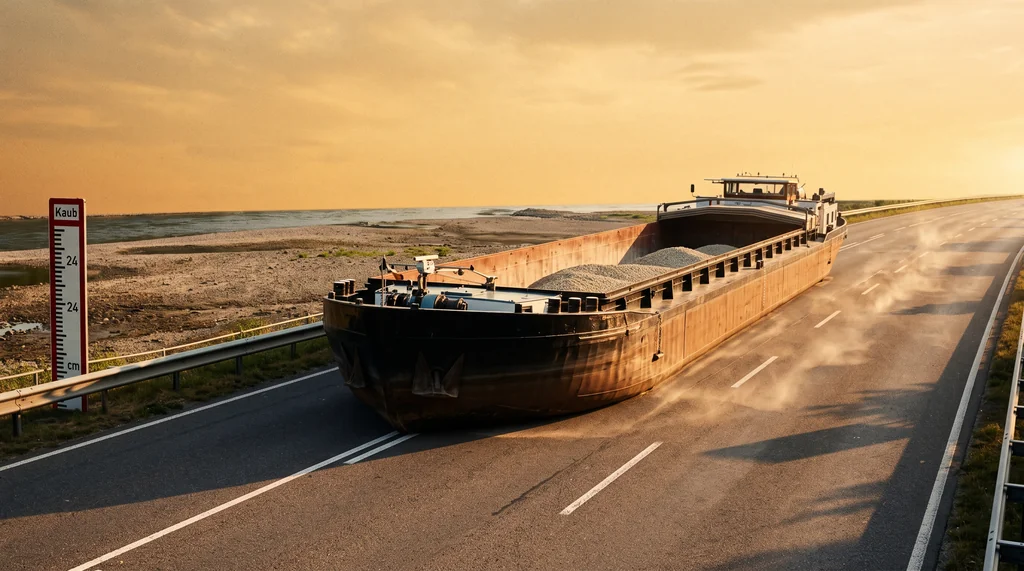
The Rhine’s missing capacity cannot simply move onto Europe’s roads.
Image composition · tobriefA barge passing Kaub on the Middle Rhine this week carries roughly a third of what it could hold a month ago. The river is not closed. But at current water levels, its economic usefulness has collapsed: freight costs have tripled along the corridor connecting Rotterdam to the chemical plants, steel mills and fuel depots of western Germany, eastern France and Luxembourg.
The same ship sails, but it delivers far less
The gauge at Kaub, the best-known commercial bottleneck between the North Sea ports and Germany's industrial heartland, read around 23–24 cm in early August and hit a record 19 cm on 5 August (Pegelonline). A gauge reading measures water level at a fixed reference point, not the depth available everywhere in the channel. When water drops at a bottleneck like Kaub, barges must shed cargo to sit higher and avoid scraping the riverbed.
The shedding is steep. According to Koninklijke Binnenvaart Nederland (the Dutch inland-shipping association), every 10 cm of lost depth can strip roughly 100 tonnes of cargo from some vessels (Trouw). At Rotterdam, barge loading fell from about 70% to 30–35% of capacity. The port saw roughly 100 extra ship calls per week, yet total Rhine volume stayed more than 10% below normal (Transport Online, WNL). More ships carrying less cargo, at higher cost per tonne.
Tanker freight on the Rotterdam–Karlsruhe route reportedly tripled, from about €45 per tonne in late June to around €150 (RFI, Le Marin).
The cargo loss shows up in other countries too
BASF CEO Markus Kamieth warned in late July that low water could force product shortages at the company's Ludwigshafen complex, which sits directly on the Rhine and depends on continuous waterborne supply. The company declared force majeure on several product lines, a legal notice telling customers it cannot meet contracts because conditions are outside its control (Breakbulk). German states including Baden-Württemberg and Bavaria lifted Sunday truck bans to let road freight fill gaps (Onvista).
A bottleneck on the German Rhine thins cargo long before it reaches neighbouring countries. In Luxembourg, barges arriving at the Moselle port of Mertert loaded just 450–500 tonnes on vessels built for 2,000, about 25% of capacity, because the Rhine had already forced shedding upstream (RTL Infos, Luxtoday). In Alsace, French terminals face the same constraint set by water levels at Kaub, hundreds of kilometres upstream. The main overland alternative is no help either: freight forwarder Kuehne+Nagel flagged that rail between Troisdorf and Wiesbaden is simultaneously shut for maintenance (Kuehne+Nagel).
Who pays when the river shrinks
Trucking extra loads on Sundays or rerouting to rail are rational crisis measures. They protect time-sensitive flows: a fuel depot near minimum stock, a chemical plant close to stopping a production line. They do not replace the lost capacity. One barge losing 1,000 tonnes of cargo means 40 heavy trucks to carry the equivalent. Multiply that across the corridor and the arithmetic breaks. Road and rail are rationing tools, not substitutes.
The losers are concentrated: chemicals, petroleum products, steel, ores, construction materials, fertilisers and grain, all heavy, low-margin goods built around cheap river transport (Destatis, Eurostat). Households would feel this later through higher producer costs and delayed deliveries.
This drought shows the Rhine problem is capacity, not navigation. Europe can improvise around that for days. It cannot truck its way around it for a summer.
Details about this article
- Model:
- claude-opus-4-6
- Generated:
- 8/11/2026, 10:40:40 AM
- Pipeline run:
- eu_pipeline_20260811_005006
- Watermark:
- SynthID (Google's invisible watermark)
- Human review:
- None before publication