Romania plans for a nuclear-free November
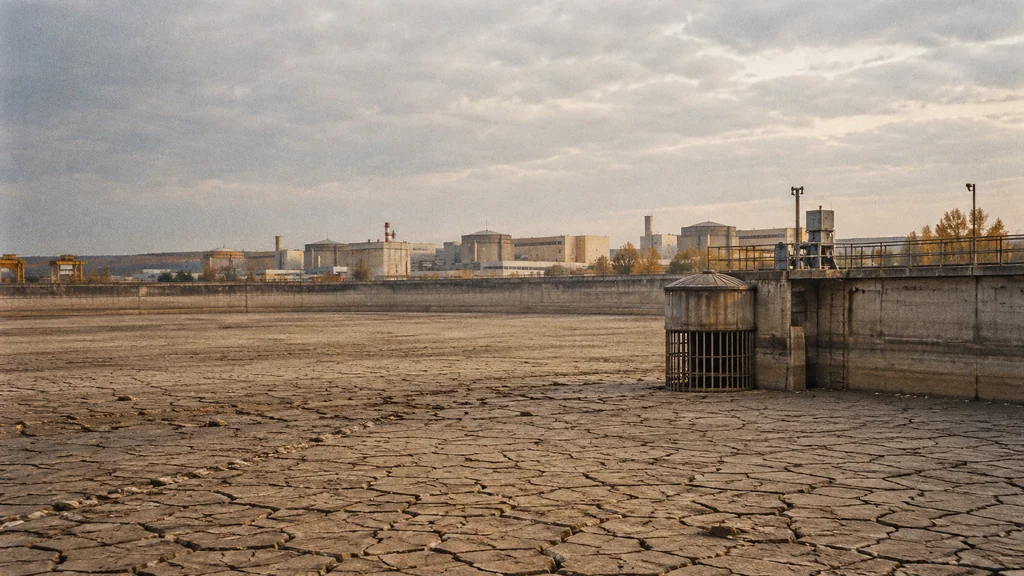
Romania waits for the Danube to rise and stay high.
Image composition · tobriefBoth reactors at Romania's Cernavodă nuclear plant remain shut because the Danube is too low to cool them. On 29 October Nuclearelectrica, the state-controlled operator, said they stay safely offline and gave no restart date (Nuclearelectrica). Romania's emergency committee has extended an energy alert by 30 days and is planning on the assumption that neither unit returns in November (AGERPRES).
Why a small rise in the river is not enough
Cernavodă takes water from the Danube through a branch and a canal, and uses it to carry heat away from its reactors. A reactor that has been shut down still gives off some leftover heat, and its safety systems can manage that. Generating electricity is a bigger job, because the cooling pumps need a steady, dependable flow of water.
Water in the basin that feeds those pumps rose by about 10 centimetres this week. The operator called the rise local, with no matching recovery further upstream (Nuclearelectrica). Before it asks to restart, it wants the level to hold for several days and keep climbing, with forecasts pointing the same way. Both units had already been taken offline earlier this month for the same reason (To Brief).
A planning assumption, not a ban
Energy Minister Dumitru Chisăliță said in an interview reported on 27 October that one reactor might restart around 15 November if the river kept rising. He added that new forecasts could move that date in either direction (Digi24). The committee's decision of 28 October took the cautious side. It cited a ministry assessment that neither unit could restart during November (MonitorulJuridic, LawChat).
Some coverage read this as an order. Mediafax's headline said reactors 1 and 2 "do not restart in November" (Mediafax). The decision itself sets no binding date and does not forbid an earlier restart.
The forecasts behind the decision show the Danube partly recovering around 11–12 November, then dipping again around 16–18 November (ZF). The minister's conditional date needs the first improvement to hold. The second dip is the most likely reason planners chose not to count on it.
How Romania fills the gap
Without Cernavodă, Romania's own power plants do not cover its needs, and imports make up the difference. On 28 October demand averaged 6,648 megawatts, domestic generation 5,462 megawatts and net imports 1,185 megawatts. Those figures come from a nonofficial compilation of grid-operator data (Energia României).
Winter evenings will ask for more. Planners expect November evening demand of up to 8,500 megawatts. They also list reactors at Kozloduy in Bulgaria, Temelín in Czechia and Paks in Hungary as partly unavailable (ZF). The neighbours Romania leans on are carrying their own outages.
The alert gives Transelectrica, the national grid operator, a fixed order of steps. It must first raise output from available plants and then secure imports. Only after both does reducing consumption come into play, as a last resort (LawChat).
The cost reaches people unevenly. A factory whose power contract follows the spot market (prices set day by day on the exchange) feels a tight market within days. A household on a fixed tariff may notice little for now. Generators with spare output, and foreign sellers exporting into Romania, stand to earn more, though no one has published a figure for those gains.
The operator's own data gives Romania good reason to plan for a continued outage, and the committee has done exactly that. Nuclearelectrica has still set no restart date. A sustained rise in the Danube, if the mid-November forecast holds, could bring one unit back before the alert expires.
Details about this article
- Model:
- claude-opus-5-5
- Generated:
- 10/30/2026, 1:39:22 AM
- Pipeline run:
- eu_pipeline_20261030_005008
- Watermark:
- SynthID (Google's invisible watermark)
- Human review:
- None before publication