Romania’s 90% EU funds claim awaits Brussels
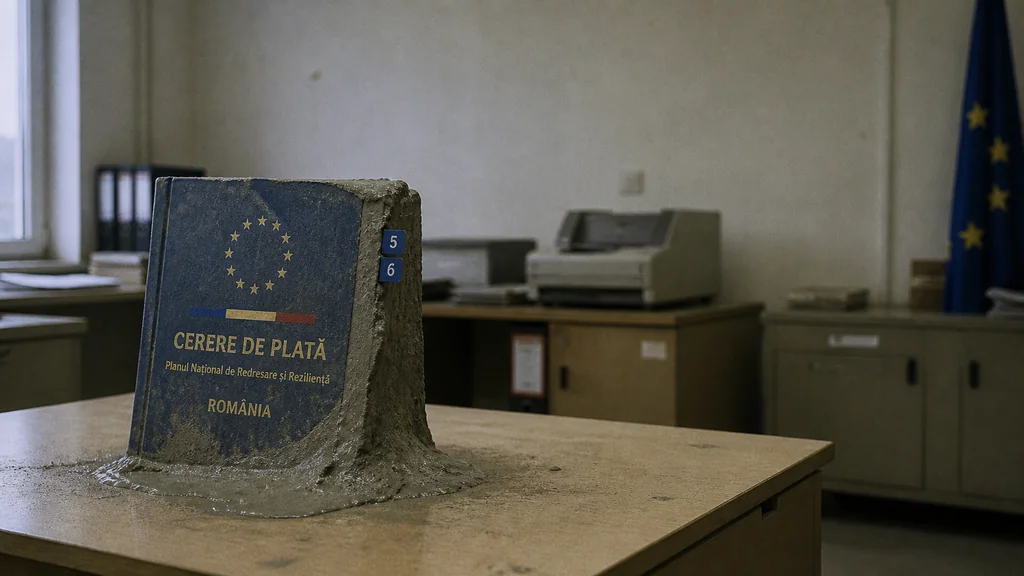
Romania’s promised billions remain suspended between paperwork and delivery.
Image composition · tobriefRomania's interim EU funds minister, Dragoș Pîslaru, says the country will collect more than 90% of the grants available under its EU recovery plan (EVZ, Curs de Guvernare). That percentage is a projection. As of 1 September, Romania had actually received about €13 billion from a plan worth €20.1 billion, roughly 64% (Gândul, Aktual24). Getting from 64% to 90% requires Brussels to approve billions more. That has not happened yet.
The money comes from the RRF (the Recovery and Resilience Facility), the EU's post-pandemic programme that pays countries not for plans or contracts but for completed reforms and investments (European Commission). As we reported on Sunday, Romania's implementation period ended on 31 August, with interim Prime Minister Ilie Bolojan acknowledging that missed reforms had already cost the country hundreds of millions.
Two Requests, No Cheques
Pîslaru's 90.58% figure depends on two outstanding payment requests. Request 5 was filed on 14 August, worth €2.84 billion gross (Agerpres, Mediafax). Pîslaru said the Commission's preliminary decision could take around two months (RFI România). Request 6, the final one, is expected by 30 September (Profit.ro). It has not been filed.
Filing is not getting paid. The money moves only after three checks: the Commission confirms that agreed reform steps and measurable targets were delivered, EU finance officials review the assessment, and Brussels signs the payment decision (EUR-Lex). Romania's 90% headline counts what it hopes to pass through that process. The Commission has not yet said yes.
Wage Law and Coal
Romania already knows some of what it will lose. Bolojan said the country forfeited €770 million because Parliament failed to pass a unified public-sector wage law, a reform Brussels had explicitly required. He blamed PSD, the largest party, for blocking it (HotNews, Euronews). That number is Bolojan's domestic estimate. The formal deduction will come from the Commission's final assessment.
Coal adds a second risk. Romania had agreed to shut down lignite-fired power units as a decarbonisation milestone. Instead, Parliament voted to keep plants at Turceni and Craiova running, and the Commission said it would review whether the milestone could still count as fulfilled (Romania Insider, Agerpres). Bolojan estimated that exposure at about €100 million (Economica). The coal case is trickier than the wage law because it tests whether a milestone Brussels once accepted as delivered can be undone by a later parliamentary vote.
Governments Count Plans, Brussels Counts Delivery
This gap between political claims and verified cash is not unique to Bucharest. Italy's government reported €153.2 billion received and 366 milestones achieved, but the Corte dei conti (Italy's national auditor) found only 12.4% of projects completed by value, with over €75 billion still being built (Struttura di missione PNRR, LavoriPubblici.it). Even Spain, the EU's strongest performer, saw the Commission hold back €537 million from its sixth payment because some objectives were unfinished (El País).
Governments are counting expected payments before Brussels has finished checking delivery. Romania's version of the gap is wider because its political failures on wages and coal are larger, and because Romania can least afford the shortfall. Fitch holds the country at BBB- with a negative outlook (Fitch). Any EU grants that fall away must be replaced by borrowing by the Romanian state at that rating, which is more expensive. That cost lands on taxpayers, public services, and a budget already running one of the EU's largest deficits.
Romania's risk is no longer whether it can announce EU money but whether it must replace missing grants with costlier debt. Only the Commission's assessment of requests 5 and 6 will fix the final amount.
Details about this article
- Model:
- claude-opus-4-6
- Generated:
- 9/2/2026, 2:08:02 AM
- Pipeline run:
- eu_pipeline_20260902_005006
- Watermark:
- SynthID (Google's invisible watermark)
- Human review:
- None before publication