Romania’s Nuclear Output Falls to Zero
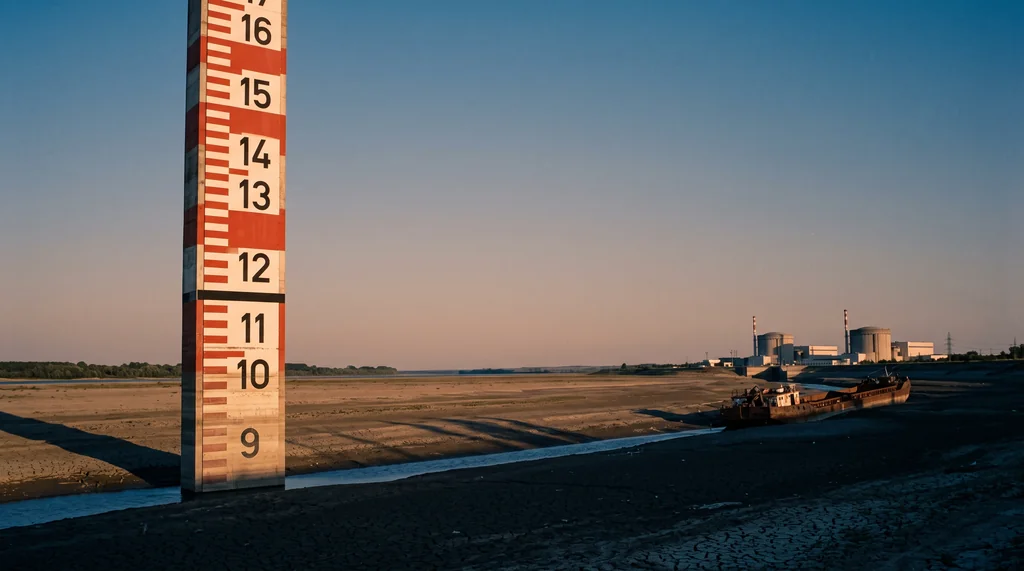
A falling river now sets the limits of Romania’s power system.
Image composition · tobriefRomania's only nuclear plant stopped producing electricity on 13 August. Cernavodă Unit 2, the last reactor still running, shut down that morning because the Danube had dropped below the minimum level needed to cool its reactors (ABC News/AP, Digi24). Unit 1 had already gone offline on 28 July for the same reason. Together, the two reactors supplied roughly 1.4 GW of steady, round-the-clock power, about a fifth of Romania's electricity (Agerpres, Reuters via Global Banking & Finance). That output is now zero.
The mechanism is simple. Nuclear reactors generate intense heat to make steam, and they need large volumes of water to cool down safely. When the river drops too low, operators cannot guarantee sufficient cooling intake. The reactors are not damaged, but they cannot run. Bucharest spent more than €2 million on emergency river works, including dredging and sinking barges to redirect flow toward the plant's intake (Al Jazeera, Firstpost). None of it was enough. The Danube's flow at Baziaș was forecast at roughly 1,400 cubic metres per second through 17 August, about a third of the August average (Agerpres).
After sunset, the squeeze
The real strain arrives each evening. Solar panels cover part of Romania's daytime gap, but after sunset, air conditioning and household demand stay high while solar output drops to nothing. That is when Romania must import. The Energy Ministry said evening import needs could reach 2,300 MW, against cross-border transmission capacity of about 4,000 MW (Digi24). But capacity is the pipe, not the water: it measures what the wires can carry, not whether neighbours actually have surplus electricity to sell at 9 p.m.
The stress was already visible before the full shutdown. On 5 August, Romania's evening demand hit 7,675 MW while domestic generation managed 5,321 MW. Imports covered close to 31% of consumption, and wholesale prices for next-day delivery had jumped 48% to about €178 per megawatt-hour (Brussels Signal). If shortfalls deepen, Romania's contingency plan allows grid operator Transelectrica to cut large industrial consumers by 10–30% and suspend exports (Balkan Green Energy News).
Same river, same problem, shared bill
Hungary's Paks plant sits on the same Danube and hit the same wall. On 7 August, Paks was producing roughly 230 MW out of its 2,000 MW capacity (HVG, kormany.hu). Nearly 1,770 MW of steady Hungarian generation was gone at the same time Romania lost its own.
The cost showed up fast. Hungary's daily net import bill rose from about 0.6 billion forints in late July to nearly 4 billion forints by early August, because the country was buying most of its power during expensive evening hours when prices topped €200/MWh (Telex/G7, Portfolio). These are wholesale prices, the rates utilities and large buyers pay in power markets. They do not land on household bills overnight, but they raise costs for energy suppliers who eventually pass them on.
Both countries were trying to buy evening power from a region that had less spare supply to sell.
Who gains, who pays
Bulgaria was the clearest short-term winner. Its Kozloduy nuclear plant uses spray ponds and backup wells for cooling, essentially stored water that buys time when the river drops. That made it more resilient. Energy Minister Iva Petrova reported exports of 32,000–33,000 MWh per day, with about 1,355 MW flowing toward Romania on 7 August (Club Z, economic.bg). Bulgarian wholesale prices rose to €150–170/MWh, up from €100–120/MWh a week earlier (Mediapool). Sofia was selling into scarcity at a premium. But Kozloduy's advantage has limits: Bulgarian officials said the plant could keep running for roughly another week and a half at current water levels (BTA).
The losers are Romanian and Hungarian industrial consumers facing possible curtailment, electricity buyers paying double or triple normal summer wholesale rates, and taxpayers who funded emergency river works that delayed but did not prevent the shutdowns. Romania's power system is not about to go dark. But it is stable only if wind keeps blowing, hydro keeps producing within shrinking limits, neighbours have surplus to sell, and evening demand stays manageable. That is the bet Bucharest is making while the Danube keeps falling.
Details about this article
- Model:
- claude-opus-4-6
- Generated:
- 8/14/2026, 2:03:31 AM
- Pipeline run:
- eu_pipeline_20260814_005006
- Watermark:
- SynthID (Google's invisible watermark)
- Human review:
- None before publication