Rosatom survives Europe’s energy sanctions
Europe closes Russian energy routes while leaving the nuclear passage open.
Image composition · tobriefA German fuel plant received permission last month to build reactor components using Russian state technology. The German government says it opposes this but cannot legally stop it. That contradiction exposes a gap in Europe's sanctions regime: the EU has cut off Russian coal, most oil, and much of its gas, but left civil nuclear trade almost entirely alone.
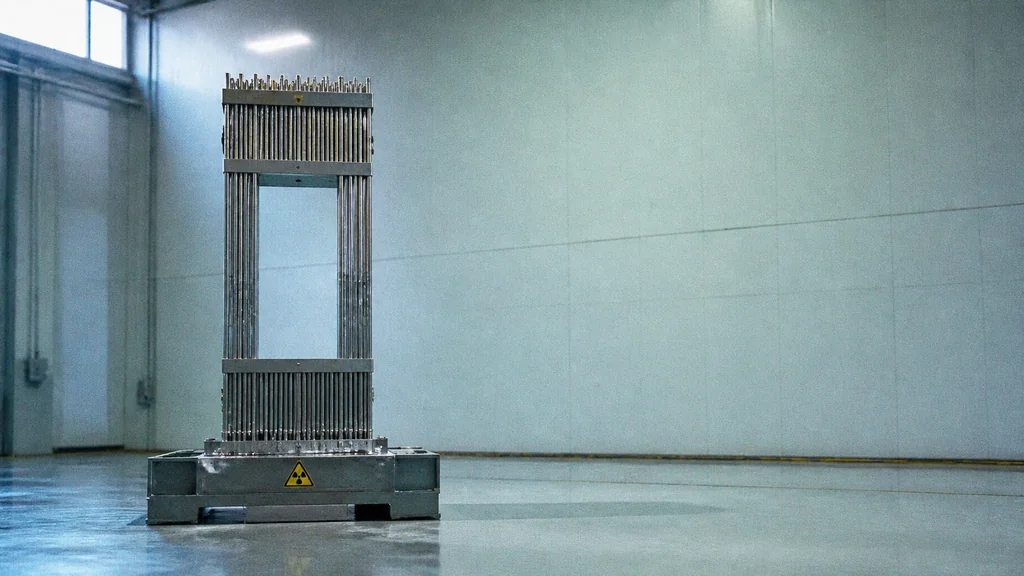
On 22 July, Lower Saxony approved an expansion at the fuel-element plant in Lingen, run by a subsidiary of France's Framatome. The expansion lets the plant manufacture fuel assemblies for VVER reactors, a Soviet-era design still powering plants across Central and Eastern Europe (Framatome, BMUKN). The production relies on licences, technology and machinery from TVEL, the fuel arm of Russia's state nuclear corporation Rosatom.
Why Berlin Approved What It Opposes
The federal environment ministry said it had no legal grounds to refuse. German atomic law governs safety, not geopolitics, and current EU sanctions do not cover civil nuclear cooperation (BMUKN). Lower Saxony's environment minister Christian Meyer called the Russian involvement wrong but said the state was acting under federal supervision and could not deny the licence (NDR).
The approval did come with security restrictions: limits on Rosatom personnel access, IT separation and hardware checks (ZEIT). Germany is trying to manage Russian involvement, not remove it.
So why hasn't the EU closed this loophole? Two reasons, one technical, one political.
Nuclear fuel is not a commodity you swap like crude oil. A fuel assembly is an engineered component designed for a specific reactor, licensed by a national regulator and loaded on a fixed schedule. Framatome counts 19 VVER reactors operating in the EU (Framatome). Replacing their Russian-origin fuel requires new designs, test assemblies and plant-by-plant approval, a process measured in years.
The political barrier is simpler: EU sanctions require unanimous agreement under Article 31 of the EU Treaty (EUR-Lex). One government can block the whole package. Hungary's foreign minister Péter Szijjártó has said nuclear sanctions would endanger Budapest's Paks II expansion, a Rosatom-led project backed by a Russian state loan of up to €10 billion (Agenzia Nova, World Nuclear Association).
Where the Real Dependency Sits
Russia's grip is strongest not in raw uranium but in the processing steps. According to the Euratom Supply Agency, Russia supplied about 15.6% of the EU's natural uranium in 2024, but roughly 22.4% of conversion services (turning uranium ore into gas suitable for enrichment) and 23.5% of enrichment services (concentrating the fissile material so it can power a reactor) (Euratom Supply Agency, S&P Global). These midstream steps are harder to replace because only a handful of facilities worldwide can do them at scale.
The countries running VVER reactors fall into three groups. Czechia and Bulgaria are already switching: Temelin received its last TVEL delivery at the end of 2024, and Kozloduy's Unit 5 is loading Westinghouse fuel (Seznam Zprávy, Sega). Slovakia has Western fuel contracts signed but not yet fully implemented across all five reactors, and nuclear provides about 62% of its electricity, leaving less room for disruption (Reuters, World Nuclear Association). Hungary has not yet licensed any Western fuel for Paks; Framatome's first alternative assemblies are expected around 2028 (Atlatszo).
France adds a supplier-side twist. Reuters reported that France imported 39% of its enriched uranium from Russia in 2025 (Reuters). Orano, France's fuel-cycle company, favours declining quotas rather than an abrupt cut, while Framatome stands to gain VVER fuel contracts from the Lingen expansion. Paris is both advocate for diversification and beneficiary of the status quo.
The Economic Case for Deadlines
The United States already showed a middle path. Washington banned Russian uranium imports in 2024 while allowing temporary waivers where alternatives are not yet available (Congress). The EU has not tabled an equivalent proposal, despite pledges under REPowerEU to end Russian energy dependence (European Commission).
Westinghouse, Framatome and Urenco-linked European enrichment would gain contracts and a clearer reason to invest in new capacity. Uncertainty over EU action is already holding back spending decisions at Urenco (Reuters). Rosatom would lose revenue. Budapest would lose diplomatic leverage.
A blanket immediate ban would be reckless; some reactors cannot yet run on non-Russian fuel. No ban at all keeps Rosatom embedded in European energy infrastructure for another decade. The evidence points to a third option: binding deadlines timed around when each reactor can actually switch, with waivers for those that genuinely cannot. Without that, Europe keeps sanctioning Russian energy while licensing Russian nuclear cooperation in the same breath.
Details about this article
- Model:
- claude-opus-4-6
- Generated:
- 8/25/2026, 2:07:43 AM
- Pipeline run:
- eu_pipeline_20260825_005008
- Watermark:
- SynthID (Google's invisible watermark)
- Human review:
- None before publication