A RUB 10,000 firm takes four giants
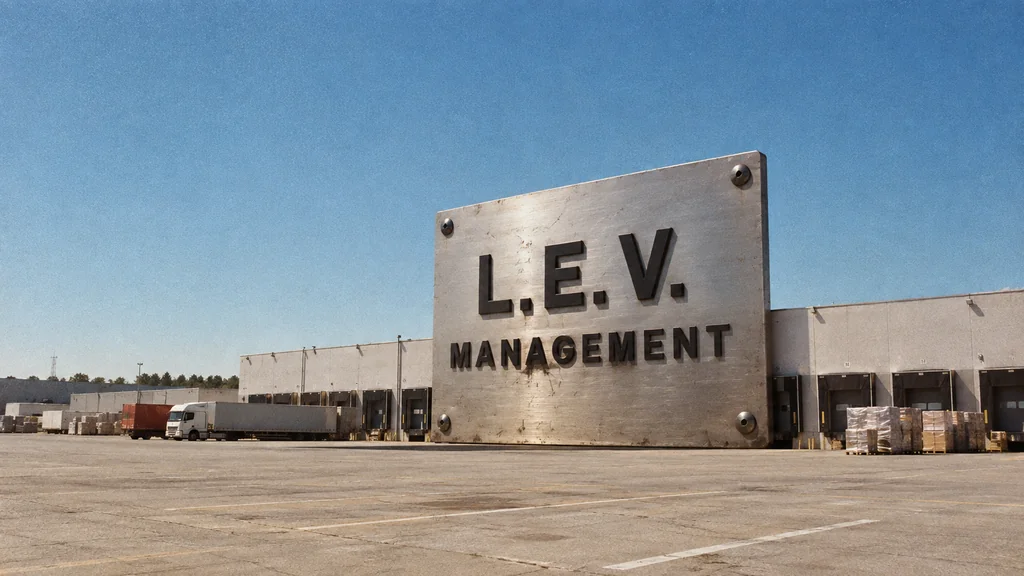
A paper-thin company takes command of Europe’s stranded Russian businesses.
Image composition · tobriefAndrey Krayushkin became general director of L.E.V. Management on 10 September 2026. The company was registered in Moscow in October 2024 with stated capital of RUB 10,000. Krayushkin's previous job was first deputy head of the Russian Interior Ministry's migration directorate (Ecomhub). The sources reviewed do not identify L.E.V.'s ultimate owner.
One week after his appointment, Vladimir Putin signed Decree No. 661. It placed the Russian subsidiaries of Nestlé, Auchan, Leroy Merlin's successor Lemana Pro, and logistics group FM Logistic under L.E.V.'s temporary administration (TKS). Krayushkin now votes the shares, appoints the managers and controls the budgets of operating companies across French, Swiss and German corporate families.
How Russia separates ownership from control
"Temporary administration" is Russia's legal device for stripping a foreign company of every power that makes ownership useful. The European parent stays on the shareholder register. But the administrator takes over voting rights, board seats, commercial strategy and profit distribution (Kremlin, Consultant Plus). A share you cannot vote, manage or sell is a share in name only.
The decree reached companies in different positions. Auchan and Nestlé were still operating in Russia (MarketScreener). Groupe Adeo had announced transferring its Leroy Merlin chain to local management in 2023, renaming it Lemana Pro. FM Logistic had made a similar announcement. Yet the ownership records cited in the decree still showed foreign holding companies as shareholders (Reuters via Investing.com). Announced departures did not count as completed ones.
Two precedents, same outcome
Previous cases of temporary administration have produced either a politically managed sale at a steep discount or continued exclusion from control. No European owner has come out whole.
Danone's Russian dairy business was placed under state control in July 2023. Moscow installed Ramzan Kadyrov's nephew to run it, then approved a sale to a buyer linked to the same political network. Danone completed the transaction in May 2024 and booked roughly €1.2 billion in impairments (accounting write-downs reflecting the gap between what its Russian business had been worth on its books and what it recovered) (Danone, Swissinfo).
Finland's Fortum and Germany's Uniper represent the other path. Their Russian power-generation subsidiaries remain under state administration. The parents wrote them down by approximately €1.7 billion combined and stopped counting them in group accounts (Fortum, EPRussia). Years later, neither company has recovered anything.
Russian regulations require approved buyers to pay no more than market value, discounted by at least 50% according to Rödl & Partner's analysis of the mandatory exit rules (Rödl & Partner). The buyer gets a working business at half price. The European seller absorbs the difference.
What remains unresolved
The mechanism is now well-tested: temporary administration transfers control, Russian authorities pick the buyer and the price, and the foreign owner writes down the loss. The outcome for Nestlé, Auchan, Lemana Pro and FM Logistic is not yet determined, but every prior case points in the same direction.
What the evidence does not yet show is whether the four new targets will be offered even a discounted sale, or whether they will join Fortum and Uniper in indefinite limbo. Nestlé said it was "assessing the impact" of the decree (MarketScreener). Auchan has not publicly commented. The affected companies span France, Switzerland and Germany, but each negotiates its exit individually, with no shared European framework for recovering value.
The decree's practical significance is straightforward. Temporary administration is no longer an exceptional response. It is a routine tool, applied whenever Moscow decides a European owner's formal title has outlived its usefulness as a bargaining chip.
Details about this article
- Model:
- claude-opus-4-6
- Generated:
- 9/19/2026, 1:41:04 AM
- Pipeline run:
- eu_pipeline_20260919_005005
- Watermark:
- SynthID (Google's invisible watermark)
- Human review:
- None before publication