Russia’s 17-trillion-ruble defence plan deepens debt
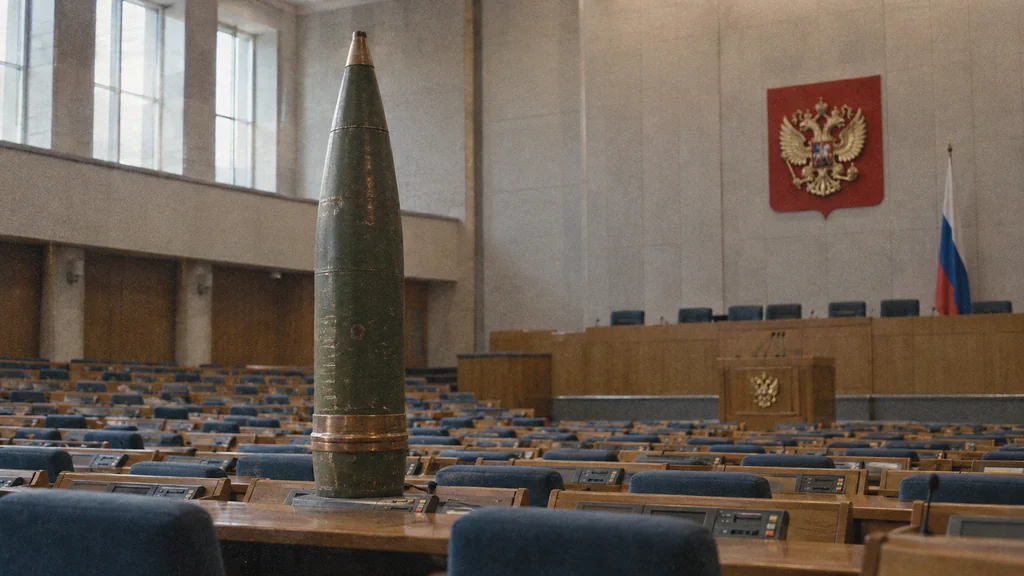
Russia’s proposed defence increase now awaits a parliamentary vote.
Image composition · tobriefRussia's government has approved a draft budget that would give national defence 17.1 trillion rubles in 2027, according to budget documents seen by Reuters (Defense News). That is 27% above the 13.5 trillion rubles Moscow's own 2025 budget had set aside for the same year. The figure therefore measures a revision of the Kremlin's earlier plan, not a jump from this year's spending (The Moscow Times). Parliament still has to pass it, and the government proposes to pay for it with new taxes and heavier borrowing.
Ministers approved the package on 24 September, and it was due to reach the State Duma, Russia's lower house, by 1 October (RBC, Interfax). The detailed document was not yet public (Novaya Gazeta Europe). The defence figure is Reuters' reading of it. The outlets repeating the number are relaying that single source, not confirming it independently.
Who would pay for it
The Finance Ministry wants to spread the cost across several groups. Some metals, mining and fertiliser producers would pay a proposed 30% levy on windfall income (RBC). Savers and investors would see dividends and bank interest taxed on the same progressive scale as wages. Russians buying from foreign online shops would pay VAT on those purchases.
The taxes cover only a small part of the bill. Reuters expected the windfall levy to raise about 200 billion rubles a year, a sliver of the 3.6 trillion ruble upward revision (DW). Finance Minister Anton Siluanov put the resulting 2027 deficit at 2.2% of GDP (Interfax).
Borrowing fills most of the rest. The draft projects gross borrowing of 7.7 trillion rubles in 2027, enough to lift public debt to 21.7% of GDP, past the 20% level the authorities themselves call safe (The Moscow Times). That threshold is an official comfort marker, not a legal limit, so crossing it breaks no rule. It does show the government accepting more debt than it has told the public is prudent.
The squeeze started before 2027. Moscow has already doubled its 2026 deficit forecast to 3.2% of GDP while cutting expected oil-and-gas revenue (DW). The government's draft protects planned defence spending by proposing higher taxes and more borrowing instead of trimming the military budget.
A budget line is not a count of weapons. Reuters warned that real defence spending is classified and some military costs sit elsewhere in the budget. The revision therefore says nothing precise about how many drones or shells Russia will produce (Defense News).
Ukraine's deadline comes sooner
Moscow's numbers describe a long horizon. Across 2027–29 it plans roughly 50 trillion rubles of defence spending (Meduza). Ukraine's problem runs on a much shorter clock, because weapons for next year have to be ordered now.
As we reported (To Brief), President Volodymyr Zelenskyy put Ukraine's defence funding gap at $27 billion. He said drones for early 2027 must be ordered in October and November (Hromadske). A 28 September report said Kyiv had since narrowed that hole by about $7 billion (AOL).
Europe's main instrument is already agreed. The EU's €90 billion Ukraine Support Loan for 2026–27 earmarks €60 billion for defence purchases (EEAS). EU defence ministers met in Brussels on 28 September with Ukraine's funding gap on the agenda (Euronews). The reporting on that meeting records the discussion. It does not record any decision taken in response to Moscow's budget.
The two stories connect through timing, not through a European reaction. If parliament passes the draft, Moscow has shown it will tax savers, shoppers and commodity firms and borrow past its own comfort line to fund its military plans. For European support, the test this autumn is whether enough money reaches Ukrainian contracts in time for Kyiv to place its drone orders.
Details about this article
- Model:
- claude-opus-5-5
- Generated:
- 9/29/2026, 2:26:02 AM
- Pipeline run:
- eu_pipeline_20260929_005007
- Watermark:
- SynthID (Google's invisible watermark)
- Human review:
- None before publication