Russia’s eight drone pads await rails
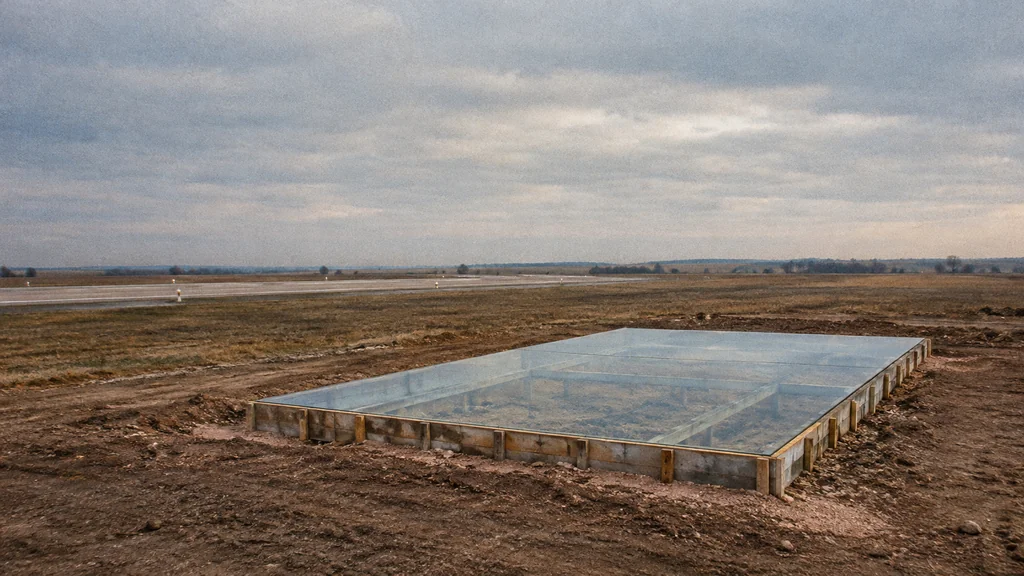
Russia’s new launch ground takes shape before any launch is documented.
Image composition · tobriefOn 31 August 2026, commercial satellites photographed an almost empty field beside Millerovo airfield in Russia's Rostov region. By 14 October the same ground held a complex of about 0.9 square kilometres with eight launch platforms, most still without launch rails (Reuters). Finland's Helsingin Sanomat built its 1 November survey of Russia's drone network around the site, while stating it has no information about such bases near the Finnish border (HS).
The evidence shows fast Russian building for the war on Ukraine. It does not show a new base aimed at Finland.
What the pictures prove
Satellite images show concrete and earthworks. They cannot show what flies from them, so everything beyond the construction itself rests on how experts read the layout.
Ukraine's Defence Intelligence projects up to 100 launches a day once the site is complete, on top of the launch infrastructure already at the airfield next door (GUR). Mike Monnik, founder of the drone-security firm DroneSec, gave a similar estimate and judged the pads suited to Geran-4 and Geran-5 jet-powered attack drones (Reuters). Rob Jordan of the Royal United Services Institute, a London defence think tank, told the same agency the layout matches Geran launch tracks.
Both capacity figures are projections. They depend on drone stocks, trained crews and steady supplies. None of the reporting documents a single launch from the new field.
Millerovo extends a pattern rather than starting one. In June, Radio Svoboda identified at least five launch sites in the Smolensk, Oryol and Bryansk regions, the largest under construction since August 2024 (Radio Svoboda). Their position near Belarus gives Russia extra routes toward Kyiv and western Ukraine, which forces Ukrainian air defence to watch more directions at once.
Why Finland is asking, and what HS itself rules out
Helsingin Sanomat's question follows from the hardware. Ukrainian intelligence puts the Geran-5's maximum range at about 950 km (GUR). Millerovo, though, sits in southern Russia close to Ukraine's eastern border, far from the Nordic and Baltic states.
A drone's theoretical reach shows what a launch point makes possible. It says nothing about where Russia intends to aim, which is why the newspaper's own caveat matters. The Russian construction near Finland's border that we reported in August involved different military facilities, not drone launch pads (To Brief).
Europe's drone incidents, and who answers them
Europe has already met Russian-made drones, but no investigation links any incident to Millerovo. On 29 May a Geran-2 crashed into a residential building in Galați, Romania, injuring two people, and on 17 October Romanian F-16s shot down two jet-powered Gerans over the country's territorial waters (MApN, MApN). In Estonia, prosecutors closed their inquiry on 23 October into the drone that hit the Auvere power-plant chimney, without establishing where it came from (Estonian prosecutors).
When such a drone appears, the decisions are national. Commanders choose whether to warn or fire under their own country's law. NATO pools allied radar data so every member sees the same sky. The EU pays for equipment but runs no interception force of its own. Its leaders named counter-drone systems and early warning among their priorities in their 18 June conclusions (European Council).
The record supports a narrow, firm conclusion. The images document that Russia can add launch capacity beside Millerovo within weeks. The cited reporting documents neither a launch from that field nor any link to the drones that reached Romania or Estonia. The next satellite passes, showing whether rails go in and launches begin, will be the first test of the projections.
Details about this article
- Model:
- claude-opus-5-5
- Generated:
- 11/2/2026, 1:38:17 AM
- Pipeline run:
- eu_pipeline_20261102_005008
- Watermark:
- SynthID (Google's invisible watermark)
- Human review:
- None before publication