Russian missiles sever Ukraine’s steel chain
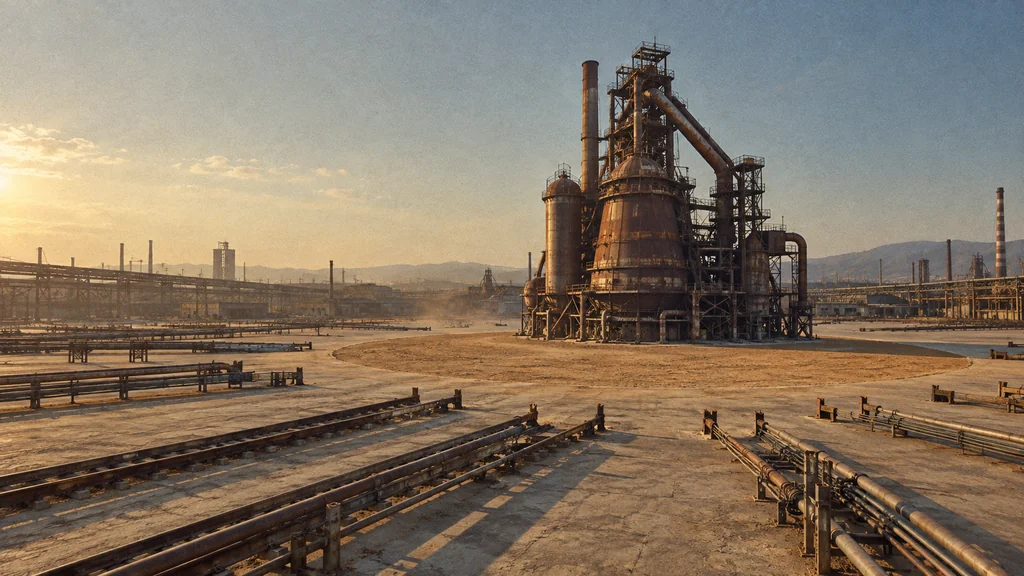
Ukraine’s furnaces stand intact as the lines feeding them are severed.
Image composition · tobriefBetween August and September 2026, Russian ballistic missiles struck three steel plants that together had recently produced an estimated 90% of Ukraine's steel output (Hromadske). All three stopped production. The immediate losses are Ukrainian: lost revenue, lost jobs, a further blow to a war economy already running on external support. The evidence for a broader European shortage is thin, but specific buyers are already exposed.
What the missiles broke
The three facilities are Zaporizhstal and Kamet Steel, both owned by Ukraine's largest steelmaker Metinvest, and ArcelorMittal Kryvyi Rih, part of the world's second-largest steel group. Each was struck repeatedly over roughly five weeks. Workers were killed at every site. At Zaporizhstal alone, Metinvest reported 17 ballistic missiles in a month, and its chief operating officer called the production chain "effectively broken" (Interfax-Ukraine). ArcelorMittal said its primary production had halted after Russia targeted its ironmaking operations twice (ArcelorMittal, UNN).
A steelworks runs only when furnaces, electricity, oxygen supply and internal railways all work together. Destroying one connection stops production without destroying the furnace itself. That is what happened at ArcelorMittal: the company reported that some units kept running at minimum levels while the main output chain was severed. The missiles did not flatten the plants. They disconnected them.
How much steel Ukraine has left
Before the full-scale invasion, Ukraine produced roughly 21.4 million tonnes of crude steel a year (World Steel Association). After Russia occupied Mariupol and its massive Azovstal and Ilyich works, output collapsed to about 7.4 million tonnes in 2025, according to Ukraine's steel industry association Ukrmetprom (LIGA). The three plants just halted were most of what survived that earlier loss.
The damage is already showing in official numbers. August crude-steel production fell to 277,000 tonnes, down 57.3% from a year earlier. Output of pig iron (the molten iron that comes from blast furnaces before being converted into steel) dropped 65.6%, consistent with disruption at the furnace stage (LIGA). Some 16,500 workers at Zaporizhstal and Kamet Steel face reduced shifts or furloughs (Interfax-Ukraine).
Steel is one of Ukraine's largest export categories and a source of foreign-currency earnings, meaning the dollars and euros the country needs to pay for imports. With most production halted, those earnings shrink at a time when Ukraine's economy depends heavily on external financing to keep running.
Where Europe feels it
Ukraine is not a major steel supplier to the EU as a whole. Industry estimates put Ukrainian steel exports to the bloc at roughly 2.2–2.6 million tonnes in recent years (GMK Center, The Gaze), a small share of total EU consumption. But the disruption is not spread evenly.
Romania has the clearest documented exposure. Zaporizhstal had been supplying hot-rolled sheet (steel flattened into wide strips used in pipes, vehicles and construction) to Metinvest's pipe factory in Iași, with volumes reportedly planned to reach 180,000 tonnes this year (Economica.net). That supply line is now interrupted. Whether other EU buyers face similar gaps, or whether EU-wide steel prices will move, depends on inventories, substitute suppliers and product types that the available data does not yet resolve.
Repairs that may not last
Kamet Steel has reportedly restarted one blast furnace (S&P Global). Repair is technically possible: Metinvest completed furnace overhauls under wartime conditions before this round of strikes. But repeated targeting changes the calculation. A transformer or oxygen unit replaced this week can be struck next week.
Russia does not need to destroy every furnace. It can keep production offline by hitting the systems that connect them, forcing repeated shutdowns and making each repair a bet against the next missile. The strikes have halted plants estimated to produce most of Ukraine's current steel without destroying equivalent capacity. The immediate losses are Ukrainian. Whether they become European depends on how long the halt lasts and whether specific supply chains, starting with Romania, can find alternatives.
Details about this article
- Model:
- claude-opus-4-6
- Generated:
- 9/21/2026, 1:40:59 AM
- Pipeline run:
- eu_pipeline_20260921_005007
- Watermark:
- SynthID (Google's invisible watermark)
- Human review:
- None before publication