Russian satellite shadows ICEYE at 500 metres
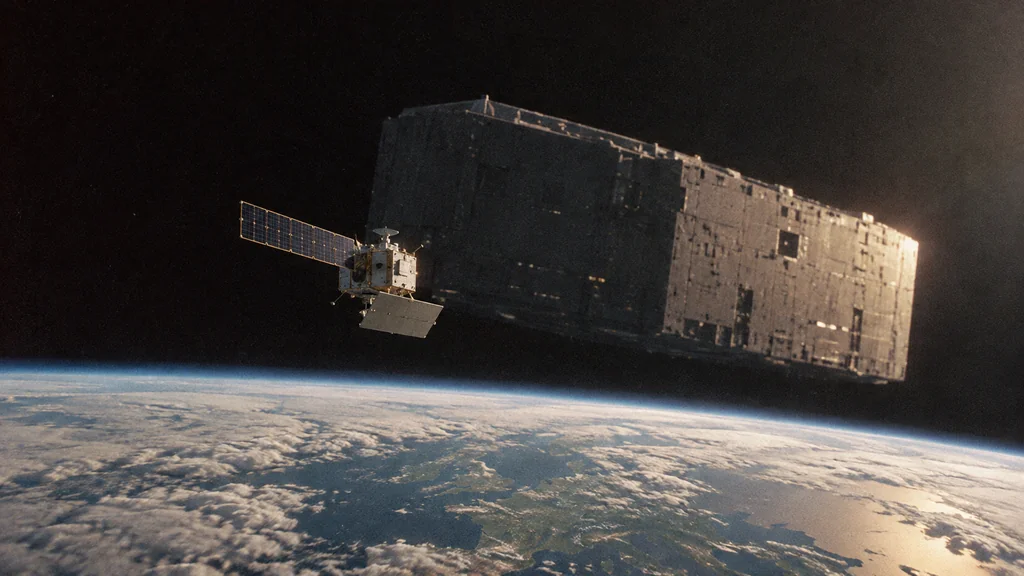
A Russian spacecraft approaches the imaging fleet European forces depend on.
Image composition · tobriefRussia's Kosmos 2612 spent mid-October matching orbits with ICEYE-X36, a commercial radar-imaging satellite, and closed to within roughly 500 metres of it, according to the tracking firm LeoLabs (TWZ). ICEYE, a Finnish-founded company, sells radar images to European armed forces. The public record shows Russia shadowed the satellite on purpose. It shows neither damage nor a reason for the manoeuvre.
The target, X36, has been in orbit since 4 March 2024 (UN registry filing). LeoLabs described a controlled approach, a spell of hovering ahead of and behind X36, then a controlled departure. Two satellites drifting past each other do not behave like that. Someone planned this rendezvous.
How close, and why, remains unclear
The 500-metre figure is an estimate. LeoLabs said the exact gap was hard to pin down because the Russian craft kept manoeuvring and the two were difficult to tell apart (Rzeczpospolita).
Headlines in Germany and France reported a pass of a few dozen metres. That figure was a prediction, not a confirmed event. A public forecast had projected a 26-metre approach on 19 October, and later screening never confirmed it took place (Orbital Radar).
Dutch orbital analyst Marco Langbroek puts the likeliest close pass early on 18 October, within a few hundred metres, and saw no shift in X36's orbit that would suggest a collision (Langbroek). No public report shows damage or an interruption to ICEYE's service.
Motive is harder still. Public tracking cannot reveal what Kosmos 2612 carries or what Moscow wanted. Inspection, intelligence gathering and signalling all fit what observers saw, and so would a rehearsal for interfering with satellites later.
Why Poland and Germany are watching
Poland has built its own satellite reconnaissance on ICEYE's technology. Its defence ministry said on 15 May 2026 that four satellites had been launched and its MikroSAR system handed to the armed forces (Polish defence ministry). Defence minister Władysław Kosiniak-Kamysz called the Russian manoeuvre purposeful and raised the possibility of spying or disruption (Polsat News).
Germany went the same way this autumn. Rheinmetall ICEYE Space Solutions, a joint venture with the German arms maker, announced on 6 October that the Bundeswehr can now request images from several dedicated radar satellites, partly to protect its brigade in Lithuania (Rheinmetall). For both governments, a Russian craft parked beside an ICEYE satellite signals that Moscow can reach the fleet their forces now depend on.
Ukraine uses ICEYE imagery too. Whether it uses X36 is unproven: a Ukrainian official confirmed his military works with the company but said it was unclear whether that particular satellite was involved (Axios).
What an EU response would take
Weeks before the approach, EU governments adopted a procedure for answering threats in space. Council Decision 2026/2195 dates from 28 September (EUR-Lex).
It works in three steps. A government that sees itself facing a space-based threat can ask for a proposal. The High Representative, the EU's foreign-policy chief, then puts forward options, from diplomatic protests to targeted sanctions. Governments decide unanimously, so any one of them can block a response.
The text leaves one question for governments to settle: whether a close approach with no proven harm counts as the kind of threat the procedure covers. Nothing in the public record shows that any government has asked for a proposal.
So far the protest has played out at the UN. At the General Assembly's disarmament committee on 21 October, a US representative accused Russia of manoeuvring dangerously close to the satellite, Finland backed Washington, and Russia called its activity peaceful (UN transcript).
The manoeuvre has drawn public protest but no publicly announced move to use the EU's new procedure. Any response through it would need every government to agree. Tracking cannot establish what Russia intended. It does show that Moscow can bring a satellite alongside the commercial fleet Polish and German forces now rely on for images, and Warsaw or Berlin would have to decide whether that alone justifies asking the EU to act.
Details about this article
- Model:
- claude-opus-5-5
- Generated:
- 10/26/2026, 1:34:03 AM
- Pipeline run:
- eu_pipeline_20261026_005007
- Watermark:
- SynthID (Google's invisible watermark)
- Human review:
- None before publication