Russian warship sails after Gulf explosion
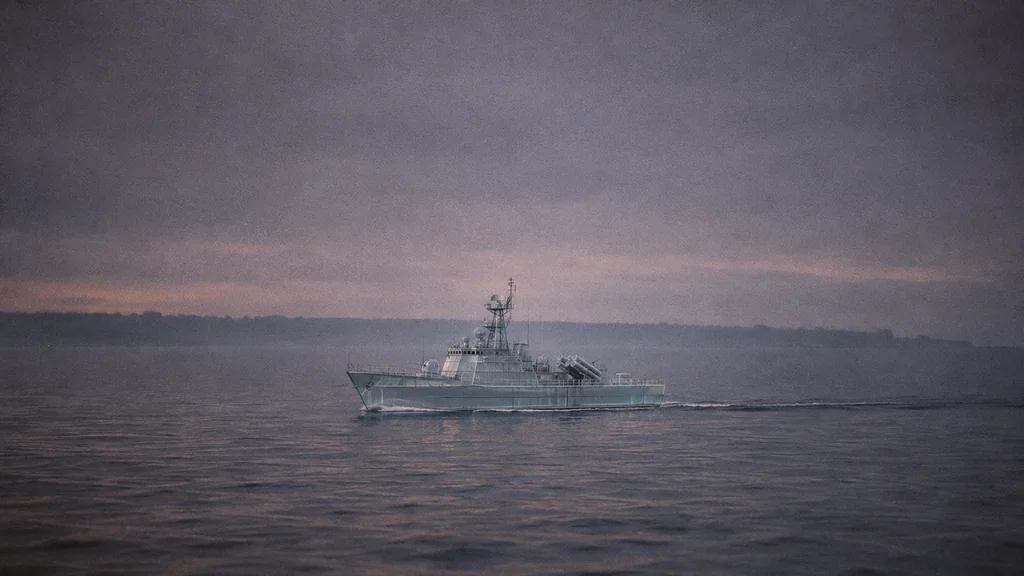
A warship leaves the gulf; the evidence of a hit remains unseen.
Image composition · tobriefFinnish military sensors recorded an explosion aboard a Russian warship in the eastern Gulf of Finland before dawn on 11 November (Yle). Ukraine says it hit the ship (SBU, Janes). No one has published evidence of the damage. Meanwhile Finland and Estonia, two NATO members on either side of the gulf, spent the night handling drones and stating that they had no part in the attack.
What the neighbours saw
The Finnish account comes from sensors, not from cameras on the deck. Brigadier-General Markku Viitasaari, speaking for the Finnish military, said they picked up flashes, smoke and then an explosion on the missile ship Naro-Fominsk (Yle).
He could not say whether the ship was anchored or moving, or what it was doing among several nearby tankers. After the blast it left under its own power. That proves it could still sail. It does not show how badly it was hurt.
Viitasaari reportedly placed the explosion in international waters, between the Finnish coast and a Russian-held island (Europa Press). If that is right, the blast happened outside Finland's own sea territory. The published reporting gives no coordinates, so outsiders cannot check the position.
Estonia watched from the southern shore and drew a more cautious conclusion. Defence Minister Martin Herem said an explosion struck a Russian Baltic Fleet vessel at about 05:30, smoke rose, and the ship headed toward St Petersburg (ERR). He also said Estonia's observation alone could not show whether a Ukrainian attack or an accident caused it.
Kyiv's version names the ship and little else. Ukraine's Security Service, the SBU, says it struck the Naro-Fominsk during a drone raid on Russia's Ust-Luga oil port (SBU). The defence publication Janes noted that the announcement gives no coordinates, weapon, casualty count or damage assessment. That makes it a claim of responsibility, and Janes does not independently confirm the hit (Janes).
The raid on the port is better documented. Russian regional authorities acknowledged a fire at Ust-Luga and three injured workers (Reuters).
Two NATO states in the flight path
The neighbours' real burden that night was the drones, not the ship. Each government used the powers it had. Finland controls its own air and sea traffic. It closed airspace over the eastern gulf at 02:09 and shipping at 02:15, then lifted both at 07:20 (Yle). Those restrictions responded to drone activity hours before the blast, not to the strike itself.
Estonia faced an actual intrusion. Some drones briefly crossed into its airspace over the gulf (ERR). NATO fighters then took off from Ämari air base on air policing duty, the standing mission in which allied jets identify and shadow unauthorised aircraft.
Tallinn stressed that Ukraine had neither asked for nor received permission to fly through Estonian skies. The distinction matters to Estonia. A NATO state that authorised strikes on Russia from its airspace would look like a participant, which is the label Tallinn wants to avoid. Foreign Minister Margus Tsahkna added that preliminary border guard data showed the swarm approaching the warship from Russian territory or airspace (Estonian Foreign Ministry). That shows the direction the drones came from, not where they were launched.
Helsinki drew the same line. Defence Minister Antti Häkkänen said Finland neither took part in the strike nor allowed its territory to be used. He also warned Kyiv that the corridor carries energy, freight and passenger traffic through an environmentally sensitive sea (Helsingin Sanomat). The message to an ally Finland supports was pointed: fight Russia, but not in waters that Finns depend on.
What Kyiv still has to show
The record supports three facts. Finland and Estonia both observed an explosion on a Russian warship. A Finnish general identified that ship as the one Ukraine named. The ship then sailed away under its own power. Those facts fit Ukraine's claim, but they do not prove it. Estonia's defence minister could not rule out an accident.
No photographs, damage reports or casualty figures have surfaced from any side. Moscow has said nothing about the ship that would settle the question. The burden of proof therefore sits with Kyiv, which claimed the hit and has not yet released the evidence to back it.
Details about this article
- Model:
- claude-opus-5-5
- Generated:
- 11/13/2026, 1:45:03 AM
- Pipeline run:
- eu_pipeline_20261113_005009
- Watermark:
- SynthID (Google's invisible watermark)
- Human review:
- None before publication