Highway Code proposal: fewer licence suspensions, cameras in driving tests
AI Daily Synthesis
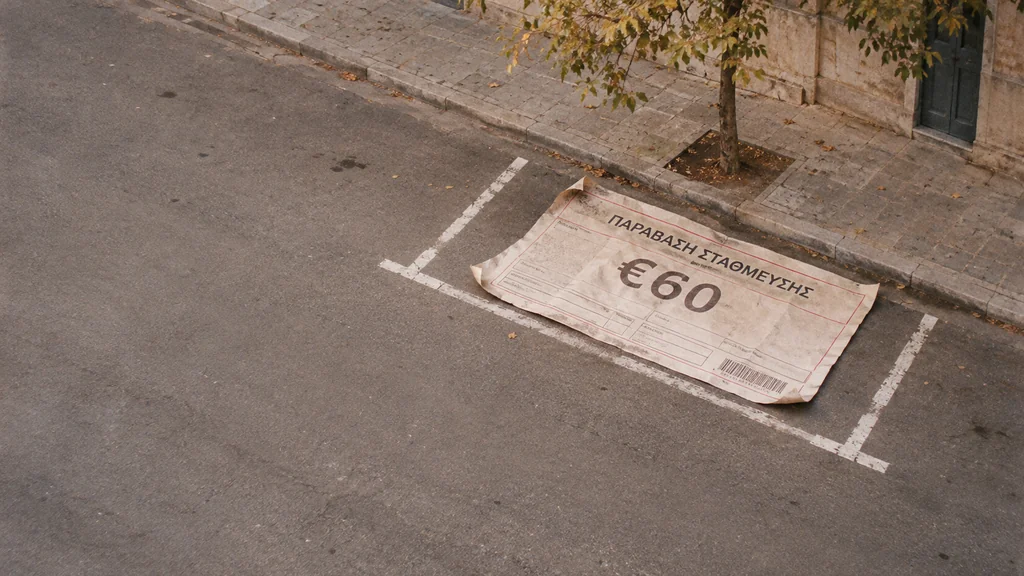
Image composition · tobriefGreece’s Ministry of Infrastructure and Transport opened a bill for public consultation on 21 November that would change the Road Traffic Code in areas affecting every driver: illegal parking, driving without the right licence category, powerful cars and practical driving tests (ERT, Capital). Deputy Minister Giorgos Kotsiras presented the draft. For ordinary parking offences, the fine would double from €30 to €60, but drivers would keep their licences (Ethnos). Comments are accepted until 7 December at 10:00 (Athens Voice).
This is not a new code. The changes to the current Road Traffic Code, Law 5209/2025, form Part B of a broader bill. Part A incorporates the EU directive on intelligent transport systems (Capital). That directive, 2023/2661, requires member states to make existing transport data available through national access points (EUR-Lex).
Parking and the wrong licence category
The parking change concerns signs P-39 (no parking) and P-40 (no stopping or parking). Today, a driver pays €30 and loses their licence for ten days. Under the draft, they would pay €60 and keep their licence, unless an additional sign says otherwise (Gazzetta, Ethnos). According to the same reports, strict penalties would remain for parking on disabled-access ramps, pavements, pedestrian crossings and bus lanes.
The second major change concerns drivers who lack the right licence category for their vehicle. Article 98 of the current Road Traffic Code penalises them with a one-year licence suspension, the removal of the vehicle’s registration documents and plates for 30 days, and a fine of €500 for two-wheelers, €700 for private cars and €1,000 for public-service passenger vehicles and buses (Article 98).
Article 30 of the draft, as quoted in news reports, offers a way to end the suspension early: after 30 days, the driver can apply to extend their licence to the category they lacked. If they pay the fine and pass the required tests, a theory test where applicable and a practical test, the one-year suspension ends automatically (Car and Motor, Kokkinos Law Firm). The “one month instead of one year” described in brief reports therefore applies only to drivers who complete that process (STAR). A month passing does not restore the licence by itself, and confirmation that an application has been filed does not give the driver the right to drive (Car and Motor).
Kotsiras says serious offences would still face strict penalties, while penalties for lower-risk offences would become more proportionate and effective (Athens Transport). Ethnos reports that, within a few months, thousands of licences were suspended for long periods over offences unrelated to crashes or antisocial behaviour, and that recorded speeding offences fell by 33.7%, from 303,024 to 200,764 (Ethnos). Documento describes the changes as a retreat from tougher penalties and quotes Minister Giorgos Floridis as saying that some provisions are considered excessive and will be adjusted without weakening the protection of human life (Documento).
Powerful cars and cameras in driving tests
The draft also introduces a stricter rule. Article 32, as quoted in news reports, would allow only drivers aged at least 22 who have held the relevant licence category for at least three years to drive a passenger car with power above 250 kW, roughly 340 horsepower. Violators would face a €2,000 fine and an immediate 60-day licence suspension (Newsauto, Dedomeno). The test is the car’s power, rather than whether it is called a “supercar”, so electric cars and SUVs could also fall under the rule (Newsauto). Today, Article 105 requires new drivers only to display a special sign on their car for the first year, with no power limit (Road Traffic Code).
The draft would make recording mandatory in practical car driving tests: the examiner would have a tablet, and a portable 360° camera would cover the pedals and the instructor’s seat. The examiner, vehicle and Training and Examination Record would be identified by QR code, while an artificial intelligence system would check that the cameras were correctly positioned and working (ERT, Dnews). This gives concrete form to the ministry’s October announcement of cameras in driving tests, random selection of examiners and a right to appeal. Kotsiras called the proposed process “tamper-proof” (Dimokratiki Rodou).
The draft also creates a separate offence for buses carrying more passengers than their registration permits. It would also allow roadside assistance vehicles to use the emergency lane when responding to an incident (FinanceNews, Dnews).
The draft’s approach is clear in its numbers: drivers who would keep their licences would pay more; those who would get them back sooner would first have to pay and pass driving tests again.
Details about this article
- Model:
- claude-opus-5-5
- Generated:
- 11/23/2026, 4:18:41 AM
- Pipeline run:
- incremental_20261123_033011
- Watermark:
- SynthID (Google's invisible watermark)
- Human review:
- None before publication