Serbia’s students lead, Russia policy holds
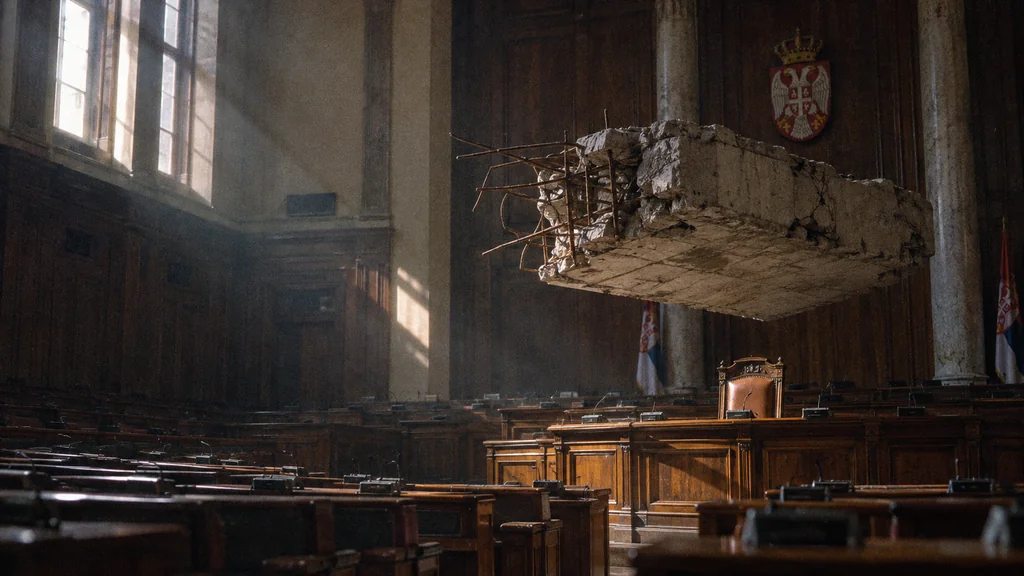
A new majority inherits the questions left beneath Novi Sad’s canopy.
Image composition · tobriefAleksandar Vučić conceded on election night, projecting 135 to 140 seats for the student-backed list and about 105 for his own bloc (Reuters, Anadolu Agency). The official result is not final, and no cabinet has been voted in. Even if the students take power, they have said they would keep Serbia's refusal to sanction Russia.
Vučić gave up the presidency in September to run for prime minister (To Brief). Instead, his own numbers hand parliament to a movement that grew out of anger over the canopy collapse at Novi Sad station on 1 November 2024, which killed 16 people (European Commission).
How solid the lead looks
Two independent counts agree. CRTA, a Serbian election-monitoring group, ran a parallel vote tabulation. That method projects the national result from official tallies at a random sample of polling stations. It put the student list on 51.47% against 40.42% for Vučić's list (CRTA). The pollsters CeSID and Ipsos estimated about 52% against 39.3% (Anadolu Agency).
The vote itself still faces questions. While polls were open, CRTA's observers reported pressure on voters, polling-station staff or observers at 29% of the stations they sampled (N1). Monitors from ODIHR, the election-watching office of the OSCE, were due to give their preliminary verdict at 15:00 Belgrade time on 26 October (ODIHR).
From a projection to a prime minister
A governing majority needs 126 of 250 deputies (Serbian constitution). Three steps stand between the projection and that majority in office. First, the election commission has to confirm the final result.
Second, someone has to nominate a prime minister. With the presidency vacant, the constitution hands the head of state's duties to the speaker of parliament, and that person consults the parties and proposes a candidate. Nothing in the constitution forces that choice to come from the largest list. Third, the nominee and cabinet need the votes of a majority of all deputies. If no government is elected within 90 days of the new parliament's first sitting, Serbia goes back to the polls (Serbian constitution).
The student list's top candidate is Ilija Srdanović (CRTA). Its mandate, as the movement's origins suggest, is about accountability at home: who signed off on the contracts and inspections that failed at Novi Sad.
A new majority, the same line on Russia
On 30 September, the student list said it would keep Serbia's opposition to sanctions on Russia (N1). That puts it on the same side of the issue as Vučić. The Commission's latest annual assessment of Serbia had already named that refusal as a problem (EUR-Lex).
The stance matters because of how membership talks work. Candidates are expected to bring their foreign policy, sanctions included, into line with the EU's. Each new stage of the talks needs every EU government to agree, so any one of them can hold Serbia back if Belgrade keeps saying no on Russia.
The students' mandate fits the other half of what EU capitals ask for. On 22 October, three days before the vote, German Chancellor Friedrich Merz called rule-of-law reform indispensable for countries hoping to join (German government). He was speaking about enlargement in general, not this election. Still, independent courts and honest public contracts are exactly what the student movement campaigned for.
Independent estimates and Vučić's own projection point to a student-backed majority. The official result and a cabinet vote are still outstanding, and the observers' report is due later today. On the record so far, the movement has won a mandate to repair Serbia's institutions, not to change its position on Russia. Whoever the acting head of state nominates will have to say before the cabinet vote whether that position stays. That answer will decide whether a change of government in Belgrade also moves Serbia's talks with the EU.
Details about this article
- Model:
- claude-opus-5-5
- Generated:
- 10/26/2026, 1:33:23 AM
- Pipeline run:
- eu_pipeline_20261026_005007
- Watermark:
- SynthID (Google's invisible watermark)
- Human review:
- None before publication