Six countries build a €2tn veto wall
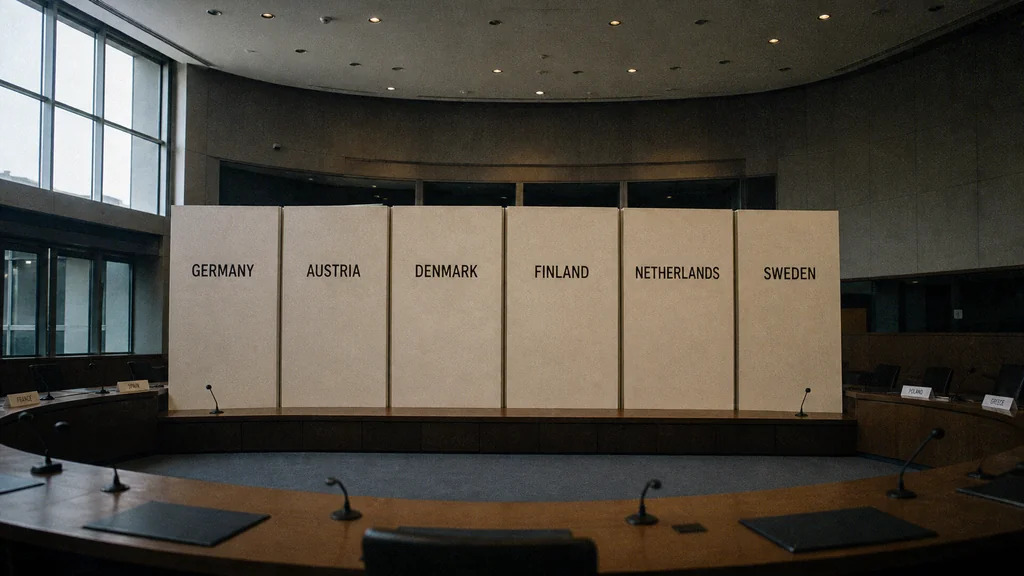
Six governments turn a minority position into Europe’s budget barricade.
Image composition · tobriefGermany, Austria, Denmark, Finland, the Netherlands and Sweden told the European Commission on 27 August to slash "several hundred billion euros" from its proposed €2 trillion seven-year budget (Bundeskanzleramt). Six out of twenty-seven governments would normally be a comfortable minority. But the EU's budget rules require unanimity in the Council (where national governments sit), so six coordinated refusals are not a losing vote. They are a veto wall (EUR-Lex).
The Commission proposed setting the 2028–2034 spending ceiling, known as the Multiannual Financial Framework (the MFF, the EU's binding seven-year budget cap), at 1.26% of EU gross national income (European Commission). That figure is meant to cover a five-fold increase in defence spending, repayment of pandemic-era borrowing, a new competitiveness fund, farm support and cohesion money (EU funding for poorer regions and infrastructure) (ECFR). The six net contributors say the price is too high. As To Brief reported last month, this fight shapes regional development, farm income and the power balance between countries that pay more into the EU and those that depend on its spending.
Why the timing matters
European Council president António Costa began visiting EU capitals on 25 August, trying to map each government's red lines before drafting a negotiating framework in October: the compromise document that starts turning positions into actual numbers (Euronews). The joint statement dropped before Costa could build momentum toward the Commission's figure. It moved the starting point.
Costa warned in Vilnius that leaders must agree by year-end to avoid funding gaps for farmers, businesses and students when the current budget expires (Yeni Şafak). If they miss that deadline, current spending ceilings roll over automatically. No cliff edge, but no new defence or competitiveness money either (European Parliament).
Everyone's "cut" exempts something different
The six agree on a lower total. Beyond that, their protected interests collide. Austria's chancellor Christian Stocker says net contributors are "not the EU's ATM," but wants Austria's annual rebate and farm support shielded from cuts (Bundeskanzleramt Österreich). Sweden insists regular spending stay around 1% of GNI and defends rebates worth SEK 8–11 billion a year (Riksdagen). Finland wants a lower ceiling but accepts higher defence spending and supports some new EU-level taxes (Valtioneuvosto). The Netherlands wants sharper spending choices, but Dutch coalition politics make open farm-budget cuts risky (NOS).
"Cut several hundred billion" is the easy sentence. The hard sentence names what gets cut. Nobody in the coalition has written it yet.
What the cuts would hit
The trade is direct. The six want a lower bill. Countries that rely on EU funds want defence, cohesion, and farm spending protected. Romania, for example, has €31.5 billion in approved cohesion support directed at transport, green transition and social inclusion (European Commission). These are motorways, water systems and regional jobs. Romania and Spain have aligned with a "Friends of Cohesion" bloc to defend those flows (G4Media, El País).
The Commission tried to sidestep this collision by proposing new EU-level taxes, from carbon border levies to corporate contributions, that it says would raise €58.5 billion per year and fund new priorities without raising national contributions (European Commission). But these taxes are not money the Commission can simply collect. Each one requires its own unanimity vote in the Council plus ratification by every national parliament, giving capitals and legislators a second arena to block (European Parliament). Several of the six are already sceptical: the Netherlands opposes the corporate levy; Austria accepts new revenues only if they do not increase its burden (Officiele Bekendmakingen, Parlament Österreich).
Unanimity gives the six leverage, but it also forces them to expose their own contradictions. By October, Costa's framework will require them to prove something harder than blocking: that "several hundred billion" means an actual cut list, not just a cheaper headline.
Details about this article
- Model:
- claude-opus-4-6
- Generated:
- 8/28/2026, 1:59:03 AM
- Pipeline run:
- eu_pipeline_20260828_005006
- Watermark:
- SynthID (Google's invisible watermark)
- Human review:
- None before publication