Sklavenitis raises base pay to €1,100
AI Daily Synthesis
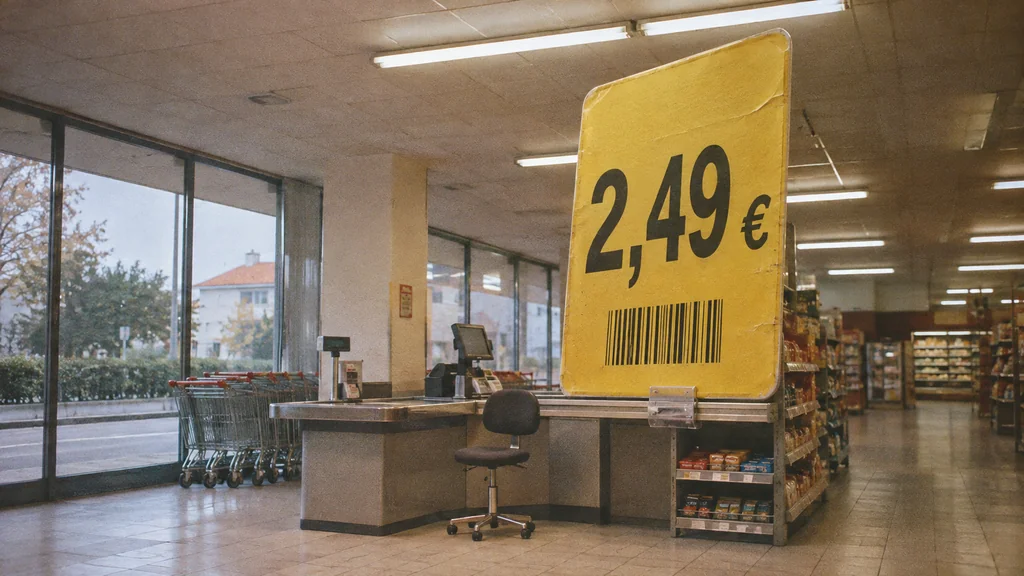
Image composition · tobriefThe base salary at Greek supermarket chain Sklavenitis is rising from €1,000 to €1,100 gross a month, an increase of 10%. The increase is set out in a new company-wide collective agreement announced by the workers’ union on 20 November. The agreement between the union and the employer sets working conditions at the company and applies to all its employees, whether they belong to the union or not (Money Review, Hellenic Parliament). The average increase for staff is much smaller: 4.37% for 99% of employees, effective from 1 November (Euro2day, Insider). Only those paid the old base salary receive the full €100.
Why the €100 does not go to everyone
The base salary is the minimum paid by the company. It is not an amount added to every pay packet. Consider two employees. A cashier paid exactly the old base salary of €1,000 sees her gross pay rise by €100 because the minimum itself has gone up. Her colleague, already earning €1,300, is above the new minimum, so the change to the base salary does not affect him.
For the second employee, the tiered increases matter. Under the reported terms, employees earning up to €1,400 receive 4%, while those earning from €1,400 to €2,100 receive 3%, provided they do not receive an increase under another provision of the agreement (Money Review). If that scale applies, 4% of a €1,300 salary is about €52 gross. The simplest explanation for the lower average, then, is that the largest increases go to employees at the bottom of the pay scale.
Both sides give the 4.37% average: sources close to the company cite it, as does the union. The union also reports an average increase of 4.85% for store employees and increases of “up to 8%” for those paid close to the old base salary, without explaining how it calculates that figure (Financial Report, EFSYN). Neither the company nor the union has published payroll data or its calculation method, so none of these averages can be checked independently.
How many people does the agreement cover? The union says 36,800 employees. Company sources put the total at 37,340, with 99% of them receiving an increase. Neither side has explained the small discrepancy (Mononews, Euro2day). Greece’s statutory minimum wage for full-time work has been €920 gross since 1 April 2026 (Ministry of Labour). Sklavenitis’s new base salary is therefore €180 above it, almost 20% higher. Because these figures are gross, the difference in take-home pay will be smaller.
Set against prices, the two increases tell different stories. In October, prices were 5.7% higher than in October 2025, according to the Hellenic Statistical Authority (ELSTAT) (ELSTAT), as we wrote when the figures came out. The 10% rise in the base salary clearly exceeds inflation. The average increase of 4.37% falls below it, although the comparison is not exact: the pay rise takes effect in November, while the price index compares October with October of the previous year.
On 13 November, before the agreement, the union had published its demands. They included an entry-level salary of €1,100, which was adopted in full. Three other demands, a 10% increase for everyone, a 35-hour week and fixed shifts, do not appear in the published terms (Aftodioikisi). Management has made no statement on the record; its account has circulated only through anonymous sources.
Allowances and length of service
The agreement also introduces new monthly allowances. The family allowance ranges from €60 for a married employee without children to €140 for those with three or more children. It covers children up to age 19, or 25 if they are studying. The length-of-service allowance starts at €100 after 20 years with the company and reaches €250 after 35 years (Powergame). There is also a one-off payment of €200 in food vouchers for each child who takes up a place at an educational institution in another city (Hania News).
Some questions will be answered only when the signed agreement is made public: whether the allowances can be combined, how they apply to part-time work and how long the agreement will last. The overall picture is already clear. The union asked for 10% for everyone and an entry-level salary of €1,100, and secured the latter. That is why only employees at the bottom of the pay scale see a 10% increase, while the average employee’s increase is close to 4.4%.
Details about this article
- Model:
- claude-opus-5-5
- Generated:
- 11/21/2026, 4:20:39 AM
- Pipeline run:
- incremental_20261121_033011
- Watermark:
- SynthID (Google's invisible watermark)
- Human review:
- None before publication