SpaceX catches Ship 42, loses booster
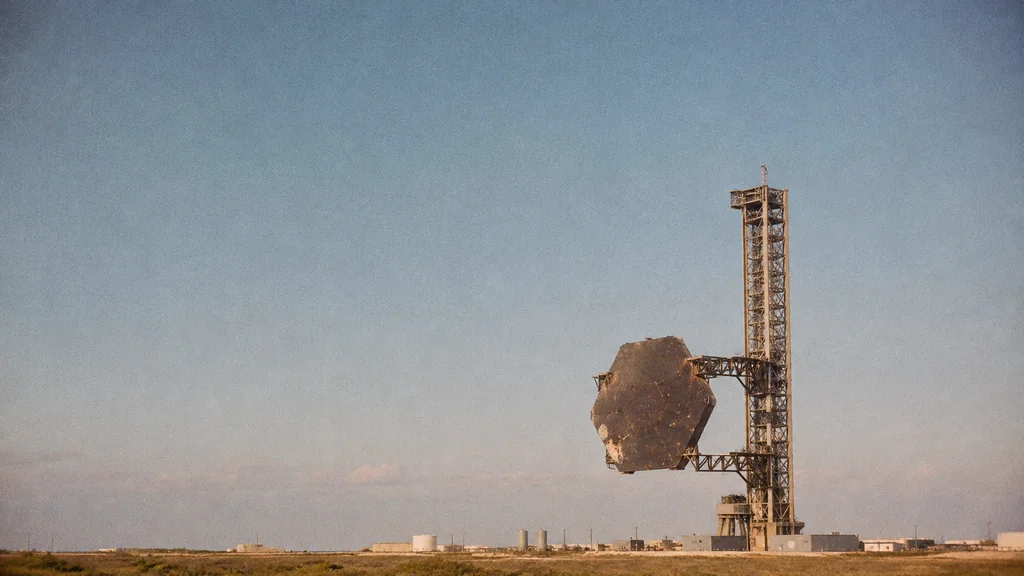
An orbital catch puts Starship’s flown heat shield within engineers’ reach.
Image composition · tobriefSpaceX caught Ship 42, the upper stage of its Starship rocket, at Starbase, Texas, on Saturday after 14 orbits and roughly 22½ hours in flight (Space.com). SpaceX's footage and reporters following the flight show the ship settling into the two mechanical arms of the tower that launched it (SpaceX, Ars Technica). Because the ship had already delivered satellites to orbit, engineers now have hardware that did a real job in space and is back on the ground where they can study it. The rocket's lower stage, meant to be caught first, was lost at sea.
Why the top half is harder to catch
The name causes confusion. "Starship" means both the whole two-stage rocket and the spacecraft riding on top.
SpaceX had caught its Super Heavy boosters with the tower before. A booster, though, drops away within minutes and never circles the planet. The upper stage has to come all the way down from orbit and still arrive at one exact spot.
Two things make that return hard. The ship is moving much faster, so reentry heats it far more. And while it circles, the Earth keeps turning, carrying the tower away from where the ship started. That is why Saturday marked the first time SpaceX caught this stage (Space.com).
What the ship did before coming home
Flight 15 lifted off on Friday. After separating from its booster, the ship reached low Earth orbit and, according to SpaceX, released all 26 Starlink satellites it carried (SpaceX).
Three of those satellites carried cameras meant to photograph the ship's heat shield, the tiled underside that protects it during reentry. SpaceX's flight plan said the images were intended to help controllers assess whether the ship was fit to return (SpaceX flight plan).
Orbit alone was not new. Flight 14 in September also reached orbit and released 26 Starlink satellites, but that ship splashed down in the Pacific and was never recovered (SpacePolicyOnline, CNN). Ship 42 did the same job and came back, as we reported when it happened (To Brief).
The return itself happens in stages. First, a short engine firing called the deorbit burn trims just enough speed for the ship's path to dip into the atmosphere. From there the air does most of the braking, and that braking turns speed into heat, which is what the tiled shield is for.
Next comes the steering. The ship falls belly-first, adjusting movable flaps the way a skydiver uses arms and legs. Near the ground it relights its engines, swings upright and slows enough for the tower's arms to close around it (Scientific American).
The booster that ran short
SpaceX had aimed for both stages. Booster 22 was supposed to reverse course and land in the tower about six and a half minutes after liftoff (Spaceflight Now).
On the webcast, SpaceX commentators said the booster's return burn ended early after a low-fuel alarm. Its guidance system then steered it offshore rather than risk the tower (CNN).
Elon Musk later said the booster was slightly low on fuel and its engines had slightly underperformed. He also warned that first conclusions are often partly wrong, and that a full review of telemetry, the data the rocket records and radios down during flight, was needed (Musk on X). Until that review appears, his account stays a first reading.
The ship catch is what changes the work on the ground. Engineers no longer have to infer the state of an orbital Starship from camera views taken in space. They can walk up to the tiles, engines, flaps and structure and examine them directly.
SpaceX has now shown that a Starship upper stage can deliver satellites to orbit and return to the tower that launched it. Reuse remains unproved until Ship 42, the recovered ship itself, flies again.
Details about this article
- Model:
- claude-opus-5-5
- Generated:
- 11/16/2026, 1:52:01 AM
- Pipeline run:
- eu_pipeline_20261116_005008
- Watermark:
- SynthID (Google's invisible watermark)
- Human review:
- None before publication