Spain’s lobby vote puts €260m at risk
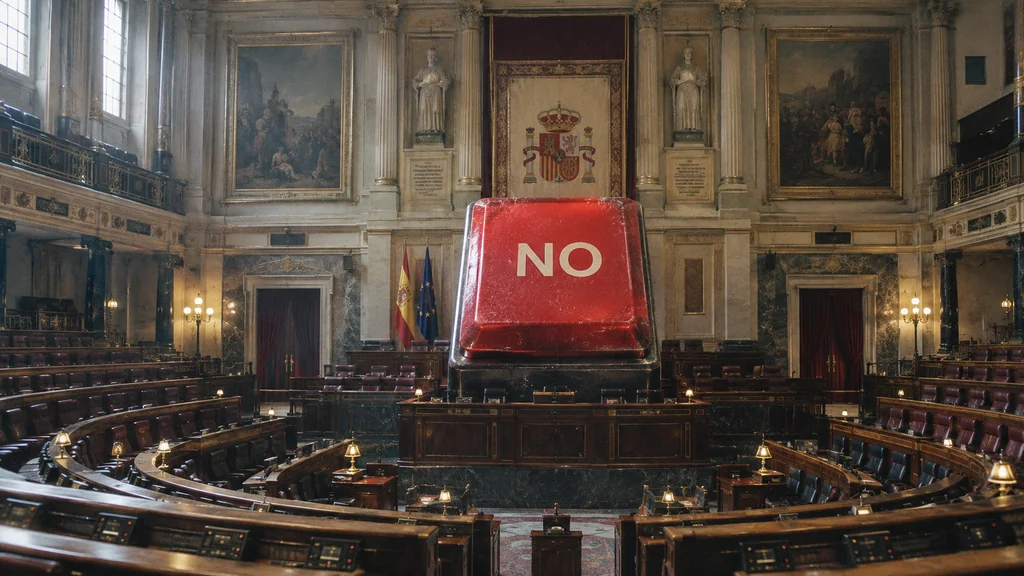
A parliamentary no puts €260 million beyond Madrid’s immediate reach.
Image composition · tobriefSpain's parliament voted down the government's lobby-transparency law on 16 September, leaving an EU recovery-plan milestone unfulfilled and a reported €260 million in European transfers in jeopardy. The 179–155 defeat strips away a reform that Madrid had promised Brussels in exchange for money from the Recovery and Resilience Facility (the EU's post-pandemic performance fund, which pays countries after they prove they delivered agreed reforms). It also exposes a democratic tension baked into the system: the executive commits to a reform, the parliament refuses to pass it, and the bill lands on European taxpayers.
The rejected measure, Real Decreto-ley 21/2026, would have created Spain's first comprehensive mandatory register for interest groups seeking to influence government decisions (La Vanguardia, The Objective). The register had already gone live on 4 September, with more than 250 entities enrolled. Congress erased it twelve days later.
Why Congress said no
The opposition's objections were procedural and substantive, not simply anti-transparency. PP, Vox, Junts and UPN argued that a law reshaping democratic participation should go through ordinary legislation with amendments, not arrive as an emergency decree demanding an up-or-down vote (20minutos). They also objected to classifying trade unions and employers' federations as ordinary interest groups. That was not a technicality: Spain's constitution gives social partners a formal role in collective bargaining and social dialogue that differs from a corporate lobby seeking access.
The government itself conceded the point. Digital Transformation Minister Óscar López promised a revised measure by October excluding unions and employers, an acknowledgment that the decree's scope could not survive unchanged (La Vanguardia). Prime Minister Pedro Sánchez framed the vote as PP and Vox hiding their lobbyist connections. That was a political claim, not proof of motive. The record supports a narrower reading: Congress rejected this instrument, this route and this definition of who counts as a lobbyist. Whether all 179 opponents would block a better-drafted ordinary bill remains untested.
The €260 million question
Earlier government estimates had warned of €800 million to €1.5 billion at risk. The reported €260 million is smaller because the Commission credited other completed reforms grouped under the same payment instalment, isolating the lobbying failure rather than cancelling the whole tranche (20minutos). When we last covered Spain's recovery trajectory, the Commission had just released €6.234 billion tied to housing, healthcare and transport milestones (To Brief), bringing total receipts to roughly €78 billion. The lobbying setback lands as Madrid prepares its final request of approximately €25.9 billion tied to 148 milestones (La Voz de Galicia).
Whether the €260 million is already a definitive loss remains unclear. Under the RRF regulation's Article 24, the Commission can suspend payment for unfulfilled milestones and give the country six months to fix the problem. Only after that correction window closes does a suspension become a permanent reduction. No Commission implementing decision confirming the €260 million figure has surfaced publicly.
What other countries reveal
The EU's track record shows that suspended money is not automatically lost. Bulgaria had €214.5 million withheld over an unfulfilled anti-corruption milestone; after a plan revision and corrective action, the Commission cancelled the suspension (Commission assessment of Bulgaria's fourth payment request). Portugal saw roughly €714 million temporarily frozen over professional-services and healthcare reforms, then recovered part of it after submitting new evidence (ECO). Romania tells the cautionary tale: approximately €458.7 million became a definitive reduction after corrective measures failed (Agerpres).
Spain can still legislate a lobbying law through ordinary parliamentary procedure. But the RRF's completion deadline expired on 31 August, and final payment requests must land by the end of September. Passing a law after the deadline does not automatically satisfy a milestone that was due earlier. The Dutch government told its parliament as much: domestic political difficulty is not an objective circumstance that justifies rewriting a commitment (Dutch Parliament).
The deeper pattern
The vote illustrates a structural tension the EU's recovery system created across the continent. National governments draft reform commitments and negotiate their financial weight with the Commission. Parliaments are then asked to deliver the promised legislation, sometimes under emergency procedure, with the threat that refusal costs EU money. Parliament's constitutional power to say no remains intact. The fiscal consequence of saying no does not.
The European Court of Auditors has warned that milestone verification may confirm a deliverable without proving the reform achieved its intended result (ECA Special Report 26/2023). Spain's case adds a different concern: not whether a reform worked, but whether the Commission's method for pricing a failed one is transparent enough to be publicly scrutinised. The €260 million figure emerged from a methodology the Commission published in 2023 that uses adjustment factors for importance, ambition and partial fulfilment. It is flexible enough to avoid punishing an entire instalment for one failure. It is also opaque enough that no outsider can independently reproduce the calculation. That gap between enforcement and legibility is the question the Commission still owes an answer to, not just for Spain but for every member state approaching the programme's close.
Details about this article
- Model:
- claude-opus-4-6
- Generated:
- 9/17/2026, 2:41:51 AM
- Pipeline run:
- eu_pipeline_20260917_005006
- Watermark:
- SynthID (Google's invisible watermark)
- Human review:
- None before publication