STAR collisions challenge quark-only proton models
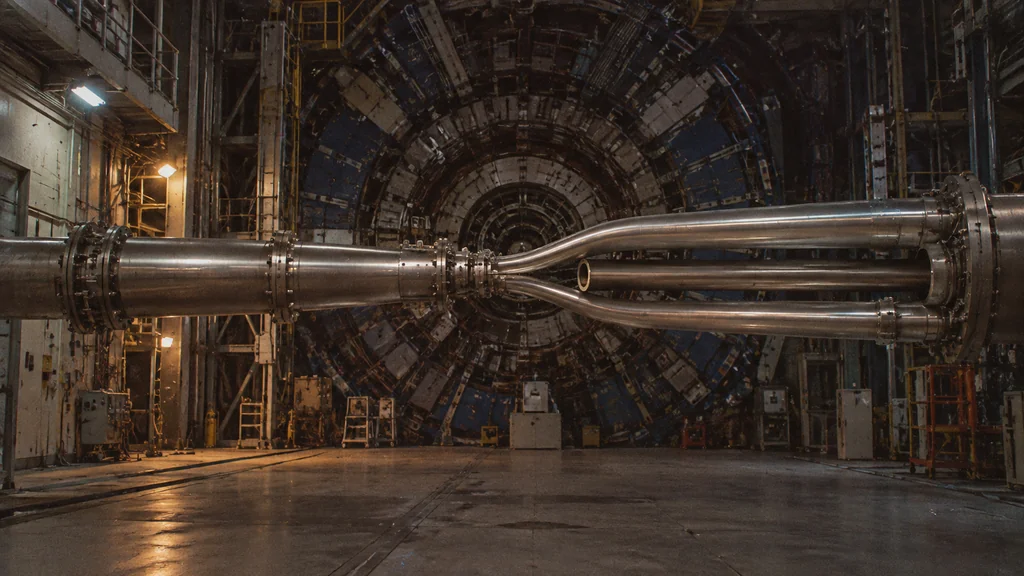
At STAR, a proton’s identity travels farther than its charge predicts.
Image composition · tobriefWhen two atomic nuclei collide hard enough, the quarks inside their protons scatter. The physical property that marks a particle as a proton or neutron, called baryon number, can never be lost, so it has to go somewhere. In two tests published in Science on 13 August 2026, the STAR Collaboration at a US collider found that it does not travel the way models tying it to the incoming quarks predict (Science). On 6 October, Nature called the work the strongest experimental evidence yet that baryon number can travel with a structure in the gluon field instead (Nature).
A ledger that always balances
Think of baryon number as a ledger that must balance after every transaction, however violent. A proton or neutron counts +1, an antiproton −1, and each quark one third, so a proton's three core quarks add up to exactly one (Science). With bookkeeping that tidy, the quarks look like the obvious owners of the tag.
Quarks are held together by gluons, the particles that carry the strong force, much as elastic cords might hold three marbles together. The gluon field linking a proton's three quarks can be pictured as three strands meeting at a single point, like the letter Y (Brookhaven).
Some theorists argue that baryon number belongs to that meeting point, called a junction, rather than to the quarks at its ends. If they are right, a collision could send the tag one way and the original quarks another.
Using charge as a tracer
Telling the two pictures apart is hard, because the junction's arms always end on quarks. STAR is a large collaboration that includes several European universities (PubMed). It used electric charge as a marker, since quarks carry charge and gluons carry none.
The team compared collisions of two nuclei that are near twins. Ruthenium-96 and zirconium-96 each contain 96 nucleons (protons plus neutrons) in total, but ruthenium has 44 protons to zirconium's 40. STAR recorded about two billion collisions of each in 2018 (STAR). The baryon count going in is identical and only the charge differs, so any mismatch between where baryons and charge end up should show.
STAR then measured two differences between the collision types: the change in baryon number reaching the centre of the collision, and the change in charge arriving there. It scaled the comparison so that if baryon number moved only with the incoming quarks, the answer would be exactly 1. In the most head-on collisions, STAR measured 1.84 (STAR paper). The largest uncertainty on that figure comes from neutrons, which the detector cannot see, so the team had to estimate them. Even so, far more baryon number reached the centre than the charge could account for.
A second crash points the same way
The second test used gold nuclei and a gentler kind of crash. STAR picked out events in which a particle of light from one nucleus struck the other, then measured how the surplus of protons over antiprotons was spread along the beam line. The standard event simulations predicted a steeper pattern, pushed further in the direction of travel. The measured spread matched the range expected if junctions carry baryon number (STAR paper). That sample allowed only the shape of the distribution, not the absolute number of protons, to be compared with theory.
Outside physicists urge care. Chun Shen told Science News the results favour junctions but are not yet a "smoking gun", and Zi-Wei Lin noted that the junction is itself a connection involving quarks, so "gluons instead of quarks" overstates it (Science News).
A sharper test could come from the planned Electron–Ion Collider. A peer-reviewed proposal from 2024 outlined comparing how baryon number and charge travel, using ruthenium and zirconium targets there (EPJ C).
The junction is inferred from collision debris, and nobody has observed it directly. What STAR did observe is that both tests depart from the models in which baryon number travels only with the incoming quarks. Any account of how a proton keeps its identity in a collision now has to explain that.
Details about this article
- Model:
- claude-opus-5-5
- Generated:
- 10/7/2026, 1:43:20 AM
- Pipeline run:
- eu_pipeline_20261007_005007
- Watermark:
- SynthID (Google's invisible watermark)
- Human review:
- None before publication