Starship reaches orbit with an engine down
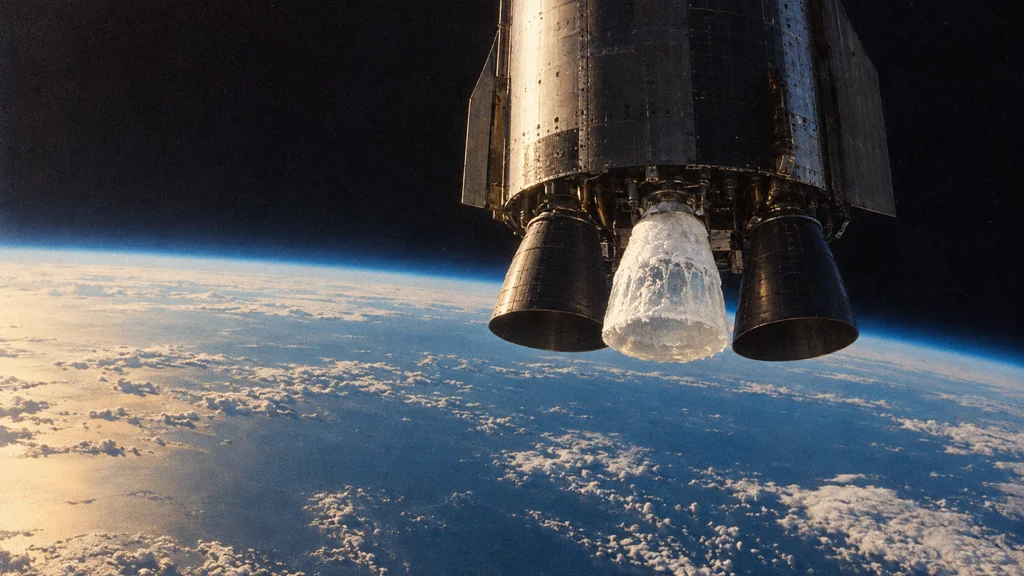
Starship reaches orbit with one engine down; longer flights still lie ahead.
Image composition · tobriefSpaceX's Starship reached Earth orbit for the first time on 28 September and released 26 Starlink satellites, even though one of its engines shut down early on the way up (CNN, SpacePolicyOnline). Controllers chose to press on, then ended the flight hours early. Orbit is the step every future job for this ship depends on, from launching satellites to refuelling a lander bound for the Moon.
Why "orbit" is the word that matters
Reaching space and staying there are separate achievements. Throw a ball upward hard enough and it clears the fence, but it still falls back. A spacecraft stays up by moving sideways so fast that, as it falls, the Earth's surface curves away beneath it just as quickly. It is still falling, only around the planet instead of into it.
Starship's upper stage had never managed that before. Its earlier test flights ended on arcs that brought it back down, and this flight's plan added one more engine firing in space to finish the climb into orbit (SpacePolicyOnline). Think of it as the last push that turns a very high throw into a lap of the planet.
The call that kept the flight going
That final push had to come from the ship's own engines, which is why what happened on the way up mattered. Starship carries three vacuum-optimised Raptor engines, versions built to work in the near-empty air of space, and one of them shut down early during the climb (Aerospace America). We reported the shutdown on launch day (To Brief).
At first, the webcast host said the team would not commit to going for orbit. Controllers then assessed the remaining engines and authorised the orbital burn roughly 25 minutes after launch (Reuters). It resembles a pilot who loses an engine, checks the others, and decides the aircraft can still reach its destination.
The ship released all 26 satellites, fired an engine to leave orbit and splashed down in the northern Pacific about 3 hours 9 minutes after launch, against a plan of almost ten hours and six orbits (NPR). SpaceX said it limited the time in orbit "out of an abundance of caution" and has not disclosed why the engine quit (Aerospace America). Neither stage was meant to be recovered, so the ocean splashdowns were part of the plan rather than failed catches.
The satellites deserve the same careful reading. SpaceX said it made contact with each one, and Elon Musk separately called them "operating nominally," meaning working as expected (SpaceX, Musk on X). Those are company statements about deployment and early health. Before carrying customer internet traffic, the satellites are expected to go through checks and raise their orbits (XenoSpectrum). The reporting available for this article found no confirmation that they have entered service.
The Moon runs through refuelling
NASA's interest in all this is real, if indirect. The agency chose a lander based on Starship for its return to the Moon, and a vehicle that big spends much of its propellant just getting to orbit. To go further, it has to be topped up in space, the way military jets meet a tanker to refuel mid-air on long missions.
The scale of that topping-up is large. In a March 2026 report, NASA's inspector general described a plan needing more than ten tanker launches to fill an orbiting fuel depot before a lander departs (NASA OIG). Flight 14 docked with nothing and moved no propellant between ships. It showed the first link in that chain, since every tanker has to reach orbit before it can deliver anything, and it showed that link holding even with an engine down.
The refuelling plan depends on ships that stay in orbit for hours or longer, meet each other and hand over fuel, and this flight's shortened timeline stopped short of that. Starship delivered satellites to orbit after an engine shutdown; this shortened flight did not demonstrate sustained orbital operation.
Details about this article
- Model:
- claude-opus-5-5
- Generated:
- 9/30/2026, 1:50:52 AM
- Pipeline run:
- eu_pipeline_20260930_005007
- Watermark:
- SynthID (Google's invisible watermark)
- Human review:
- None before publication