Starship returns; its booster does not
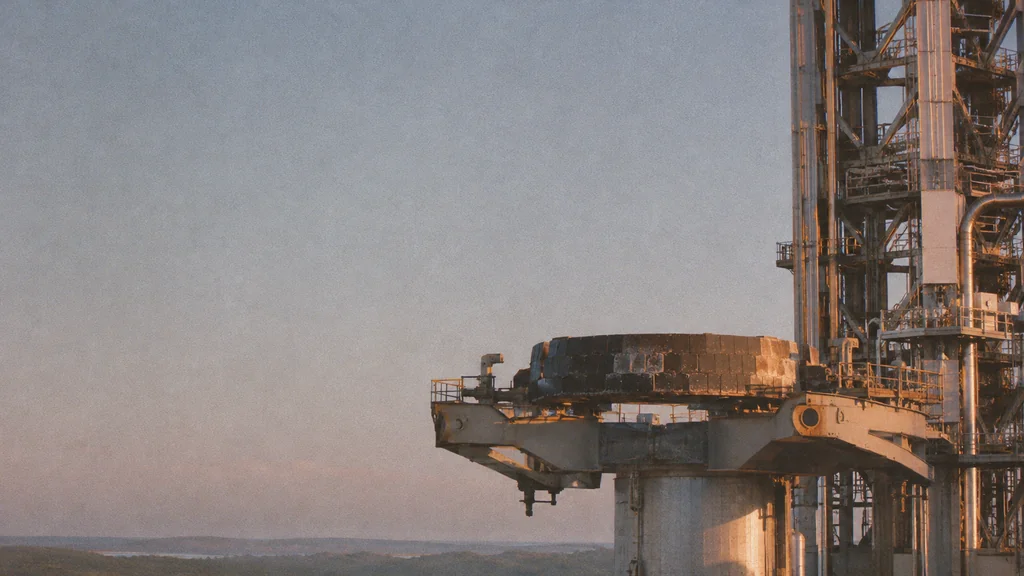
A return to the tower leaves the harder question in engineers’ hands.
Image composition · tobriefOn 14 November, a Starship upper stage lowered itself between two giant mechanical arms at SpaceX's Starbase launch tower in Texas, roughly 22½ hours after liftoff, and stayed there (Space.com). SpaceX had never before tried to catch the ship this way (SpaceX). The rocket's booster was lost on the same flight. Still, engineers now hold a spacecraft that went to orbit, did a job there and came back whole, ready to be examined.
Watching it is a little like seeing a skyscraper reverse into a parking space. The ship fell back through the atmosphere, then fired its engines to slow its final approach to the tower. According to SpaceX's published plan, the arms were designed to close onto two fittings beneath the ship's forward flaps, taking its weight the way a pair of hands catches someone under the arms (SpaceX).
A day of circling, by choice
The flight began on 13 November. Ship 42 reached orbit and released 26 Starlink satellites, three of which carried cameras to photograph its heat shield, and Space.com's account says those pictures helped controllers judge whether the ship was fit to come home (Space.com). The heat shield is the tiled skin on the ship's belly that takes the brunt of the scorching air during the fall home.
The trick is a clever one. A spacecraft cannot see its own underside, so this one set loose a few small satellites to look back at it, like asking a friend to check the back of your coat. SpaceX judged from those images that the shield looked healthy. That was an assessment made in flight, from a distance, rather than a hands-on inspection.
Controllers then passed on an earlier chance to bring the ship back and let it keep circling Earth. Picture a driver on a ring road who lets the first exit go by. Being near the exit is never enough on its own, because you still have to turn the wheel.
That turn came as a deliberate engine firing, called a deorbit burn. The ship used its engine to shed a little of its enormous speed, just enough for its path to dip into the upper atmosphere. From there, air resistance did most of the work of slowing it down.
The booster that chose the sea
The mission was meant to catch both stages. Booster 22, the giant lower stage that does the heavy lifting in the first minutes of flight, headed back toward the tower soon after launch. Its guidance computer judged that it was out of position for a safe catch and steered it offshore. The booster was destroyed just above the Gulf of Mexico (CNN).
That sequence contains two separate facts. The booster's safety logic did its job, choosing open water over a risky approach to a tower that SpaceX needs for every future launch. What put the booster out of position in the first place is the part SpaceX still has to explain.
What a caught ship can prove
Imagine scrapping an airliner after a single trip. Reusable rockets exist to avoid that kind of waste, and catching the ship is the step that makes reuse possible. An ocean landing leaves engineers with debris, or with nothing at all. A tower catch leaves them with the actual vehicle, scorch marks and all, sitting a short walk from the hangar.
A catch shows the ship survived the journey home. Reuse depends on what follows: inspection, repair and another launch, repeated until it becomes routine. SpaceX has not yet described what Ship 42 looked like up close, so how much refurbishment it needs is still unknown.
Flight 15 has shown that a Starship upper stage can deliver satellites to orbit and return to the Starbase launch tower that sent it up. Whether that makes spaceflight cheaper or faster is now SpaceX's to prove, by inspecting Ship 42, saying how much work it needed and flying it again.
Details about this article
- Model:
- claude-opus-5-5
- Generated:
- 11/15/2026, 1:51:58 AM
- Pipeline run:
- eu_pipeline_20261115_005007
- Watermark:
- SynthID (Google's invisible watermark)
- Human review:
- None before publication