Starship’s tower catch leaves reuse unproven
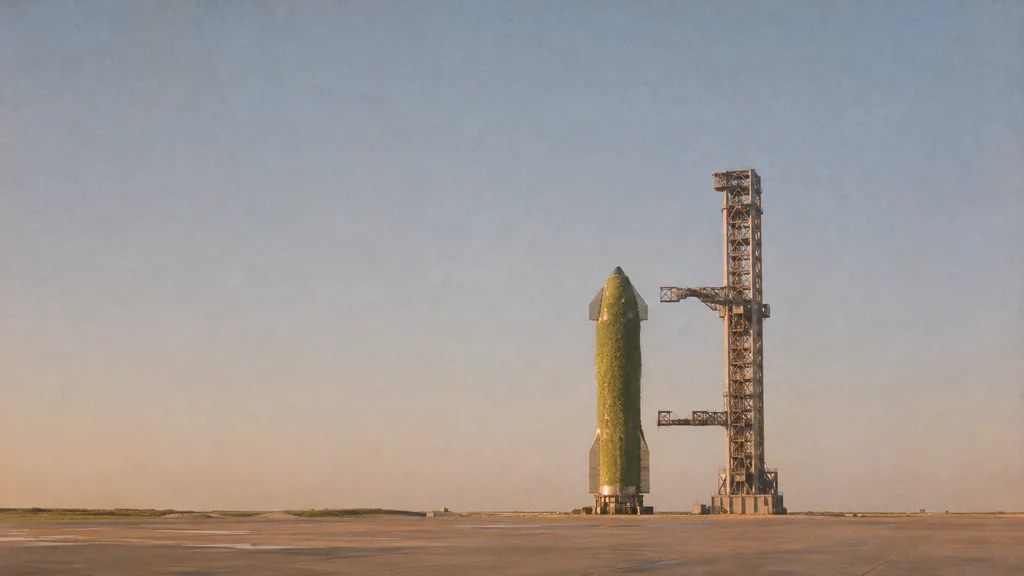
The ship is home; the next flight will prove its worth.
Image composition · tobriefTwo mechanical arms on a launch tower in Texas closed on Saturday around Ship 42, a Starship upper stage that had spent about 22½ hours in orbit (AIAA). It was the first tower catch of a Starship upper stage coming back from orbit (Aviation Week). The part of the rocket that travels farthest came home intact. What it still has to prove is that it can fly again quickly and cheaply.
Flight 15 lifted off from SpaceX's Starbase site on Friday 13 November, and the ship completed about 14 orbits before returning the next day (CNN). Along the way, SpaceX reported, it released 26 Starlink satellites (SpaceX, Payload). Putting satellites in orbit is now familiar work for Starship. The new result is what came after the delivery: the ship came back in one piece.
Why the ship is the hard one to bring home
Starship flies in two pieces, a bit like a relay race. The Super Heavy booster runs the first short leg, separating a few minutes after liftoff and turning back without ever reaching orbit (CNN). The ship runs the rest of the race alone. SpaceX had already caught boosters on three earlier tests, but none of those showed that a stage returning from orbit could make it back to the tower (Aviation Week).
The difference is speed. Being in orbit means moving sideways so fast that you keep falling around Earth instead of into it. A booster never builds up that speed. The ship does, and coming home means getting rid of almost all of it.
The atmosphere does the braking. A car's brakes turn its motion into hot brake pads, and the air does something similar to a returning spacecraft, turning its speed into heat on its outer shield. The ship has to survive that heat and still arrive on target.
That last requirement is what makes a tower catch so demanding. Splashing down anywhere in a wide patch of ocean is one thing. Stopping beside a single steel tower is another, because there the arms, nicknamed "chopsticks," can close around the vehicle and hold its weight (Space.com). Saturday's catch shows that a ship that has been to orbit can arrive that precisely.
A lost booster, and the test still ahead
The flight did not recover everything. SpaceQ reported that Booster 22 was meant to be caught too, which would have brought both stages home from one flight (SpaceQ). Instead, its automated return system judged the conditions for a catch unmet and sent it to the Gulf of Mexico, where it was lost.
The ship that did come back is now the most useful object SpaceX owns. Engineers can take apart a spacecraft that has been through launch, orbit, re-entry and a catch, and see exactly what each stage of the trip did to it. A ship lost at sea offers no such lesson.
Reuse, though, means flying again, and no caught Starship upper stage has done that yet (Space.com). Think of an airliner: what makes flying affordable is how quickly a plane can be checked, refuelled and sent back out. For Starship, only repeated cycles of inspection, repair and relaunch will show which job sets that pace, and what each flight really costs.
That answer matters beyond Starlink. NASA has contracted a Starship-derived lander for its Artemis Moon programme, and the plan depends on refilling it with propellant in Earth orbit (NASA Inspector General). Every refill means another launch, so ships that come home and fly again would make that schedule easier to sustain. Flight 15 attempted no fuel transfer, docking or landing, so those steps remain separate tests.
Saturday's catch shows that a spacecraft returning from orbit can come back through the atmosphere precisely enough for a tower to hold it. The case for cheap, routine reuse now rests with SpaceX, which has to fly a caught ship again and show what that took in repairs and time.
Details about this article
- Model:
- claude-opus-5-5
- Generated:
- 11/17/2026, 1:54:30 AM
- Pipeline run:
- eu_pipeline_20261117_005009
- Watermark:
- SynthID (Google's invisible watermark)
- Human review:
- None before publication