Sunk ship leaves containers near Hormuz
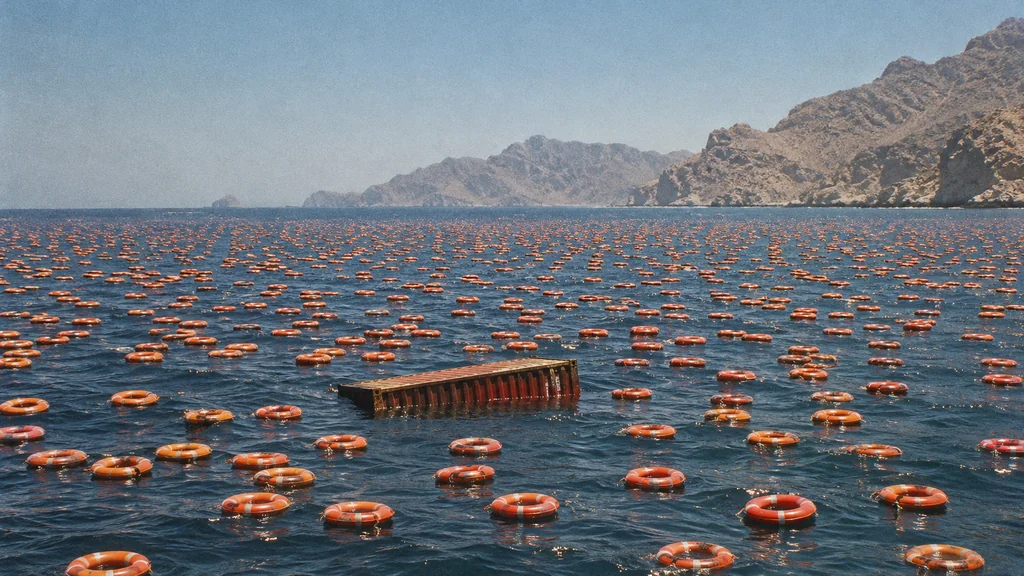
Floating cargo leaves another hazard for ships passing Musandam.
Image composition · tobriefProjectiles struck the Singapore-flagged container ship GFS Pride near the Strait of Hormuz on 13 October, and it sank (Reuters). Reports this week paired it with the bulk carrier Cape Dao as two ships lost in quick succession. Cape Dao was in fact attacked in September, and the date it finally went under remains unclear (MPA, NAVAREA IX).
The October attack had a lasting consequence. The new wreck has left cargo floating near one of the world's busiest shipping chokepoints.
Two ships, two timelines
GFS Pride caught fire after the strike and sank. All 21 crew escaped without reported injuries (MPA, Reuters). Its sister ship GFS Giselle, hit on 14 October, reached a safe anchorage under its own power with all 22 crew safe (Hansa).
Cape Dao was struck on 23 September, and one seafarer died in that attack (IMO, Reuters via Al-Monitor). A Pakistani navigation warning on 13 October described the ship as "reported sinking" in the Gulf of Oman (NAVAREA IX).
The International Maritime Organization (the UN agency that regulates shipping) still listed it as "partially sunk" on 14 October (IMO). The two accounts disagree, and neither fixes a sinking date. The death belongs to the September attack, not to October's.
Nobody has claimed the GFS Pride strike. Singapore speaks only of unknown projectiles. Iran's Revolutionary Guard said an unnamed container ship hit a sea mine while using an "unauthorised" route, and no one has independently confirmed that account (Deutschlandfunk).
CNN verified footage of the ship burning and sinking, with a small oil slick nearby (CNN). The images do not show what hit it.
Floating cargo off Musandam
A second Pakistani warning reports GFS Pride sunk, with floating containers about four nautical miles northwest of Oman's Musandam Peninsula, the headland that juts into the strait (NAVAREA IX). Drifting containers can sit just below the surface and are hard to spot. They threaten ships that had nothing to do with the original attack.
That hazard lands on people who make their own call about sailing. The IMO has said the shipping company and the ship's master keep ultimate responsibility for planning a voyage (IMO). In practice, carriers choose their own routes around the risk.
Maersk's network shows one such choice already in place. On 13 October, before the GFS Pride loss was reported, the Danish carrier announced that its alliance with Hapag-Lloyd would restart an Asia–Middle East service (Maersk). The loop calls at Khor Fakkan, a port on the UAE's Gulf of Oman coast that lies outside the strait. The decision predates the sinking, so it cannot count as a response to it.
German shipowners have asked governments to share the burden. On 15 October Martin Kröger, head of the Verband Deutscher Reeder (the German shipowners' association), called for diplomacy and for properly equipped naval missions to protect trade routes, according to Reuters via onvista. He pointed to Aspides, the EU's naval mission protecting merchant ships in the Red Sea, as a model. The call is a request from industry, and it commits no government to send ships.
The record supports a clear verdict. An October attack sank GFS Pride, a container ship, and nobody has yet shown who fired. Cape Dao was struck weeks earlier and belongs to a separate incident. The containers left behind add a physical hazard near Musandam, and the operators who must decide whether to pass now face it.
Details about this article
- Model:
- claude-opus-5-5
- Generated:
- 10/16/2026, 1:33:49 AM
- Pipeline run:
- eu_pipeline_20261016_005006
- Watermark:
- SynthID (Google's invisible watermark)
- Human review:
- None before publication