Swedish drone targeting outruns disclosed safeguards
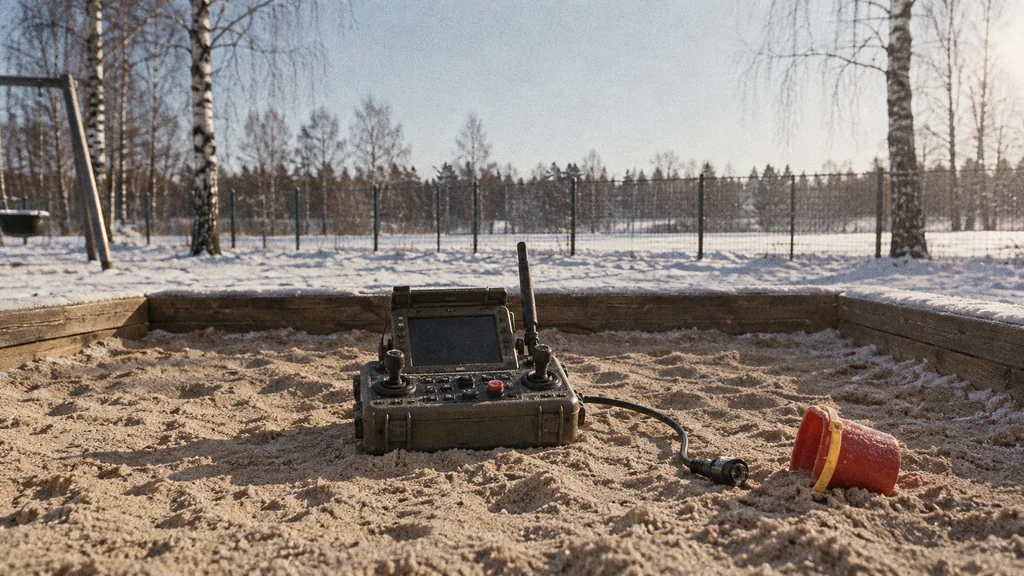
Human control remains behind as targeting judgment moves aboard.
Image composition · tobriefAt an industry test in Karlskoga, Sweden, software aboard a small drone detected several target types, selected one according to mission rules set by humans and began an autonomous approach. The sequence ran locally, without external processing or a continuous communications link, according to the developers. No operator guided the final selection.
The January demonstration was part of ALMA, the Affordable Loitering Modular Ammunition project led by BAE Systems Bofors. Swedish AI company Scaleout, a spinout from Uppsala University, provided the machine-learning software. Expando AB and Airolit supplied the drone hardware, with around 20 companies participating in the wider Winter Demo 2026 event.
What Scaleout showed was specific: a trained recognition model running aboard the aircraft, performing detection, classification and prioritisation of objects on the ground, then steering toward the one its human-written ranking rules identified as highest priority.
Why local processing changes the equation
Most military drones today work by streaming camera footage to a remote operator who watches, identifies targets and authorises action. That model depends on a fast, uninterrupted data link between the aircraft and a command post.
The ALMA approach puts the image analysis on the aircraft itself. Scaleout's technical account of its broader engineering work describes cameras capturing the scene, a compact recognition model detecting and classifying objects, tracking software following them across video frames, and ranking rules selecting a priority. All of it runs on a small onboard processor rather than a remote server.
This removes one vulnerability: an adversary jamming the communications link cannot stop the recognition software from running. But what the demonstration did not test is whether the system withstands other interference, such as sensor disruption or navigation jamming. And local processing raises a question the developers have not publicly answered: what control does the operator retain when communication is limited? Whether there are pre-set abort conditions, redundant links or other safeguards has not been disclosed.
What the test established, and what it didn't
The evidence here is an industry demonstration at a Swedish test range, not an independent benchmark or a military acceptance trial. No public source disclosed how accurately the model identifies targets, how it performs under smoke, dust, camouflage or mixed civilian and military traffic, or how quickly it produces a result. The gap between a controlled range with known vehicle types and the ambiguity of real conditions is precisely where targeting systems face their hardest challenge (NIST AI risk framework).
Whether the test involved a live warhead, an inert payload or a simulated strike also remains unclear. Secondary reporting describes an explosive charge directed against an armoured vehicle, but Scaleout's own accounts do not specify.
No source identified adoption by the Swedish Armed Forces or any NATO unit. A Vinnova research record lists Scaleout's related work as ongoing R&D, not procurement.
Who owes the next answers
The demonstration moved object selection and approach onto the aircraft under human-set rules. That is a real engineering result. It does not, by itself, establish a working weapon or prove that meaningful human oversight is preserved when the software is making targeting judgments locally.
If this configuration were adopted as a weapon, Sweden would be obliged under Additional Protocol I, Article 36 to review whether it can be used lawfully, assessing sensors, recognition accuracy, failure modes and what control the operator actually retains. The EU AI Act excludes purely military systems, and international talks on autonomous weapons have produced principles but no binding treaty defining sufficient human control.
The developers owe the public account of accuracy, false-positive rates and the operator's actual intervention options. Any future Swedish buyer or weapons reviewer owes the legal assessment of whether those controls are adequate. Until both arrive, the Karlskoga test shows what onboard software can select, not what it should be trusted to strike.
Details about this article
- Model:
- claude-opus-4-6
- Generated:
- 9/19/2026, 1:41:01 AM
- Pipeline run:
- eu_pipeline_20260919_005005
- Watermark:
- SynthID (Google's invisible watermark)
- Human review:
- None before publication