Swiss glaciers shed 5.5%, feeding summer rivers
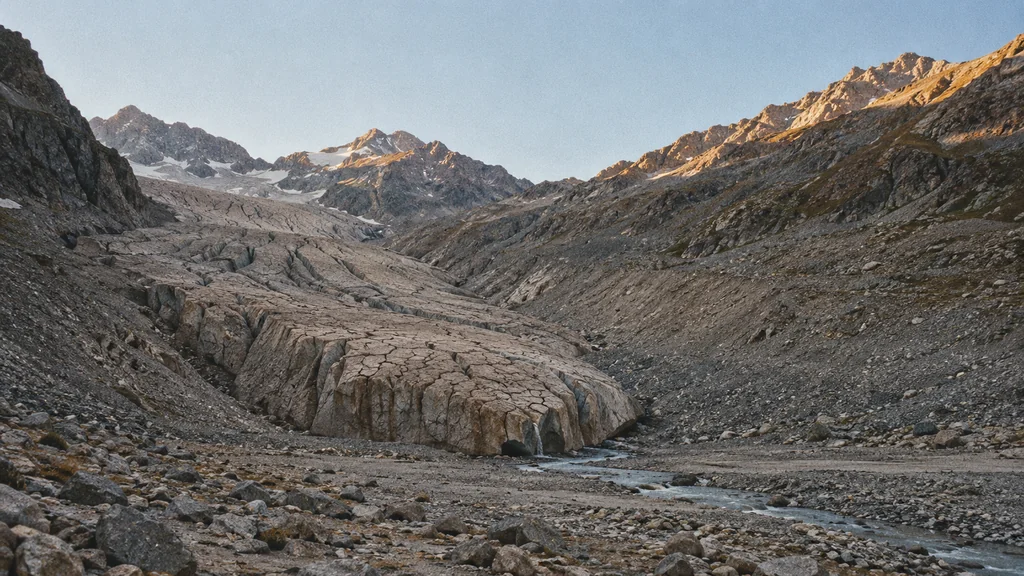
Swiss rivers draw summer water from a shrinking store of ice.
Image composition · tobriefWhen a summer turns hot and dry, rivers that rise in the Alps lean on glacier melt: water that fell as snow over many winters and was stored as ice. This year Switzerland drew heavily on that store. Its glaciers lost about 5.5% of their volume in the 2025/26 glacier year, roughly 2.5 cubic kilometres of ice (NZZ), and almost 20% over five years (GLAMOS/SLF).
The figures come from GLAMOS, the Swiss Glacier Monitoring Network, which works with ETH Zurich and the Universities of Fribourg and Zurich. The network published them through the Swiss Academy of Sciences on 1 October (ETH Zurich). Nobody weighs every glacier. Researchers measured 23 reference glaciers closely and scaled the result up to Switzerland's roughly 1,300 remaining ones (AFP), much as a poll reads a whole country from a careful sample.
Only 2022 was worse as a share of the ice, at about 6% (PBS/AP). Counted in cubic kilometres, 2026 ranks third, behind 2022 and 2003 (NZZ). Both rankings hold because there was more ice in 2003, so a smaller share could still be a bigger volume. On the glaciers themselves, the surface dropped by 2.5 to 4 metres on average (University of Fribourg).
A small deposit, then the heat
Think of a glacier as a savings account. Winter snow is the deposit. If enough of it survives the summer, it slowly packs down into new ice.
The 2025/26 winter ranked among the ten least snowy in the observation record (GLAMOS/SLF). So the glaciers went into summer with a small deposit. Snow cover also shields a glacier in general, because its bright surface bounces back sunlight that darker ice would soak up.
That cover went early. According to ETH Zurich, it was already patchy in June, and by September snow had vanished even at about 3,500 metres. The freezing level, the altitude where the air cools to zero degrees, sat above 4,000 metres on 76 days, according to the same institutional release as distributed by EurekAlert. In plain terms, unusually warm air reached far up the mountains for much of the summer.
That two-step pattern matches years of Swiss records. A peer-reviewed study of daily data from 2010 to 2024 found that snowier winters reliably brought bigger snow gains on the glaciers, and hotter summers reliably brought bigger ice losses (The Cryosphere). That describes the long-run pattern; nobody has yet split this year's loss between the thin winter and the heat.
Who the melt helps, and how much
Between July and September, the glaciers released around 2,200 billion litres of meltwater (GLAMOS/SLF). How much that helps depends on where you stand along a river.
Researchers looked at how 88 glacier-fed catchments in Switzerland coped with the 2022 drought, and found that extra melt made up as much as 70% of the water shortfall on the Rhône at Porte du Scex, but at most 5% at Basel on the Rhine (Hydrology and Earth System Sciences). A catchment is all the land that drains into a given point on a river, like a funnel. Close to the mountains, the glacier is a big part of what the funnel collects. By Basel, many other tributaries have joined, and the glacier's share shrinks.
The same study found that most of that drought-year melt came from ice that was gone for good. In savings terms, the rivers were being paid out of the principal rather than the interest.
It also compared the two great heat summers. In two-thirds of the catchments, less meltwater reached the rivers in 2022 than in 2003, even though each square metre of glacier melted faster (Hydrology and Earth System Sciences). The simplest reading is that fewer square metres of ice were left to melt, though differences in weather between the two summers also shape that comparison.
This year's measurements show the account has fallen again. How much a river gains from glacier melt in a dry summer depends on how close it runs to the ice, and the reserve behind that help is smaller after every year like 2026.
Details about this article
- Model:
- claude-opus-5-5
- Generated:
- 10/2/2026, 2:12:43 AM
- Pipeline run:
- eu_pipeline_20261002_005006
- Watermark:
- SynthID (Google's invisible watermark)
- Human review:
- None before publication