Taranto’s restart hinges on asbestos and dust
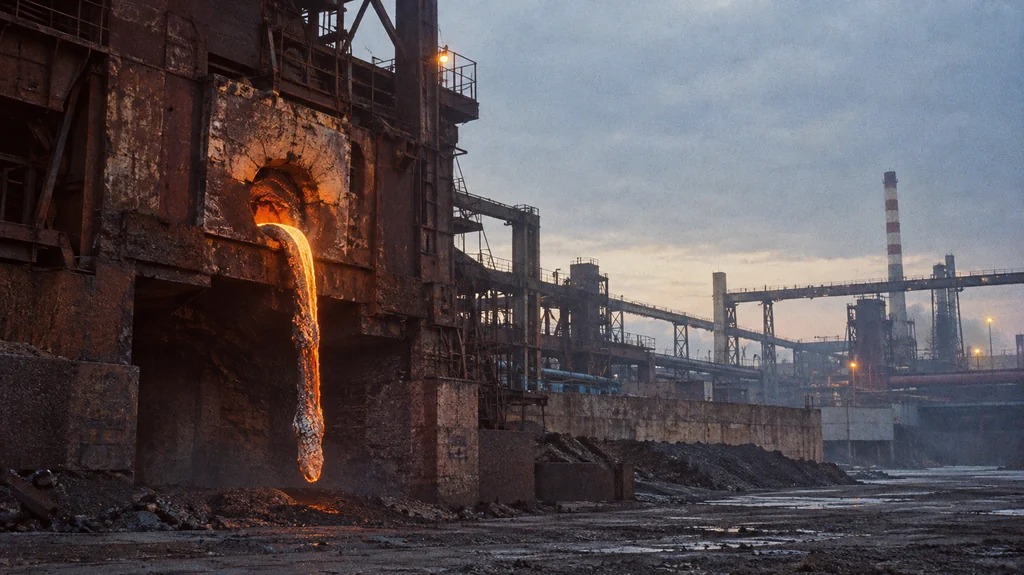
Taranto’s final pour leaves workers waiting for a safe restart.
Image composition · tobriefTaranto's last working blast furnace, AFO2, poured its final pig iron on the night of 8–9 October and has been kept warm with gas since (ANSA). Pig iron is the molten iron a blast furnace produces before it is refined into steel. On 29 October Italy's Court of Cassation published a judgment that keeps steelmaking suspended until the plant's asbestos is removed and its dust is shown to be safe (Cassation judgment).
The furnace stopped before the ruling. What the judges decided is what it would take to restart it. In the meantime, workers and the company's northern rolling mills absorb the stoppage.
Two conditions before the furnaces relight
Local residents brought the case as a civil injunction. That is a court order won in a private lawsuit, separate from any criminal seizure. It covers the hot area, the part of the plant where coke ovens and blast furnaces turn coal and iron ore into steel.
The first condition concerns asbestos. All 2,140 tonnes of it must come out of the cowpers, the towers that heat air before it is blown into the furnaces (Cassation judgment).
The second condition concerns dust. Fine-particle emissions must be safe even at the 6 million tonnes a year the plant's permit allows. That is a demanding test, because unions estimated Taranto made only about 2 million tonnes in 2025 (ANSA). The test uses full capacity because that is what the plant could lawfully produce once it restarts. Measuring emissions at today's zero output would prove nothing about the risk at full output.
The judges also found that the plant's 2025 environmental permit ignored the health risks the Milan courts had examined. They set the permit aside for this case (Cassation judgment). The approach follows a June 2024 ruling by the EU Court of Justice. It held that health effects must be assessed whenever an industrial emissions permit is issued or reviewed, and that repeated extensions cannot replace compliance where serious risks persist (EU judgment).
Rome had tried to keep the furnaces ready. A decree-law issued on 16 October let the state-appointed commissioners running the company keep preheating until the court published its reasons (Decree-law 185/2026). The reasons came with the judgment itself, so that permission has lapsed.
A furlough request, not layoffs
On 14 October the commissioners asked to extend extraordinary wage support for up to 8,622 employees at any one time until 28 February 2027, 6,964 of them at Taranto (AGI). Under this scheme the state pays part of the wages of workers whose hours are suspended, and their jobs continue.
That figure is a ceiling. It does not count people already sent home, and it does not count job losses.
After talks on 27 October, the Labour Ministry said it would keep examining the request (Labour Ministry). Until it decides, workers do not know what income support they will have during the shutdown.
Firms that service the plant have fewer options. The October decree gives contractors separate support only if more than half their turnover came from Acciaierie d'Italia, the operator (Decree-law 185/2026).
Northern mills hunt for slabs
Acciaierie d'Italia's mills in Genoa and Novi Ligure roll Taranto steel into coil, which is steel sheet wound into rolls. With the hot area idle, they need slabs from other producers. Slabs are the thick semi-finished blocks that become coil, and approving a new source can take months (Il Sole 24 Ore). Each new supplier's steel must be checked to confirm it behaves the way the mill and its customers expect.
Before the final ruling, the company reportedly agreed a plan to process about 365,000 tonnes of outside slabs, naming the Italian groups Marcegaglia and Eusider (GMK Center). The disruption on record falls on these Italian mills. No lost delivery to a buyer elsewhere in Europe has been established.
Taranto stopped making steel before the judges ruled. The court has now made asbestos removal and safe emissions at full permitted output the conditions for a restart. Three separate costs follow. Workers could lose earnings while their furlough request is pending. The northern mills face a supply gap they can only partly fill. The safety work itself still has no settled timetable and no settled payer.
The commissioners, the government and any buyer from the sale overseen by industry minister Adolfo Urso will have to answer those questions before Taranto can make steel again.
Details about this article
- Model:
- claude-opus-5-5
- Generated:
- 11/1/2026, 1:27:29 AM
- Pipeline run:
- eu_pipeline_20261101_005008
- Watermark:
- SynthID (Google's invisible watermark)
- Human review:
- None before publication