Tempi: no date for exhumations, relatives allege obstacles
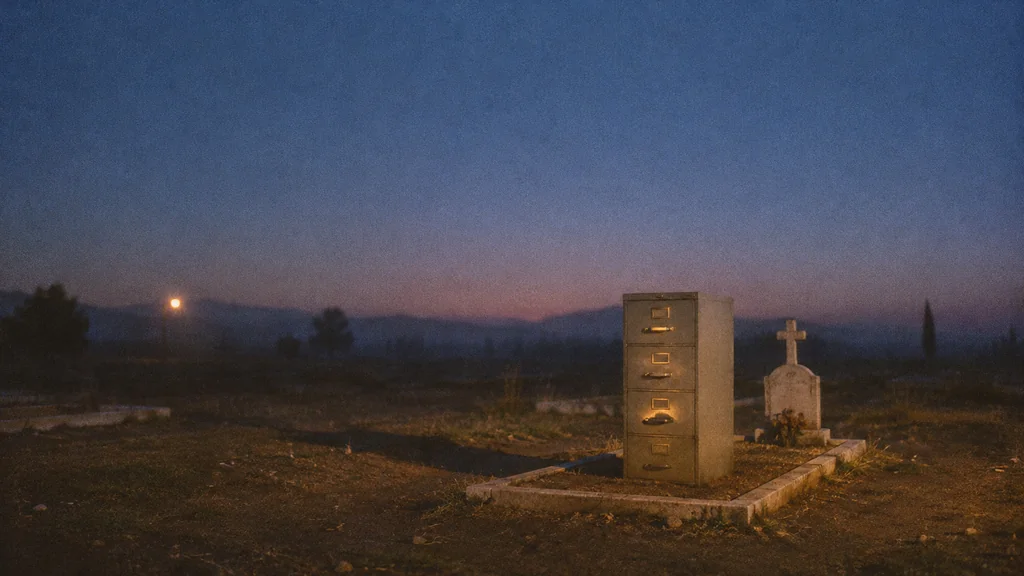
AI Daily Synthesis
Image composition · tobriefOn 13 October, the Larissa Public Prosecutor’s Office asked the appointed forensic experts to act “without delay” to finalise arrangements with a Dutch laboratory and immediately set a date for the exhumations requested by families of victims of the Tempi train crash (in.gr, 15/10). A month later, in a document dated 13 November and reported by Greek broadcaster MEGA, the prosecutor’s office was still asking the same experts to specify which tests each body needed. It also noted that the laboratory had not confirmed it could carry them out (MEGA, 22/11). Relatives accuse the prosecutor’s office of obstructing the exhumations.
The families want to know the exact cause of their loved ones’ deaths in the Tempi train crash. They therefore want tests that, they say, go beyond those carried out so far.
Three months of correspondence
The laboratory is the Netherlands Forensic Institute (NFI), the Dutch national forensic institute. It falls under the Dutch Ministry of Justice and Security and says it has expertise in nearly 40 fields (NFI). Three medical professors appointed as court experts found it. According to Pavlos Aslanidis, whose child died in the crash, Aristotle University of Thessaloniki recommended the NFI on 31 August (in.gr, 22/11). Before settling on it, the professors had contacted the International Association of Forensic Toxicologists, a laboratory in Zurich, and laboratories in Germany and the Netherlands (MEGA, 11/10).
According to correspondence published by MEGA, the NFI replied on 26 August that it would charge €393 an hour, “provided that brain tissue is found” (MEGA, 11/10). The professors informed the prosecutor’s office on 31 August. On 23 September, the prosecutor’s office asked them to explain how they had found the institute, who had contacted it and what criteria they had used to judge it suitable. It wrote that they had exchanged “numerous messages” with the institute (MEGA, 11/10).
The court experts replied on 28 September and submitted their correspondence. They also wrote that the question suggested doubt about the transparency of their work. On 5 October, the prosecutor’s office asked for more information. On 9 October, the professors replied that they could not judge a laboratory’s scientific competence to perform analyses they did not carry out themselves (MEGA, 11/10).
Four days later came an order from Aikaterini Papaioannou, the head of the prosecutor’s office. In addition to finalising arrangements with the NFI, it asked the court experts to confirm the requirements for samples and, together with the relevant authorities, arrange an exhumation date immediately. It set no specific deadline (in.gr, 15/10, Thessalia TV, 22/11).
The 13 November document, as described by MEGA, asked the experts to examine each victim’s forensic file separately, record which tests each case required and which needed the NFI, and clarify whether soft brain tissue could be collected. It said the institute “has not yet confirmed that it can undertake the required tests” and that suitable samples might not be found (MEGA, 22/11). The documents set out the prosecutor’s office’s position: before a date is set, it needs to know what will be tested, which samples will be used and who will carry out the tests.
What the relatives say
Aslanidis, who lost his son at Tempi, blames Papaioannou personally for the delay. He says the tests had been limited to DNA and toxicology checks. He cites a 30 March decision by a judicial council which, he says, instructed the court experts to identify all the tests needed to establish the exact cause of his son’s death, as well as suitable laboratories (in.gr, 22/11). According to Aslanidis, the prosecutor said the NFI had not been appointed as a court expert and would provide only supplementary scientific assistance. He also says the obstacles appeared after a hunger strike by Panos Routsis, a father of a Tempi crash victim (in.gr, 22/11).
Lawyer Stella Valani alleged on 23 November that the prosecutor’s office was obstructing exhumations requested by relatives and already ordered. She said the families were seeking DNA identification and tests for “specific substances” (Avgi, 23/11).
Under Greece’s Code of Criminal Procedure, the authority ordering an expert examination decides its scope after considering the parties’ proposals and may set a deadline (Article 195). Relatives supporting the prosecution may appoint a technical adviser, who can attend the examination and submit observations (Articles 204 and 207), but they cannot themselves decide which tests are done or set dates (Code of Criminal Procedure).
The next step rests with the three professors, who must provide a list of tests for each body, and the Dutch institute, which must say whether it can carry them out. Until then, the 13 October instruction to act “without delay” has not produced a date.
Details about this article
- Model:
- claude-opus-5-5
- Generated:
- 11/24/2026, 4:20:17 AM
- Pipeline run:
- incremental_20261124_033011
- Watermark:
- SynthID (Google's invisible watermark)
- Human review:
- None before publication