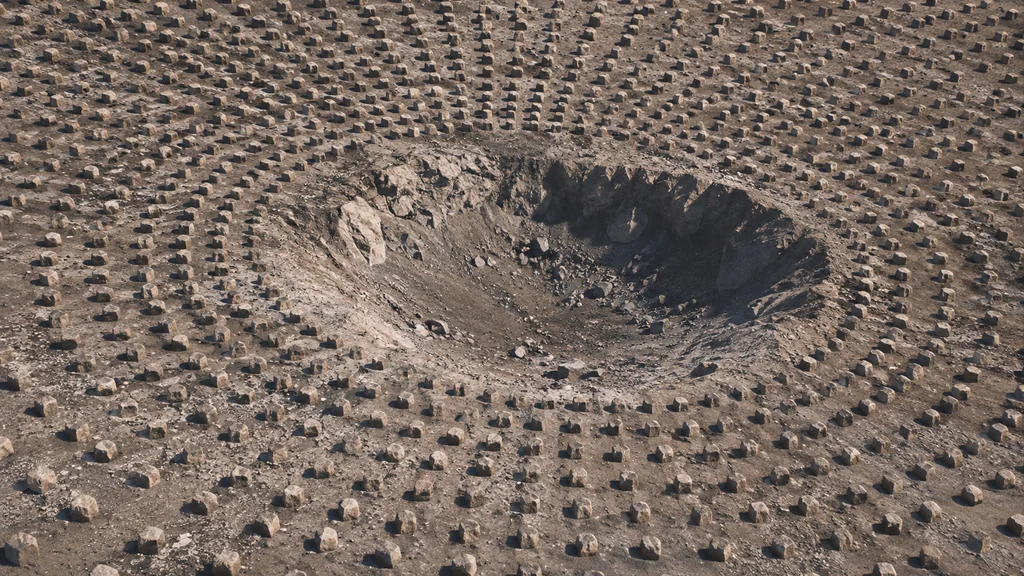
Huge crater on the asteroid NASA struck
AI Daily Synthesis
Image composition · tobriefFour years after NASA’s DART spacecraft deliberately struck Dimorphos, the small moon of the asteroid Didymos, the European Space Agency’s (ESA) Hera mission has sent back the first close-up images of its target. The side that took the impact has been flattened by a crater that, according to ESA, spans its full width (ESA). We already knew the impact changed Dimorphos’s orbit. Now we can see what happened to the body itself, giving planetary defence the evidence it needs to turn an experiment into a method.
The images are sharp enough to distinguish anything the size of a car: each pixel in the main image covers less than three metres of the surface (ESA). Dimorphos is about 151 metres across, which is why the team calls the crater “stadium-sized” (Science). These are the mission’s first images, announced before a study has been published, so the crater’s diameter and depth have yet to be measured.
Before Hera arrived, three outcomes remained possible: a distinct crater, an asteroid whose entire shape had changed, or a surface that had barely changed. Principal investigator Patrick Michel described the answer this way: “To our great surprise, it is all three at once.” Dimorphos has a huge crater and a changed shape, while other rocky areas look almost the same as they did in the 2022 images (DLR).
The biggest surprise is how it moves. Before the impact, Dimorphos always kept roughly the same face towards Didymos, as the Moon does towards Earth. Now, Michel said, it does not rotate around a fixed axis, and the crater appears first on one side, then on the other (Euronews). Planetary scientist Sabina Raducan compared it to a barrel thrown down the stairs (CNN).
Hundreds of rocks are moving around the asteroid pair (ESA). Mission scientist Naomi Murdoch estimates that more than 100 range in size from a football to a washing machine. The team does not yet know how many were thrown off by DART and how many were already there (CNN). As Hera moves closer, it will have to account for them in its path (ESA).
Why the crater matters as much as the orbit
On 26 September 2022, DART struck Dimorphos at about six kilometres per second. Its orbit around Didymos, which had taken almost twelve hours, shortened by 33 minutes (Nature). Didymos never threatened Earth; it was a safe target for a test.
But the impact does more than push with the spacecraft’s own mass. At the moment of collision, tonnes of dust and rock fly backwards, pushing the asteroid forwards, much as water spraying from a garden hose makes the hose recoil. Early analyses showed that the total push was between two and almost five times greater than the spacecraft alone would have delivered (Nature). The range is so wide because no one knew how much Dimorphos weighs. If you do not know the weight of a trolley, you cannot tell how hard you pushed it just by looking at how much it accelerated.
A 2026 study indirectly estimated its mass at about 2.7 billion kilograms, a little less than half the mass of the Great Pyramid of Giza (Science Advances). Hera will “weigh” it up close by using its radio signal to track how much Dimorphos’s gravity pulls on its path (ESA). The crater’s shape will help establish how much material was ejected. The asteroid’s shape matters too: modelling from 2024 suggests that the reshaping of Dimorphos alone may have accounted for about two minutes of the 33 (Nakano et al.).
In December, Hera will come within about 13 kilometres to take higher-resolution images (ESA). In January 2027, it will release two small companion spacecraft, one carrying radar to look inside the asteroid. The plan then calls for passes at a distance of about one kilometre in the spring (JAXA). No date has been announced for the final scientific assessment.
The next asteroid we may need to deflect will have a different mass, porosity and structure. NASA scenario studies show that deflection with a single spacecraft becomes much harder when there are fewer than 15 to 20 years of warning (NASA). Within that window, there will be time only for calculations, not tests.
The 33 minutes proved that an asteroid can be moved. Once measured accurately, Dimorphos’s crater will provide the first real benchmark for calculating how hard we need to strike the next one.
Details about this article
- Model:
- claude-opus-5-5
- Generated:
- 11/26/2026, 4:40:17 AM
- Pipeline run:
- incremental_20261126_033009
- Watermark:
- SynthID (Google's invisible watermark)
- Human review:
- None before publication