Thorium clocks sharpen a dark-matter search
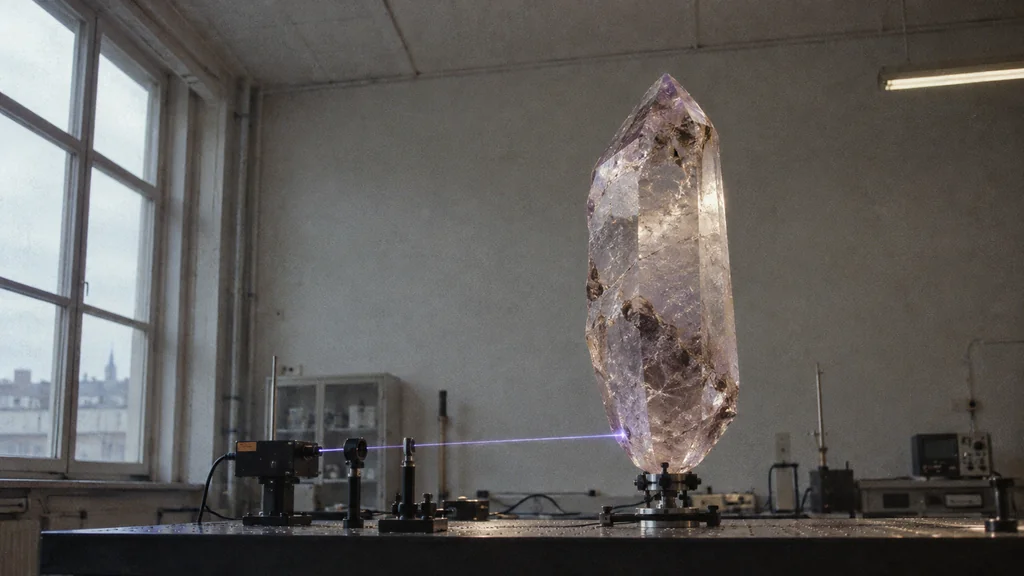
A nuclear reference runs through the night, still searching for a steadier note.
Image composition · tobriefEvery clock needs a steady reference: a swinging pendulum, a vibrating quartz crystal or, in the best atomic clocks, the exact frequency of light an atom absorbs. Teams in Vienna and Beijing have now built clocks that take their reference from the nucleus of thorium-229 instead (Vienna, Nature, Beijing, Nature). They keep time less steadily than leading atomic clocks. Yet the Vienna device has already made one kind of dark-matter search 100 to 1,000 times more sensitive than earlier atomic-clock experiments (Nature).
Listening to a nucleus
An atomic clock works a bit like a musician tuning against a reference note. A laser is adjusted until its frequency matches the light the atom's electrons absorb, and a feedback system keeps it locked there. The laser's steady oscillations become the clock's ticks.
Nuclei normally need far more energy than any laser can deliver, so they have been out of reach as reference notes. Thorium-229 is the exception. Its nucleus has a transition of about 8.4 electronvolts, low enough for ultraviolet light to reach (Physical Review Letters).
Earlier experiments found this note but read it slowly, waiting roughly ten minutes for excited nuclei to glow (TU Wien). The new clocks measure absorption instead, tracking how much ultraviolet light the thorium nuclei, embedded in a crystal, swallow. That signal arrives promptly, so the nuclei can keep correcting the laser while the clock runs, the milestone we covered this week (To Brief).
Vienna's clock ran for more than 24 hours without intervention (TU Wien). Beijing produced its ultraviolet light with a different technique, so a working nuclear reference does not depend on one laboratory's equipment.
A day-long search for a wobble
Vienna then ran its nuclear clock alongside an ytterbium-ion atomic clock at BEV, Austria's metrology office. If both clocks respond identically to everything around them, the ratio of their ticking rates stays fixed. A ratio that drifts or wobbles would mean something affects nuclei and electrons differently.
Thorium is unusually sensitive to such differences. Its small energy gap is what remains after much larger contributions nearly cancel, like a bank balance found by subtracting two enormous numbers. Nudge either number slightly and the balance swings a lot. Theory therefore predicts that a tiny change in nature's constants would move the nuclear frequency far more than an electronic one.
Some dark-matter models describe an invisible field filling space and oscillating slowly, pushing those constants back and forth. If it exists, the ratio between the two clocks should wobble in time with it.
Over roughly 23 hours of data, no wobble rose above the noise (arXiv). A null result still teaches something, because it rules out versions of dark matter that would have produced a visible signal. The big gain applies to dark matter that would interact through the strong force, the force that holds atomic nuclei together, and only across part of the range of possible masses. For interactions with light, the new limits merely match earlier atomic clocks, and how tight the limits are depends on nuclear-theory estimates of thorium's sensitivity (Nature peer-review file).
Why the new clocks still wander
Both nuclear clocks drift far more than the best atomic clocks, such as an aluminium-ion clock at NIST (NIST). Part of the problem is that the absorption is faint, so the clocks must find the centre of the note from tiny changes in detected light.
The crystal adds a second problem. Thorium nuclei sit in slightly different surroundings, so they do not all sing quite the same note. Vienna saw the line shift by up to about 1.7 kilohertz depending on where its laser crossed the crystal (Nature).
Physicists call the sharpness of that note its linewidth: a narrow line is a pure tone, a broad one is a smeared chord that is harder to lock onto. In a preprint from JILA and TU Wien researchers, not yet peer-reviewed, one transition widened from 28.6 to 94.8 kilohertz across three crystals of rising thorium concentration (arXiv). PTB's Ekkehard Peik has contrasted lines tens of kilohertz wide with a natural nuclear linewidth expected well below one hertz (Physics World).
The first nuclear clocks are rough timekeepers, but they are already working research instruments. A single day spent comparing a nucleus with an atom's electrons has tightened some of the limits on how dark matter could tug on the strong force, while faint signals and the crystals holding the nuclei keep their timekeeping well short of the sharp note thorium can offer.
Details about this article
- Model:
- claude-opus-5-5
- Generated:
- 10/11/2026, 1:37:36 AM
- Pipeline run:
- eu_pipeline_20261011_005006
- Watermark:
- SynthID (Google's invisible watermark)
- Human review:
- None before publication