Thorium clocks tick, but lag atomic rivals
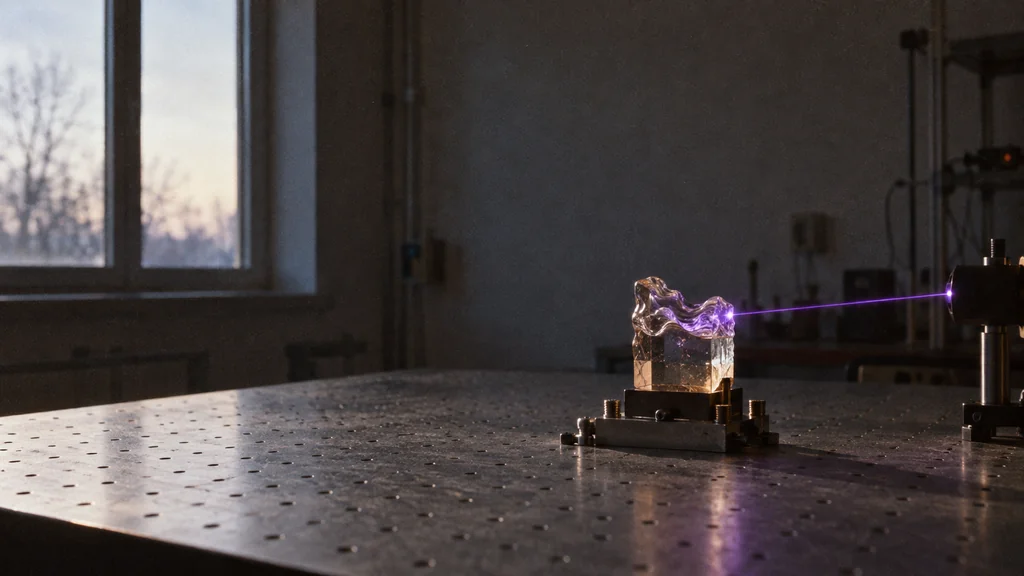
The first nuclear clocks run, but their crystal reference shifts with position.
Image composition · tobriefTeams in Vienna and Beijing have built the first clocks that keep a laser tuned to a transition inside an atomic nucleus, using thorium-229 as the reference (Reuters). That turns a long-standing idea into working laboratory hardware. NIST physicist Kyle Beloy told Chemical & Engineering News that the prototypes remain "orders of magnitude away" from the best optical atomic clocks in accuracy and stability (C&EN).
Physicists want a nuclear reference because the nucleus responds to different forces than the electrons that ordinary atomic clocks rely on. Comparing the two kinds of clock opens a new way to check whether nature's rules hold perfectly steady.
How a crystal becomes a clock
Both teams shine ultraviolet laser light through crystals laced with thorium-229 and look for a faint dip in the light that comes out (To Brief). The dip appears when the laser hits the exact frequency the nuclei absorb. Physicists call that sweet spot a resonance.
Finding the dip once is easy compared with staying on it. So the teams check absorption slightly above and slightly below the chosen frequency. If the laser sits dead centre, both sides absorb equally. If it drifts, one side absorbs more, and that imbalance tells a controller which way to retune.
Picture standing on a hilltop in fog. You can't see the summit, but a step left and a step right tell you which way the ground slopes. That constant correction turns a laser into a clock.
Three ways a clock can fall short
A bathroom scale and a calibration weight help separate three ideas. Stability is how little the reading flickers while the weight sits there. Reproducibility is whether the scale shows the same number for that same weight tomorrow. Accuracy is whether the number matches the weight's true mass.
For stability, physicists quote an "instability coefficient": how much the ticking rate wanders, averaged over time. Lower is better. Beijing reported 5 × 10⁻¹³ from a 3.8-hour record (Beijing manuscript). Vienna's clock ran unattended for a full day and reported 3 × 10⁻¹² (Vienna Nature paper).
For comparison, a published aluminium-ion atomic clock reaches about 3.5 × 10⁻¹⁶ (aluminium-ion clock paper, NIST record). Each step in that exponent means a tenfold difference, which is the gap Beloy describes. The two nuclear teams used different set-ups and averaging times, so Beijing's lower number does not make it the better clock overall.
These figures cover only short-term wobble. Neither team has presented a full accuracy budget, the audit of every effect that could pull a clock off its true frequency. So the accuracy gap cannot yet be put into numbers.
A target that won't sit still
The measured absorption peak is also wide. Beijing's selected peak was about 27 kilohertz across (Physics World). A wide peak is a fuzzy target: the controller has a harder time locating its exact centre.
The second difficulty showed up in Vienna. The team moved its laser beam among five spots in the same crystal and found the resonance centre shifting by up to about 1.7 kilohertz, while random measurement scatter would explain only about 0.13 kilohertz (Vienna manuscript). In other words, the apparent reference frequency changed with where the beam landed, like a scale that reads differently depending on where you set the weight.
The team has not pinned down the cause, and a beam path that repeats exactly is among the fixes it proposes. That unevenness helps explain why Vienna's frequencies agreed between days only to about 5 × 10⁻¹³ (Vienna Nature paper), coarser than any single run suggests.
What Vienna and Beijing have shown is real: nuclei inside a crystal can steer a laser and keep it locked for hours, even a full day. Their measured stability sits far behind leading optical clocks, and their accuracy has yet to be assessed. The caesium atom still defines the official second (BIPM). The next milestone is specific: repeated runs across days and between devices, every systematic shift accounted for, then long side-by-side comparisons with optical clocks.
Details about this article
- Model:
- claude-opus-5-5
- Generated:
- 10/18/2026, 1:35:58 AM
- Pipeline run:
- eu_pipeline_20261018_005006
- Watermark:
- SynthID (Google's invisible watermark)
- Human review:
- None before publication